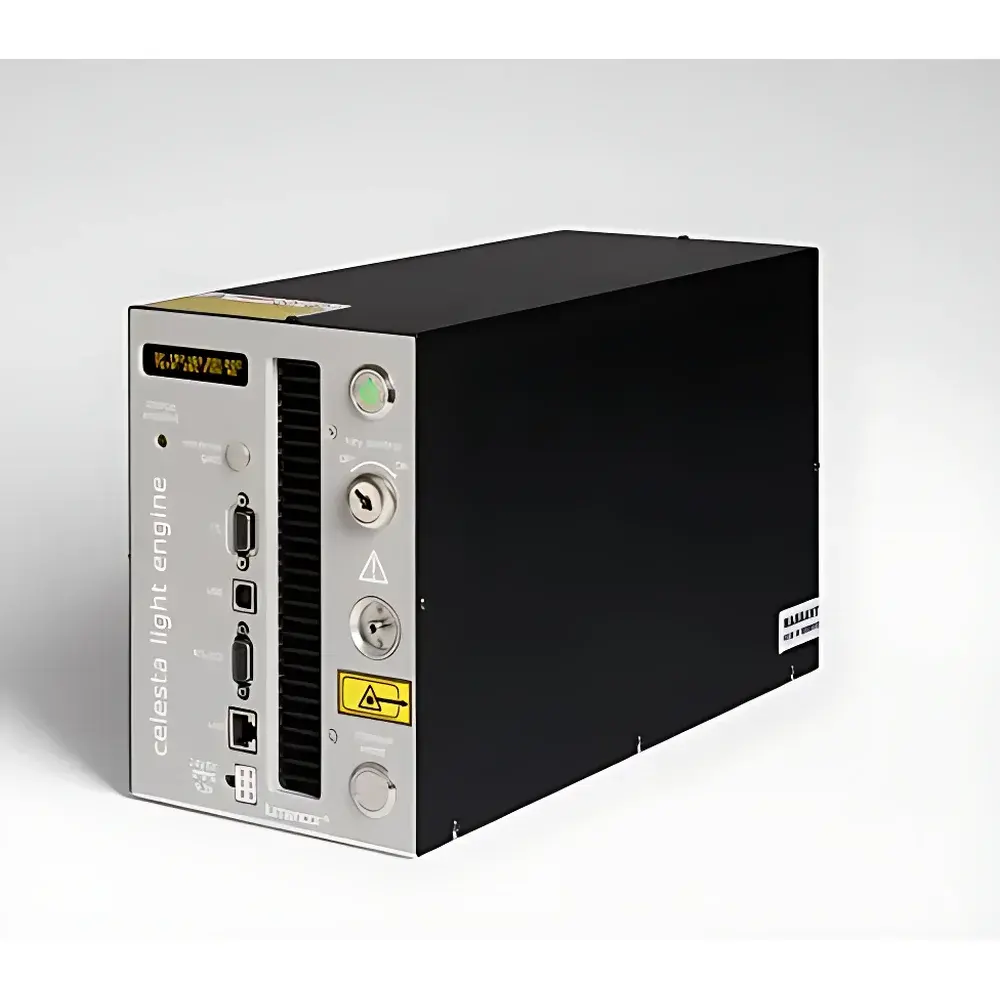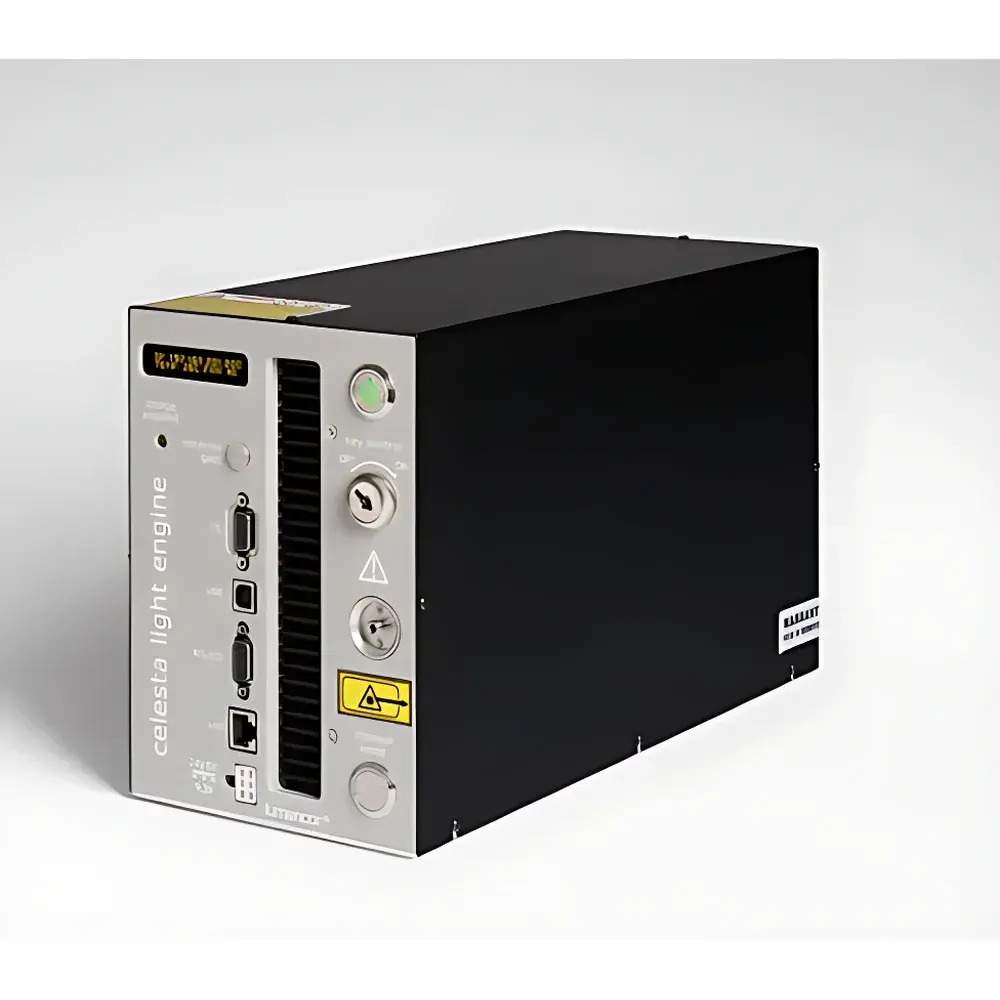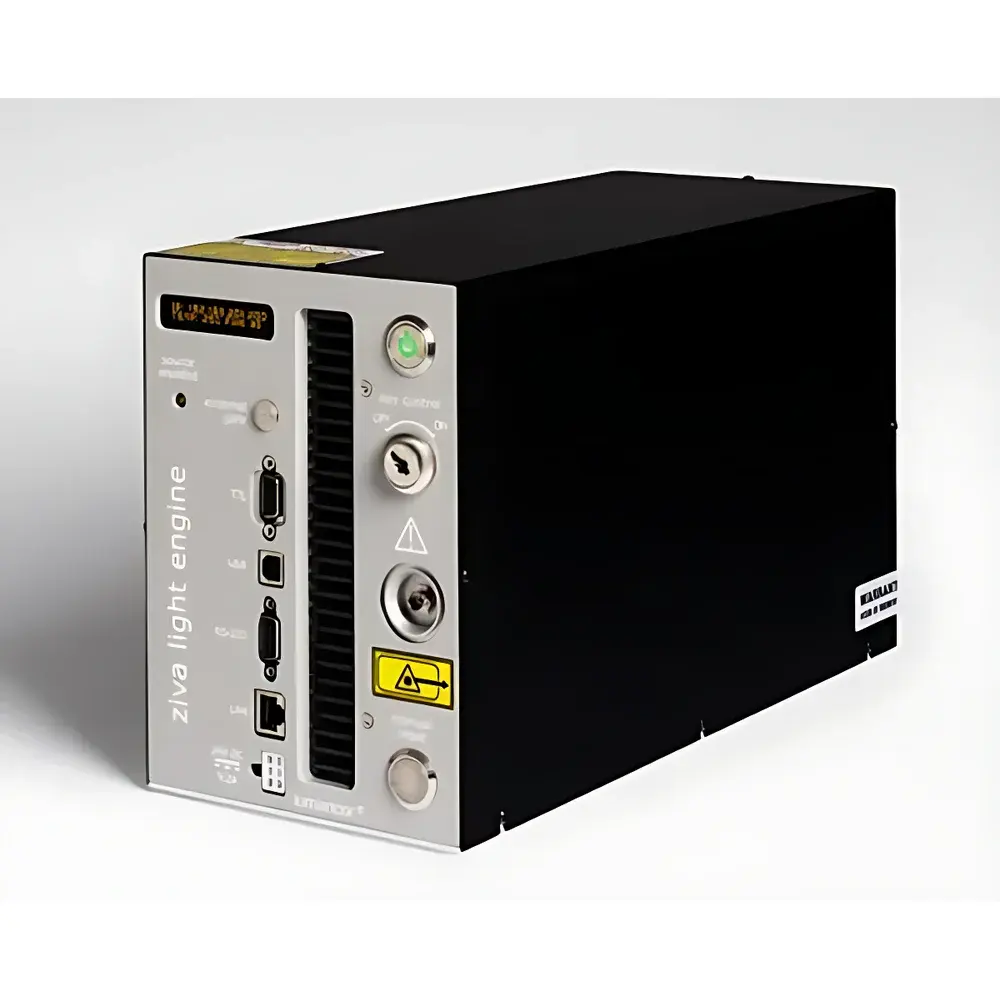
Lumencor Light Engine for Fluorescence Microscopy

| Brand | Lumencor |
|---|---|
| Origin | USA (Imported) |
| Distributor | Auniontech (Authorized Distributor) |
| Model | Spectra X / Sola / Zyla Series (Multi-Channel Solid-State Light Engine) |
| Power Supply | 100–240 V AC, 50–60 Hz |
| Dimensions | 145 mm × 340 mm × 203 mm (W × L × H) |
| Weight | 8.7 kg |
| Control Interfaces | Ethernet (TCP/IP & embedded GUI), USB/RS232 (on/off & intensity), TTL (per-channel gating) |
| Safety | Dual interlock system (mechanical key + electronic remote enable) |
| Embedded Controller | Onboard microprocessor with server/client architecture and command library |
Ask about pricing, availability and specifications.
Overview
Lumencor light engines represent a paradigm shift in fluorescence microscopy illumination—replacing legacy arc-lamp and single-wavelength LED sources with spectrally precise, digitally controllable solid-state light engines engineered for quantitative, multi-color, and time-resolved imaging. Unlike mercury or metal-halide lamps—whose spectral output drifts over time, requires frequent alignment and replacement, and emits hazardous UV/IR radiation—Lumencor systems utilize proprietary high-brightness LEDs coupled with narrowband interference filters and thermally stabilized optical pathways to deliver stable, calibrated intensity across discrete excitation bands (e.g., 395, 438, 475, 513, 565, 625 nm). These devices operate on the principle of spectrally multiplexed, electronically gated illumination: each channel is independently addressable via TTL triggers or software commands, enabling synchronization with camera acquisition, galvo scanning, or stage motion—critical for confocal, TIRF, light-sheet, and super-resolution modalities.
Key Features
- Dual Interlock Safety Architecture: Complies with IEC 60825-1 Class 1/1M laser safety requirements; operation requires both physical key switch engagement and validated electronic enable signal—preventing accidental activation during maintenance or alignment.
- Embedded Intelligent Controller: Onboard ARM-based microprocessor implements a real-time server/client communication model, supporting native command-line protocols (ASCII over TCP/USB/RS232) and an embedded web GUI accessible via standard browser—eliminating dependency on proprietary host software.
- Multi-Interface Control Flexibility: Simultaneous support for Ethernet (TCP/IP for remote orchestration in automated core facilities), USB/RS232 (basic on/off and analog intensity scaling), and hardware TTL (sub-millisecond channel gating for frame-synchronized excitation in spinning-disk or sCMOS applications).
- Thermal & Power Stability Engineering: Active thermal management maintains LED junction temperature within ±0.5 °C across ambient conditions (15–30 °C); intensity stability <±1% RMS over 8 hours (23 °C, constant current mode), verified per ISO 9001 calibration traceability protocols.
- Modular Optical Design: Interchangeable filter modules allow reconfiguration of excitation spectra without recalibration; factory-aligned collimation optics ensure uniform Köhler illumination across 25 mm field-of-view objectives (NA ≤ 1.4).
Sample Compatibility & Compliance
Lumencor light engines are compatible with all major widefield, confocal, and structured illumination platforms—including Nikon Ti2-E, Olympus IXplore, Zeiss Axio Observer, and Leica DMi8—via standard C-mount or fiber-coupled interfaces. The systems meet electromagnetic compatibility (EMC) standards per EN 61326-1:2013 and safety certification per UL 61010-1:2012 / CSA C22.2 No. 61010-1. For regulated environments (GxP, CLIA, ISO 13485), audit trails for intensity settings, runtime logs, and firmware version history are exportable in CSV/JSON format—supporting FDA 21 CFR Part 11 compliance when integrated with validated LIMS or ELN systems. All models conform to ISO 17025-accredited photometric calibration practices, with NIST-traceable spectral irradiance data provided at shipment.
Software & Data Management
Lumencor provides open API documentation (RESTful endpoints and serial command set) enabling seamless integration into Python-, MATLAB-, or LabVIEW-based acquisition pipelines. Third-party microscope control platforms—including Micro-Manager 2.0, MetaMorph, and μManager-compatible drivers—support full channel enumeration, intensity ramping, TTL-triggered burst mode, and real-time feedback of thermal status and LED drive current. Firmware updates are performed over Ethernet using signed binary packages; version rollback and configuration snapshot restore are supported. Logging data—including cumulative operating hours per channel, thermal excursion events, and interlock state transitions—is retained onboard for ≥12 months and exportable via HTTP GET or FTP.
Applications
- Quantitative Live-Cell Imaging: Stable, low-noise excitation enables ratiometric Ca2+ (Fura-2), pH (BCECF), and membrane potential (Di-4-ANEPPS) assays over >24-hour time courses without lamp decay-induced photobleaching artifacts.
- Multiplexed Genomic Imaging: Enables simultaneous detection of ≥6 spectrally distinct probes in spatial transcriptomics workflows (e.g., MERFISH, seqFISH+) by delivering precisely timed, non-overlapping excitation pulses synchronized to camera readout.
- Clinical Cytology: Integrated into FDA-cleared digital pathology scanners for standardized fluorescence brightfield hybrid imaging—improving reproducibility in HER2, ER/PR, and PD-L1 biomarker quantification.
- Industrial Metrology: Used in semiconductor inspection systems for high-throughput wafer defect mapping via UV-excited fluorescent tagging of particulate contaminants (365 nm channel), meeting SEMI E10 yield analysis requirements.
FAQ
What spectral bands are available in standard Lumencor configurations?
Standard models include 395, 438, 475, 513, 565, and 625 nm center wavelengths, with FWHM ≤15 nm; custom bands (e.g., 730 nm for NIR-II probes) are available under OEM agreement.
Can Lumencor light engines be used with resonant or galvo scanning systems?
Yes—TTL input latency is <100 ns, and channel rise/fall times are <500 ns, enabling sub-pixel dwell time gating in point-scanning architectures.
Is remote firmware update supported over Ethernet?
Yes—signed firmware images are deployed via HTTP POST; integrity verification and automatic rollback on failure are implemented in bootloader firmware.
Does the system support intensity calibration traceable to NIST standards?
Yes—each unit ships with a certificate of calibration including spectral irradiance (W/m²/nm) at 100 mm working distance, measured using an NIST-traceable spectroradiometer.
How is thermal management handled during extended multi-channel operation?
A closed-loop liquid-cooled heat sink (integrated pump and radiator) maintains LED die temperature within ±0.3 °C across all channels operating simultaneously at 100% duty cycle for >8 hours.