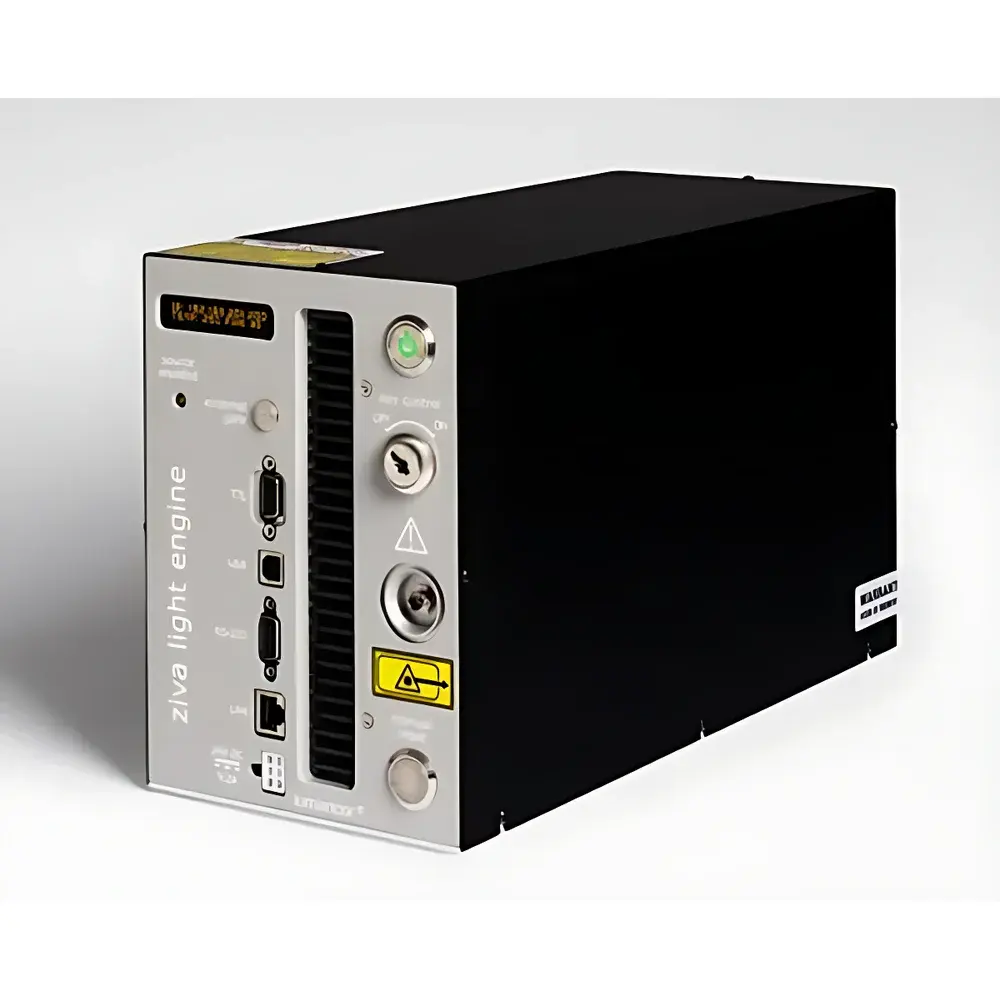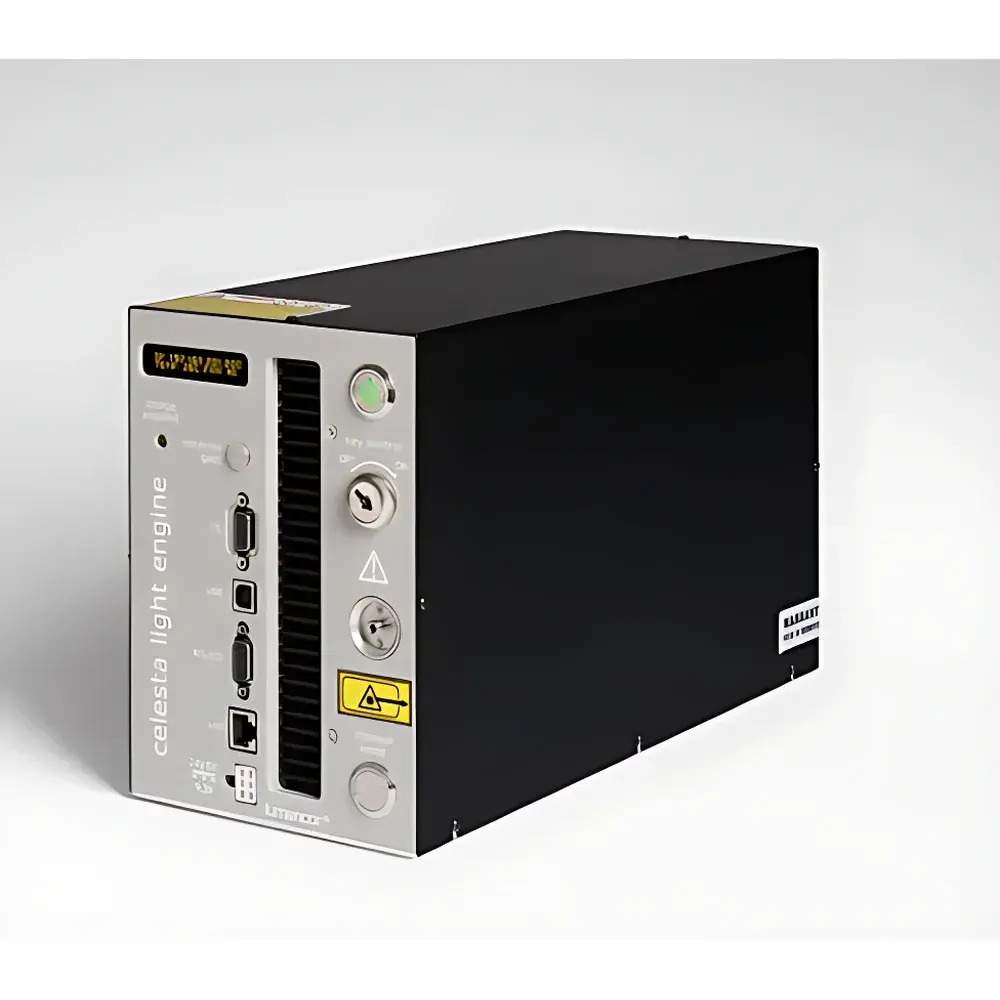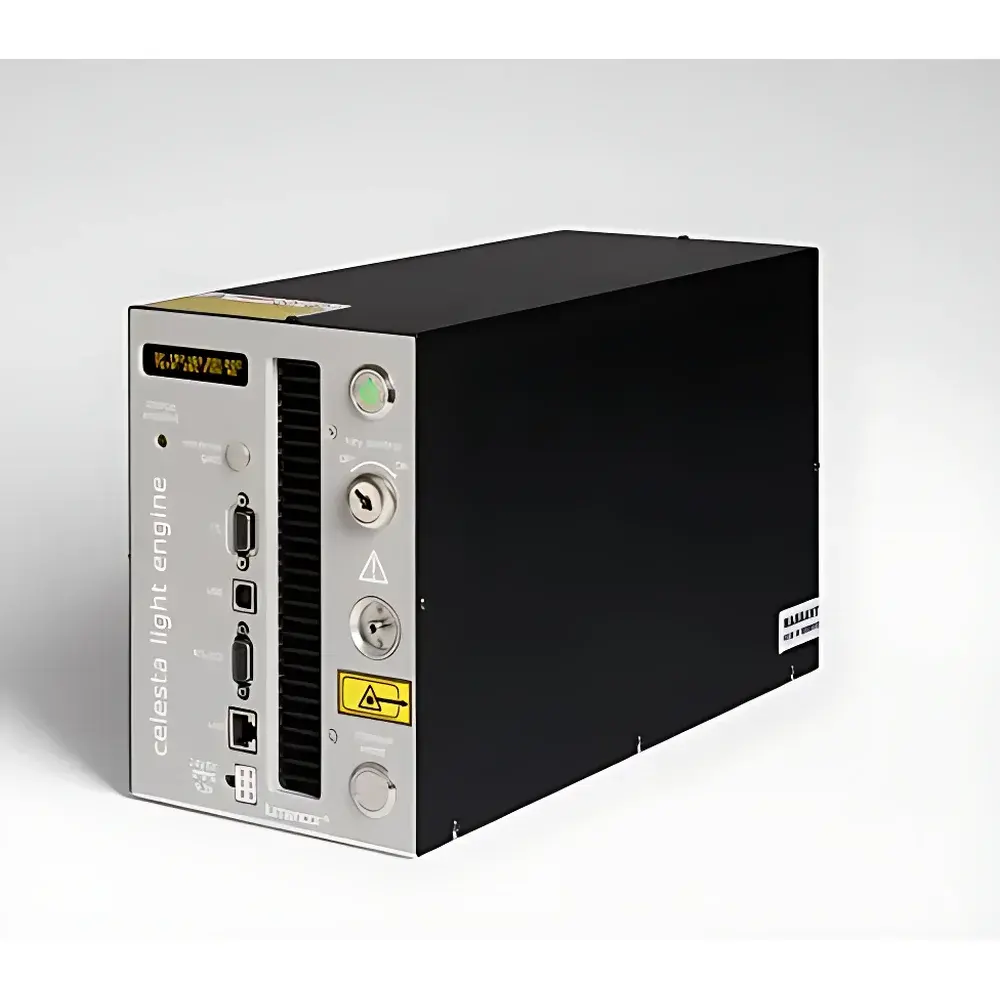
Lumencor SOLA, PEKA & LIDA Series Solid-State White Light Microscopy Light Sources

| Brand | Lumencor |
|---|---|
| Model Series | SOLA / PEKA / LIDA |
| Light Source Type | High-Power Broadband LED-Based White Light Source |
| Spectral Range | 400–750 nm (SOLA), 500–600 nm enhanced (Green-Yellow “Gap” Mitigation), NIR up to 850 nm (SOLA V-nIR/U-nIR) |
| Output Power | 3–4 W (SOLA), 85 mW (PEKA), 90 mW (LIDA RGB) |
| Color Temperature | ~6000 K (PEKA, stable vs. intensity) |
| Modulation | TTL/Analog, <10 µs rise/fall time (LIDA), software-controllable via USB/Ethernet |
| Compliance | CE, RoHS, FDA-compliant design for IVD and research-use-only (RUO) instrumentation |
| Cooling | Active thermoelectric + convection, fanless operation options available |
Ask about pricing, availability and specifications.
Overview
Lumencor’s SOLA, PEKA, and LIDA series represent a class of engineered solid-state white light microscopy illumination systems designed to replace legacy arc lamps (mercury, xenon) and tungsten-halogen sources in fluorescence, transmitted-light, and multimodal imaging platforms. These systems operate on the principle of spectrally combined, high-brightness LEDs—each independently addressable and thermally stabilized—to deliver broadband visible output with exceptional spatial uniformity, temporal stability, and spectral fidelity. Unlike conventional broadband sources, Lumencor’s architecture eliminates plasma instability, warm-up drift, UV-induced phototoxicity, and short lamp lifetimes. The SOLA platform delivers high-power continuous or pulsed white light across 400–750 nm, while its proprietary phosphor-converted LED technology bridges the so-called “green gap” (500–600 nm), enabling robust excitation of green/yellow fluorophores (e.g., YFP, Cy3, TRITC) without spectral discontinuities. PEKA provides color-temperature-stable illumination (~6000 K) ideal for brightfield, DIC, and phase contrast; LIDA integrates synchronized red/green/blue channels for high-fidelity, video-rate RGB imaging with monochrome cameras—enabling quantitative colorimetry without mechanical filter wheels.
Key Features
- Stable, drift-free output: <±0.3% intensity variation over 8 hours (25°C ambient), enabled by closed-loop thermal management and current regulation
- No warm-up required: Full spectral output achieved within <100 ms of activation; no preheat or stabilization delay
- Programmable modulation: TTL- and analog-compatible triggering with sub-microsecond timing precision (LIDA supports <5 µs exposure synchronization)
- Modular spectral configuration: SOLA models offer selectable bandpass filters (e.g., DAPI/GFP/Cy5 optimized); PEKA and LIDA support user-defined intensity ratios per channel
- Low heat load at sample plane: <1.2 W optical power delivered to objective back aperture (typical), minimizing thermal perturbation in live-cell assays
- Compact OEM-ready form factor: Designed for integration into commercial microscopes (Nikon, Olympus, Zeiss, Leica) and custom-built instrumentation
Sample Compatibility & Compliance
These light sources are validated for use with standard fluorescence microscopy configurations—including epifluorescence, confocal, spinning-disk, light-sheet, and widefield systems—and compatible with all common fluorophore families: DNA stains (DAPI, Hoechst), GFP derivatives (EGFP, mCherry), organic dyes (FITC, Cy3, Cy5, Alexa Fluor series), and near-infrared probes (Cy7, ICG). All units meet CE marking requirements for electromagnetic compatibility (EN 61326-1) and safety (EN 62471 for LED photobiological safety). Design documentation supports GLP/GMP-aligned instrument qualification (IQ/OQ/PQ), and firmware logs comply with FDA 21 CFR Part 11 audit-trail requirements when integrated with compliant host software. No mercury or hazardous gases are employed—fully RoHS 3 and REACH compliant.
Software & Data Management
Lumencor devices interface via USB 2.0 or Ethernet (TCP/IP) using the vendor-agnostic Lumencor Control Software (LCS), which supports Windows, macOS, and Linux. LCS provides real-time intensity monitoring, spectral preset recall, multi-channel ramping profiles, and hardware-triggered exposure sequencing. API libraries (C++, Python, MATLAB) enable full integration into acquisition platforms such as Micro-Manager, MetaMorph, NIS-Elements, and custom LabVIEW or Python-based control stacks. All intensity and status data are timestamped and exportable in CSV/JSON format. Firmware updates preserve calibration constants and retain user-defined presets across versions.
Applications
- Fluorescence microscopy: Multiplexed fixed- and live-cell imaging with minimal photobleaching and cross-talk
- Fluorescence in situ hybridization (FISH): Uniform excitation of SpectrumGreen™/SpectrumRed™ probes across large tissue sections
- High-content screening (HCS): Stable illumination for automated plate readers and image cytometers requiring day-to-day reproducibility
- Optogenetics: Precise, millisecond-scale light delivery for ChR2, C1V1, and other opsins without UV-associated cellular stress
- Endomicroscopy & microendoscopy: Compact, low-heat white-light illumination for fiber-coupled clinical and preclinical probes
- Microfluidic imaging: Synchronized LIDA RGB output enables real-time particle tracking and flow cytometry with color discrimination
FAQ
Can SOLA replace mercury arc lamps in existing microscope stands?
Yes—SOLA units feature standard Koehler illumination coupling and fit most epi-fluorescence ports via C-mount or adapter rings. Electrical integration requires only 24 V DC and a TTL trigger line.
Is spectral calibration traceable to NIST standards?
Each unit ships with a factory-measured spectral power distribution (SPD) report referenced to NIST-traceable radiometric standards; recalibration services are available annually.
How is thermal management handled during extended acquisitions?
All models incorporate Peltier-based active cooling with feedback-controlled fanless operation; surface temperature rise at the housing remains <8°C above ambient after 4 hours at full power.
Are these sources suitable for super-resolution techniques like STED or SIM?
While not designed as depletion lasers, SOLA’s stable, high-SNR broadband output supports SIM illumination; for STED, Lumencor offers dedicated 592/660 nm laser modules under the same platform architecture.
Does LIDA support GenICam-compliant camera triggering?
Yes—LIDA’s digital I/O supports GenICam-compliant strobe and exposure sync protocols via GPIO, ensuring deterministic frame-to-light alignment in high-speed applications.