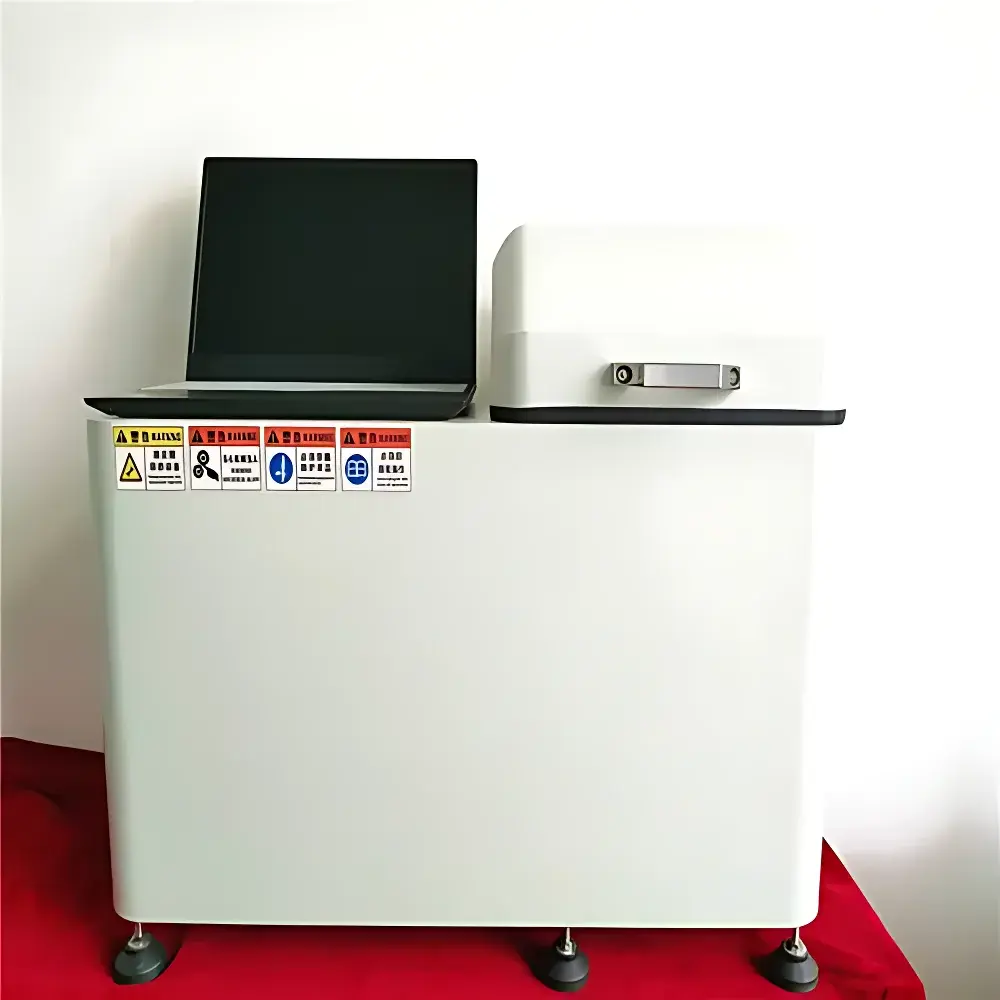
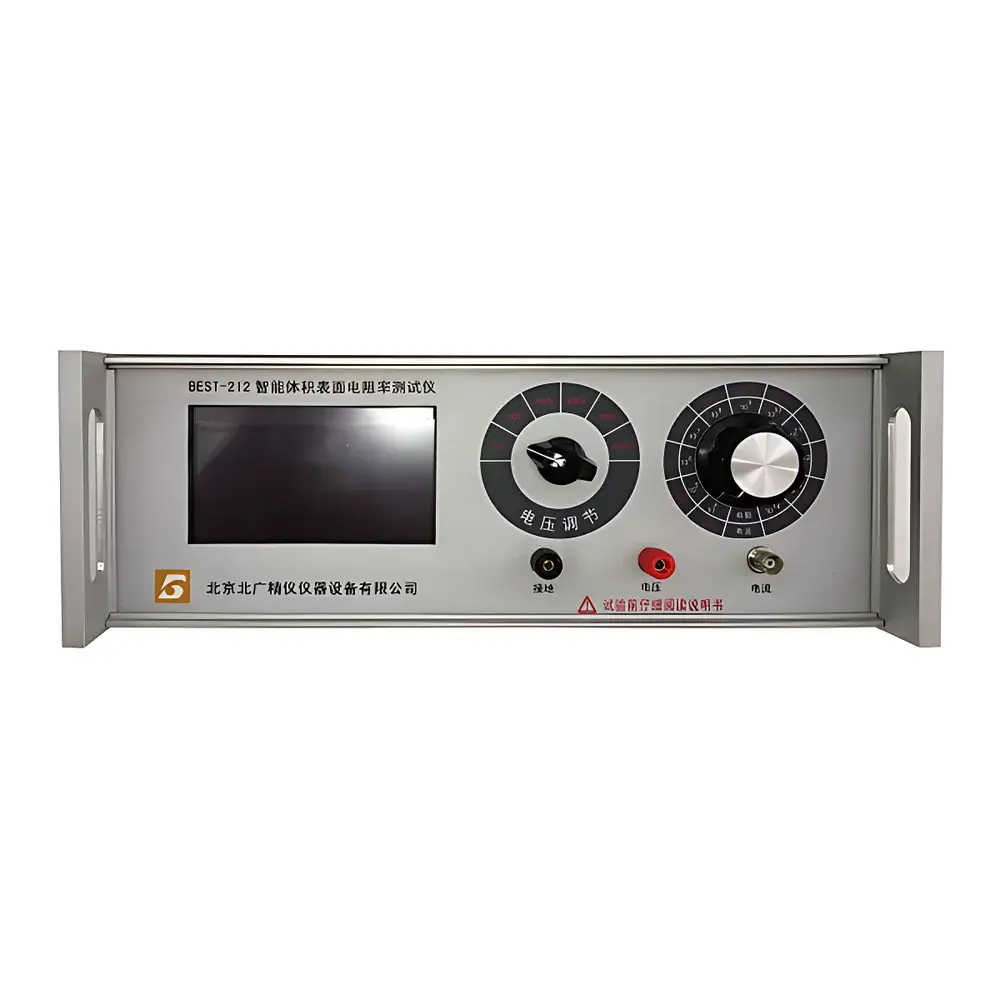
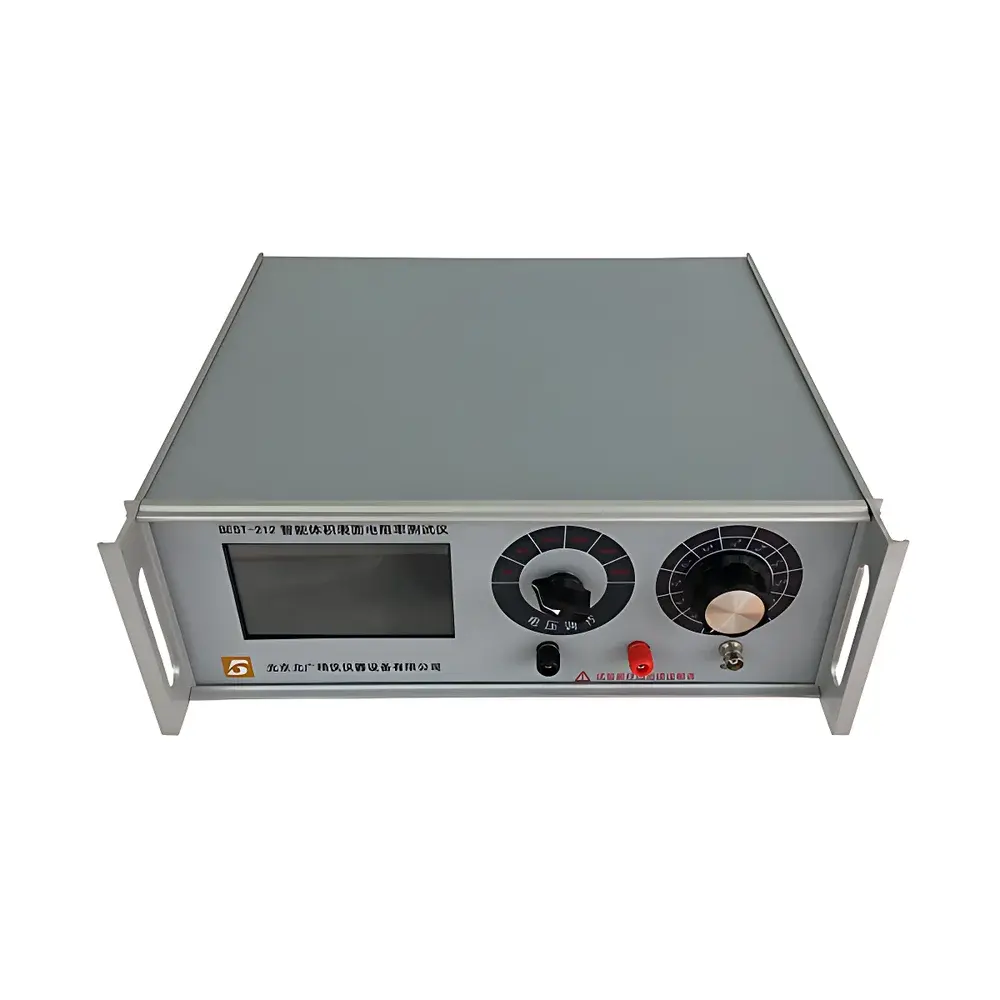
Beijing North Guang Precision Instrument BEST-201C Automatic Powder Resistivity Tester for Conductive Powders

| Brand | Beijing North Guang Precision Instrument |
|---|---|
| Origin | Beijing, China |
| Manufacturer Type | Direct Manufacturer |
| Model | BEST-201C |
| Resistance Range | 10⁻⁵–2×10⁶ Ω |
| Resistivity Range | 10⁻⁵–2×10⁶ Ω·cm |
| Conductivity Range | 5×10⁻⁶–10⁵ S/cm |
| Test Current Range | 1 μA–1000 mA (6 ranges) |
| Voltage Measurement Ranges | 2 mV / 20 mV / 200 mV / 2 V (Resolution: 0.1 μV) |
| Measurement Accuracy | ±0.1% (voltage), ±0.1–0.2% (current), ≤0.3% (resistance vs. standard resistor) |
| Height Measurement Range | 0.01–10.01 mm (Resolution: 0.01 mm) |
| Pressure Options | 200 kg / 300 kg / 500 kg / 1000 kg |
| Electrode Material | Gold-plated copper |
| Measurement Method | Four-terminal (Kelvin) configuration |
| Compression Mode | Motor-driven automatic stepwise loading |
| Demolding | Fully automated |
| Constant-Pressure Holding Time | 0–99.9 s |
| Repeatability Error | ≤3% |
| Overall Measurement Uncertainty | ≤4% (material-dependent) |
| Power Supply | AC 220 V ±10%, 50 Hz, <60 W |
| Dimensions (H×L×D) | ~700 × 650 × 300 mm |
| Net Weight | ~45 kg |
Ask about pricing, availability and specifications.
Overview
The Beijing North Guang Precision Instrument BEST-201C Automatic Powder Resistivity Tester is an engineered solution for quantitative electrical characterization of conductive and semi-conductive powders under controlled compaction conditions. It operates on the four-terminal (Kelvin) measurement principle—eliminating lead and contact resistance errors—to deliver traceable, reproducible resistivity and conductivity data across six decades of resistance (10⁻⁵–2×10⁶ Ω). Designed for compliance with GB/T 24521–2018 (Determination of Electrical Resistivity of Carbon Raw Materials and Coke) and YS/T 587.6–2006 (Test Methods for Calcined Petroleum Coke Used in Anodes—Part 6: Powder Resistivity), the system integrates precision mechanical compression, real-time dimensional metrology, and synchronized electrical acquisition. During automated compression, the instrument continuously records sample height (±0.01 mm resolution), applied pressure, and instantaneous resistance—enabling derivation of true volumetric resistivity (Ω·cm) and specific conductivity (S/cm) without manual intervention or post-processing assumptions.
Key Features
- Automated, programmable compression cycle: stepwise loading, constant-pressure dwell (0–99.9 s), and motorized demolding—all executed without operator input.
- Dual-axis synchronized acquisition: simultaneous sampling of resistance, voltage, current, height, and time at user-defined intervals (down to 100 ms).
- Four-terminal measurement architecture with gold-plated copper rotating electrodes—optimized for low-contact-resistance interface with heterogeneous powder beds.
- Auto-ranging constant-current source (1 μA to 1000 mA) with six discrete current levels; voltage measurement spans 2 mV to 2 V with 0.1 μV resolution.
- Integrated high-resolution height transducer (0.01 mm resolution) calibrated against NIST-traceable gauge blocks; compensates for porosity-induced dimensional change during compaction.
- Modular die assembly: standard 10 mm inner diameter for 200/300 kg systems; 20 mm for 500/1000 kg configurations—each with 25 mm stroke and hardened steel construction.
- USB 2.0 and RS-232 communication interfaces support integration into laboratory automation frameworks and LIMS environments.
Sample Compatibility & Compliance
The BEST-201C accommodates free-flowing, cohesive, and agglomerated conductive powders—including lithium-ion battery cathode/anode materials (e.g., LiCoO₂, graphite, silicon composites), graphene nanoplatelets, carbon black, calcined petroleum coke, metallurgical coke, tungsten carbide, and sintered metal powders. Its design meets functional requirements outlined in ASTM D3764 (Standard Practice for Bulk Density of Powders), ISO 13321 (Particle Size Analysis—Photon Correlation Spectroscopy), and supports GLP-compliant workflows through audit-trail-capable software logging. While not certified to IEC 61000-4 electromagnetic immunity standards, its grounded chassis and shielded signal paths ensure stable operation in shared lab environments. Calibration traceability is maintained via optional NIST-traceable standard resistors (1–3 units) and height calibration artifacts (1 unit), documented per ISO/IEC 17025 calibration procedures.
Software & Data Management
The included Windows-based PC software provides a validated, parameter-driven interface compliant with FDA 21 CFR Part 11 requirements (electronic signatures, audit trail, user access control). It enables full experimental protocol definition—including target pressure profile, dwell duration, current ramp sequence, and data sampling rate. Real-time visualization includes dual-Y plots of resistivity vs. pressure and height vs. time, with overlay capability for comparative batch analysis. All raw and derived parameters (resistivity, conductivity, cross-sectional area, density, porosity index) are auto-calculated and exported to CSV, Excel, or PDF report formats. Metadata embedding (operator ID, sample ID, environmental temperature/humidity tags) ensures full data lineage. Software updates are delivered via secure HTTPS channel with version-controlled release notes.
Applications
This instrument serves critical quality and R&D functions across multiple industrial sectors:
- Battery material manufacturers use it to correlate compaction pressure with interparticle contact resistance—directly informing electrode calendering process windows.
- Carbon anode producers apply it to validate raw material consistency per GB/T 24521–2018, detecting batch-to-batch variation in graphitization degree and ash content.
- Powder metallurgy labs employ it to assess green strength–conductivity trade-offs during binder formulation and debinding optimization.
- Academic research groups utilize its high-resolution height-resistivity coupling to model percolation thresholds in composite powder systems.
- Third-party testing laboratories deploy it as a primary method for contract analysis of conductive fillers (e.g., nickel-coated graphite, silver nanowires) used in EMI shielding compounds.
FAQ
What standards does the BEST-201C comply with?
It is designed and validated to meet GB/T 24521–2018 and YS/T 587.6–2006 for carbonaceous powder resistivity testing. Optional calibration kits support ISO/IEC 17025 traceability.
Can the system measure temperature-dependent resistivity?
No—the base configuration lacks integrated temperature control or sensing. For thermal resistivity studies, external environmental chambers with feedthrough-compatible electrode ports are required.
Is the software compatible with LabVIEW or Python APIs?
Yes—DLL-based SDK and documented ASCII command protocol over RS-232/USB enable custom integration with LabVIEW, MATLAB, or Python-based automation scripts.
How is electrode wear managed during long-term use?
Gold-plated copper electrodes are replaceable; typical service life exceeds 5,000 compression cycles under 500 kg load. A maintenance kit—including spare electrodes and alignment gauges—is available separately.
Does the system support GMP documentation requirements?
Yes—the software includes 21 CFR Part 11 modules: electronic signatures, role-based permissions, immutable audit trails, and exportable raw data archives with hash verification.
More from Beijing North Guang Precision Instrument
View all Beijing North Guang Precision Instrument products → Beijing North Guang Precision Instrument BEST-121 Point-to-Point Surface Resistivity Tester for Textiles and Antistatic Garments
- Beijing North Guang Precision Instrument GDAT-A High-Frequency Q-Meter for Dielectric Constant and Dissipation Factor Measurement
- Beijing North Guang Precision Instrument BEST-1211 Volume & Surface Resistivity Tester for Silicone Rubber and Insulating Materials
- Beijing North Guang Precision Instrument BEST Series Digital High-Resistance DC Insulation Resistance Tester