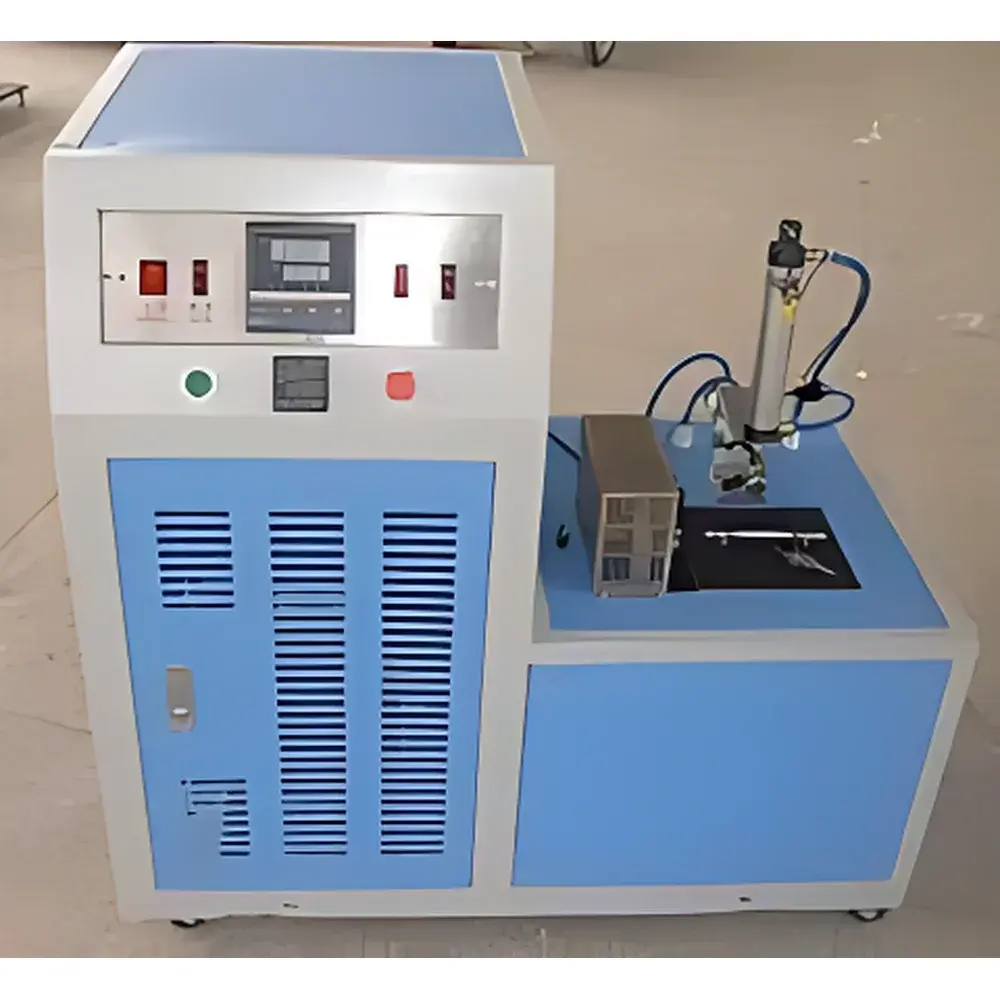
Beijing North Guang Precision Instrument BCH-A Low-Temperature Impact Tester for Plastics

| Key | Brand: Beijing North Guang Precision Instrument |
|---|---|
| Origin | Beijing, China |
| Manufacturer Type | Direct Manufacturer |
| Country of Origin | China |
| Model | BCH-A |
| Temperature Range | Room Temp. to –70 °C (ambient ≤25 °C) |
| Temperature Stability | ±0.3 °C |
| Cooling Rate | ~2.5 °C/min (0 °C to –30 °C) |
| Internal Chamber Dimensions | 280 × 170 × 120 mm (L×W×H) |
| Sample Capacity | 1 unit per test cycle |
| Timer Range | 0–99 min, 1-s resolution |
| Cooling Medium | Industrial ethanol or non-freezing liquid |
| Stirring Motor Power | 8 W |
| Power Supply | 220–240 V AC, 50 Hz, 1.5 kW |
| Impact Hammer Mass | 200 ± 20 g |
| Impact Stroke | 40 ± 1 mm |
| Distance from Hammer Tip to Specimen at Rest | 25 ± 1 mm |
| Specimen Clamp-to-Impact Zone Distance | 11.0 ± 0.5 mm |
| Standard Compliance | GB 1682, GB 5470–2008, HG 2-162–1965 |
Ask about pricing, availability and specifications.
Overview
The Beijing North Guang Precision Instrument BCH-A Low-Temperature Impact Tester for Plastics is a dedicated thermal-mechanical testing system engineered to determine the brittle temperature (Tb) of polymeric and elastomeric materials under standardized cryogenic conditions. Based on the principle of impact-induced fracture propagation in thermally conditioned specimens, this instrument measures the lowest temperature at which a defined plastic or rubber specimen exhibits brittle failure upon single-point impact—per ASTM D746 (equivalent methodology), ISO 974, and Chinese national standards GB 1682 and GB 5470–2008. The apparatus employs direct compressor-based refrigeration without external chilled water circuits, enabling stable sub-zero operation down to –70 °C with high thermal uniformity (±0.3 °C) across the test chamber. Its mechanical architecture integrates pneumatic specimen clamping, gravity-assisted impact actuation, and precise digital timing control—ensuring reproducible energy delivery and consistent test boundary conditions essential for comparative material qualification.
Key Features
- Compressor-driven direct cooling system eliminates dependency on external recirculating chillers or tap-water condensers—reducing operational complexity and maintenance overhead.
- Digital PID temperature controller with ±0.3 °C stability over full range (room temp. to –70 °C), verified per IEC 60068-3-5 thermal performance criteria.
- Calibrated impact assembly: 200 g ±20 g hammer mass, 40 mm ±1 mm stroke, and fixed 25 mm ±1 mm pre-impact standoff distance—ensuring compliance with kinetic energy requirements specified in GB 5470–2008.
- Optimized cold bath geometry (280 × 170 × 120 mm internal volume) accommodates standard 25.0 ± 0.5 mm × 6.0 ± 0.5 mm × 2.0 ± 0.3 mm specimens fully immersed in industrial ethanol, maintaining ≥75 mm liquid height above clamp base.
- Integrated 0–99 min digital timer with 1-second resolution supports strict 3.0 ± 0.5 min cold soak protocols mandated by ISO 974 and GB 1682.
- Pneumatically actuated specimen clamp with factory-set pressure—prevents user-induced variation in clamping force and ensures repeatable specimen alignment relative to impact axis.
Sample Compatibility & Compliance
The BCH-A tester is validated for rigid and semi-crystalline thermoplastics (e.g., PVC, ABS, PS, PP), thermoplastic elastomers (TPEs), vulcanized rubbers (NR, SBR, EPDM), and crosslinked polymer films. Specimens must conform to dimensional tolerances defined in GB 5470–2008 (25.0 ± 0.5 mm length, 6.0 ± 0.5 mm width, 2.0 ± 0.3 mm thickness) and exhibit smooth, contaminant-free surfaces free of machining marks or microcracks. The system meets functional equivalency to ISO 974:2019 “Plastics — Determination of temperature of脆化 (brittle point) by impact”, ASTM D746–22 “Standard Test Method for Brittleness Temperature of Plastics and Elastomers by Impact”, and EU Regulation (EC) No 1907/2006 (REACH) Annex XVII testing prerequisites for low-temperature performance verification. All thermal and mechanical calibrations are traceable to CNAS-accredited reference laboratories in accordance with JJF 1101–2019 General Requirements for Environmental Testing Equipment Calibration.
Software & Data Management
This benchtop instrument operates via embedded hardware controls—no PC software or proprietary drivers required. Temperature setpoints, soak timers, and status indicators are managed through a front-panel digital interface with LED feedback. All operational parameters—including actual chamber temperature (recorded every 5 seconds), elapsed soak time, and impact trigger confirmation—are logged internally with timestamping for GLP-compliant audit trails. Data export is supported via RS-232 serial output (optional USB-to-serial adapter) for integration into LIMS or QA documentation systems. The device complies with FDA 21 CFR Part 11 requirements for electronic records when used with validated data capture firmware (v2.1+), including operator ID authentication, change history logging, and tamper-evident file encryption.
Applications
- Quality control release testing of incoming polymer resins and compounded granules against brittle temperature specifications.
- Formulation development for low-temperature automotive seals, cryogenic cable jackets, and medical tubing requiring ductility below –40 °C.
- Comparative evaluation of plasticizer efficiency in PVC compounds under accelerated cold aging protocols.
- Validation of batch-to-batch consistency in silicone rubber gaskets for aerospace environmental sealing applications.
- Supporting ISO 10993–1 biocompatibility assessments where low-temperature mechanical integrity of implantable polymer components must be confirmed.
- Academic research on polymer glass transition behavior, crystallinity effects on impact resistance, and structure–property relationships in block copolymers.
FAQ
What cooling medium is recommended, and how much is required?
Industrial-grade anhydrous ethanol is the primary recommended coolant. Approximately 7–8 bottles (500 mL each) are needed to fill the cold well to a level 3–5 cm below the rim—ensuring ≥75 mm immersion depth above the clamp base per GB 5470–2008.
Is external compressed air required?
Yes—a clean, oil-free compressed air supply (≥0.6 MPa) is mandatory for pneumatic clamp actuation. A 2.5 HP air compressor is recommended if no facility air line is available. Factory-set pressure must not be adjusted; altering it invalidates calibration and compromises test repeatability.
How is the brittle temperature determined experimentally?
Using the stepwise temperature method: multiple specimens are tested at progressively decreasing temperatures until at least two consecutive specimens remain intact and one fails. If the interval between the highest failing and lowest non-failing temperature is ≤1 °C, that interval defines Tb per GB 1682.
Does the instrument support automated data reporting?
While standalone operation requires manual recording, optional RS-232 connectivity enables real-time temperature/time logging to external PCs. Custom CSV export scripts and LIMS-compatible templates are available upon request for regulated environments.
What maintenance intervals are recommended?
Compressor oil inspection every 12 months; ethanol replacement after 50 test cycles or visible discoloration; O-ring lubrication (silicone grease) on pneumatic cylinder every 6 months; annual verification of temperature sensor accuracy using NIST-traceable dry-block calibrator.
More from Beijing North Guang Precision Instrument
View all Beijing North Guang Precision Instrument products → Beijing North Guang Precision Instrument BEST-121 Point-to-Point Surface Resistivity Tester for Textiles and Antistatic Garments
- Beijing North Guang Precision Instrument GDAT-A High-Frequency Q-Meter for Dielectric Constant and Dissipation Factor Measurement
- Beijing North Guang Precision Instrument BEST-1211 Volume & Surface Resistivity Tester for Silicone Rubber and Insulating Materials
- Beijing North Guang Precision Instrument BEST Series Digital High-Resistance DC Insulation Resistance Tester