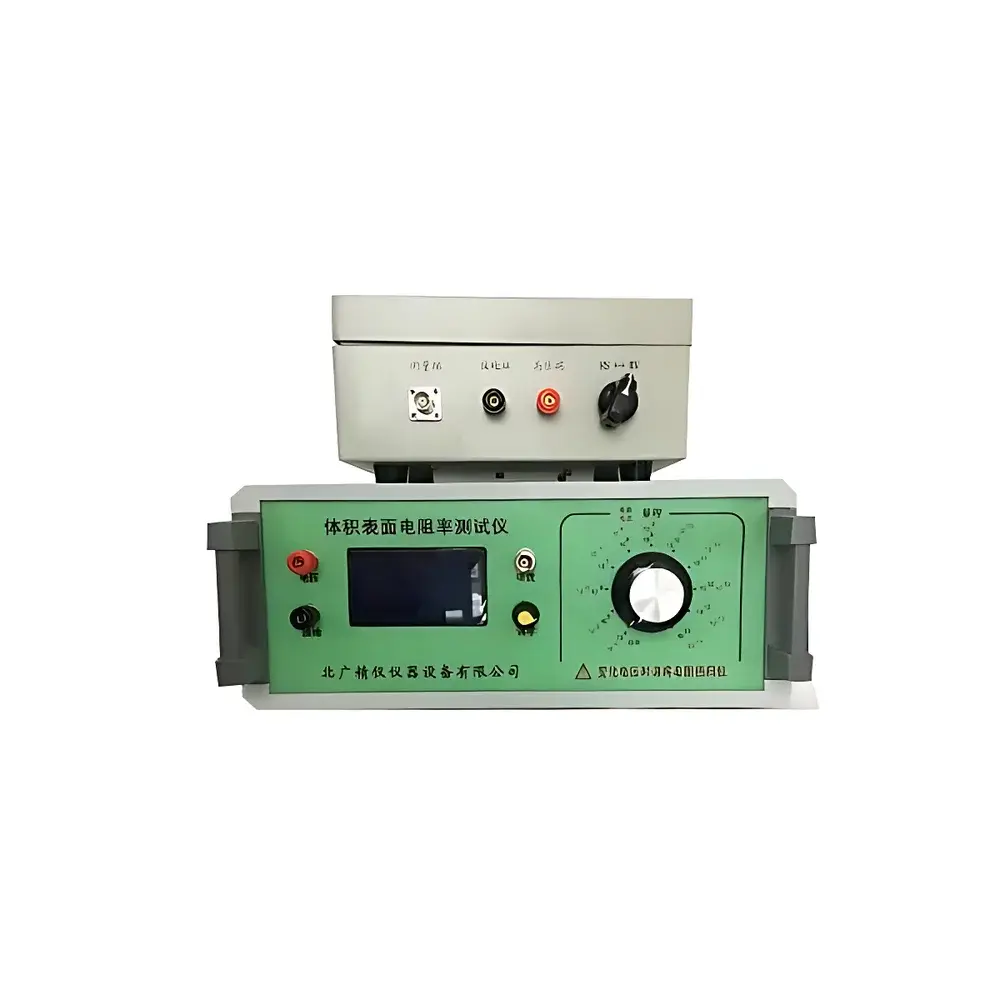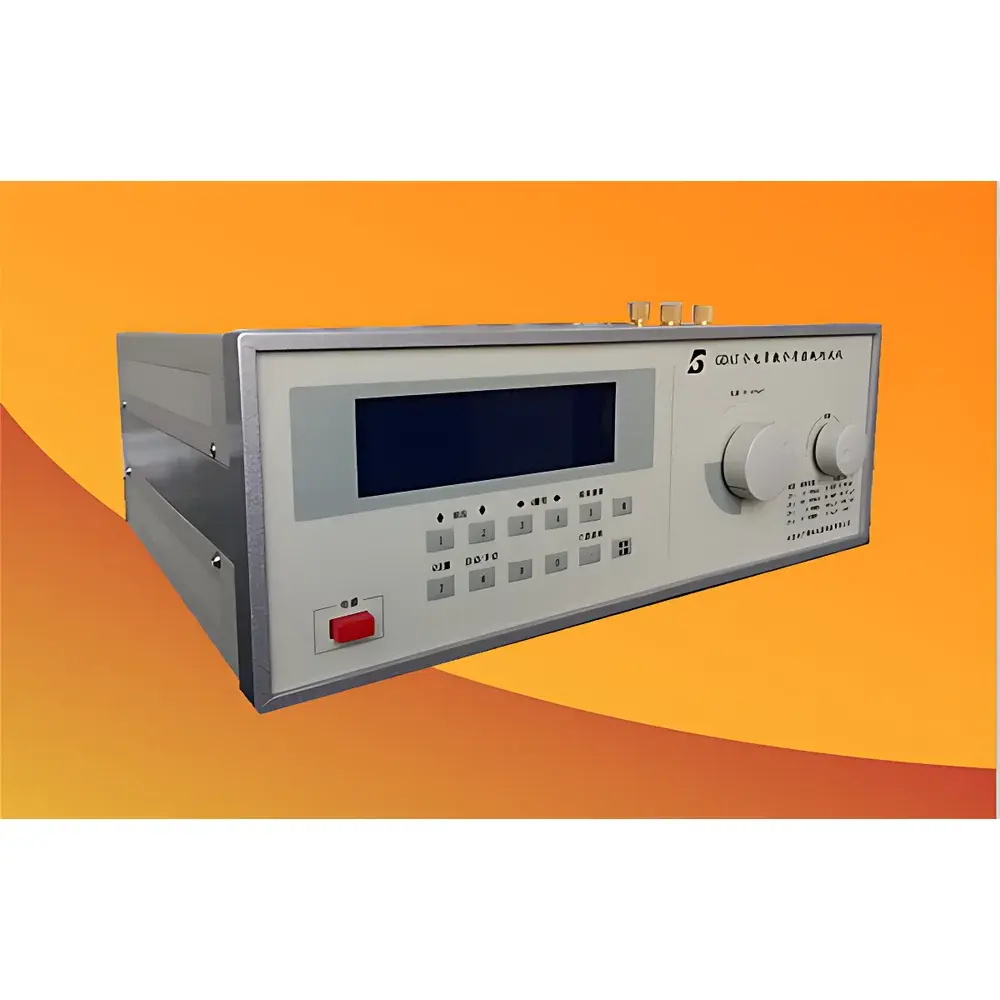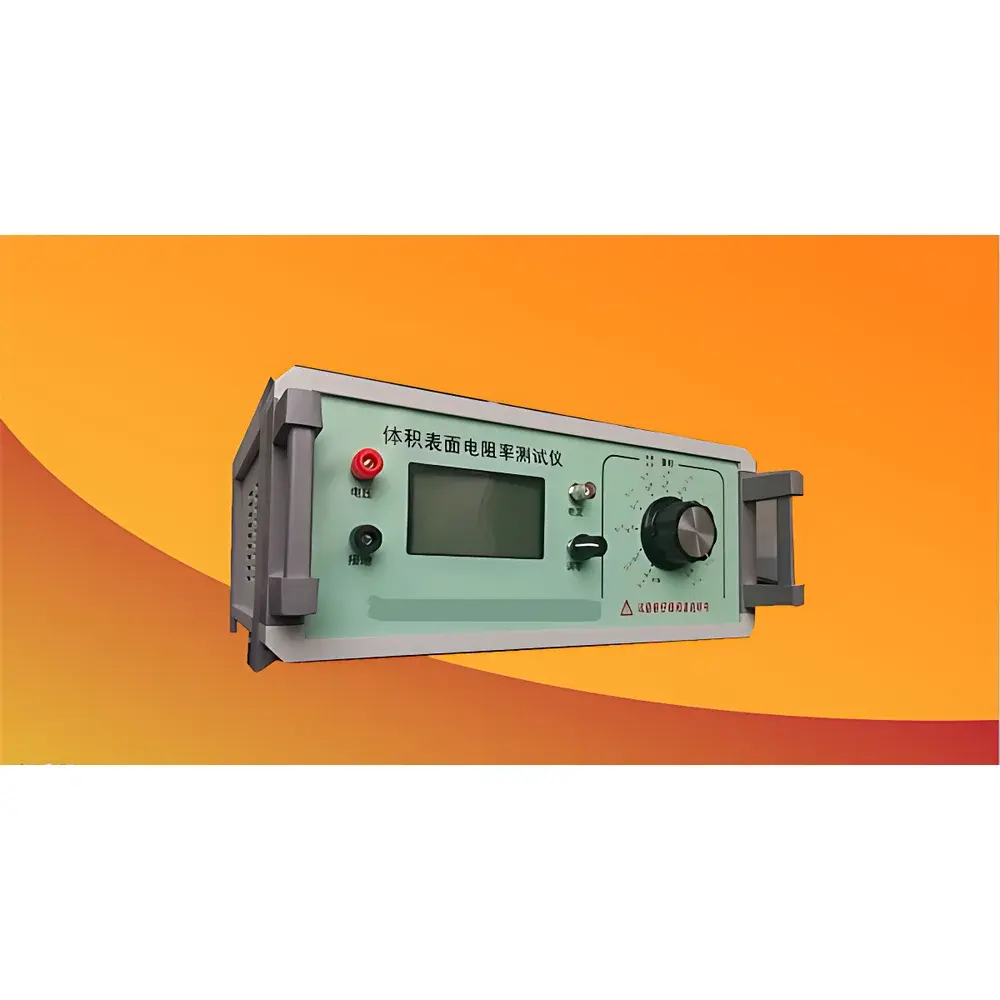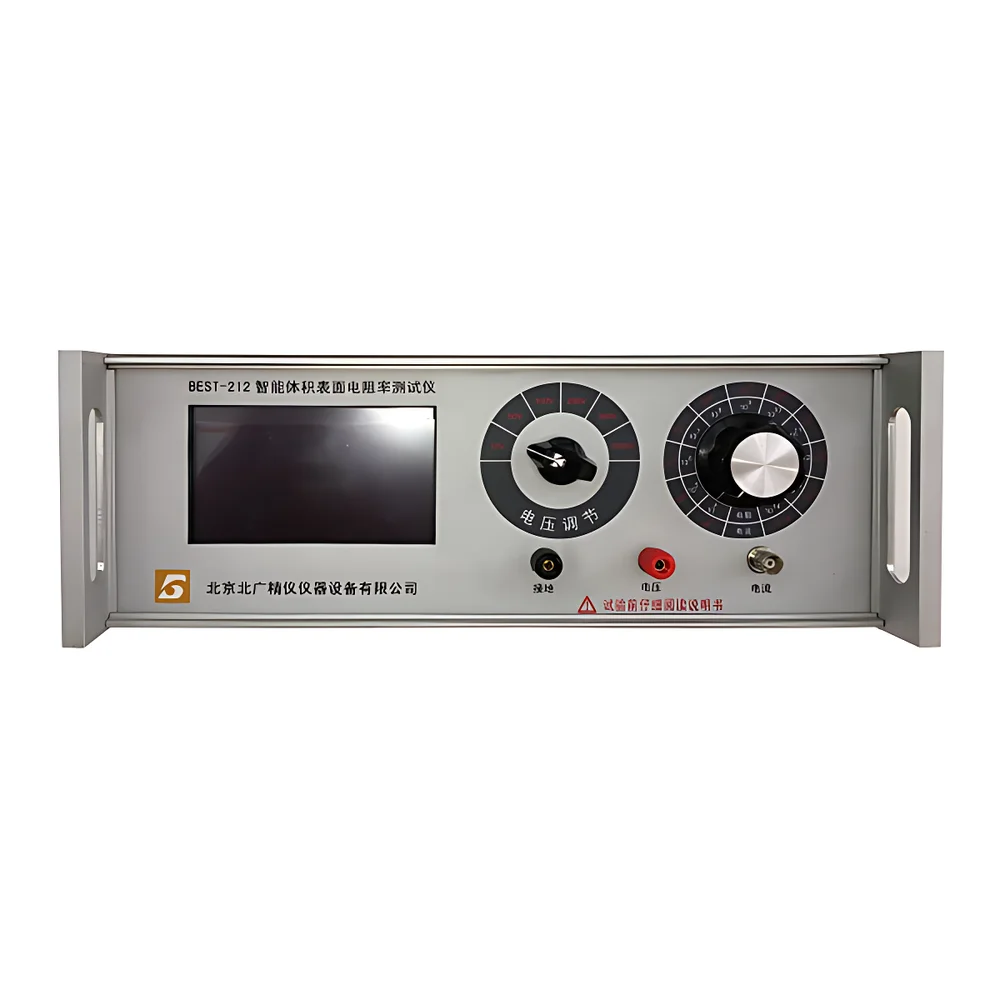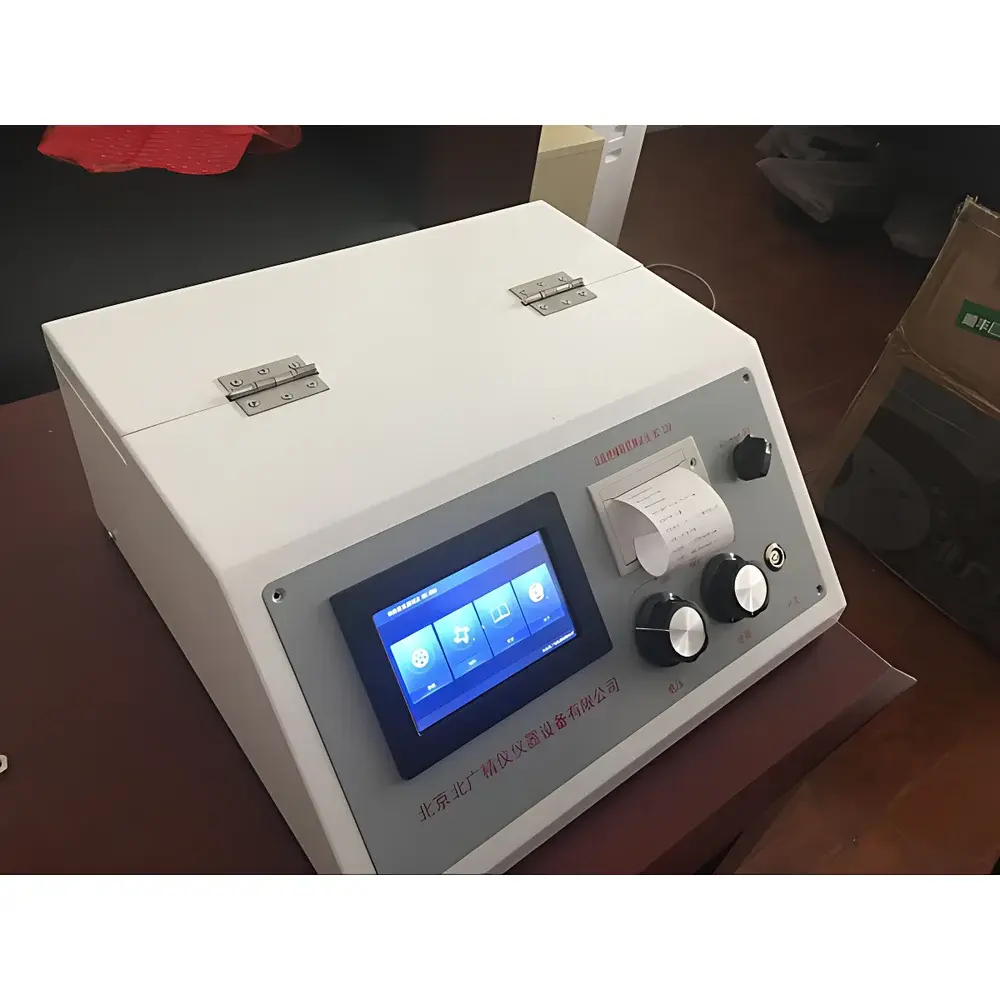
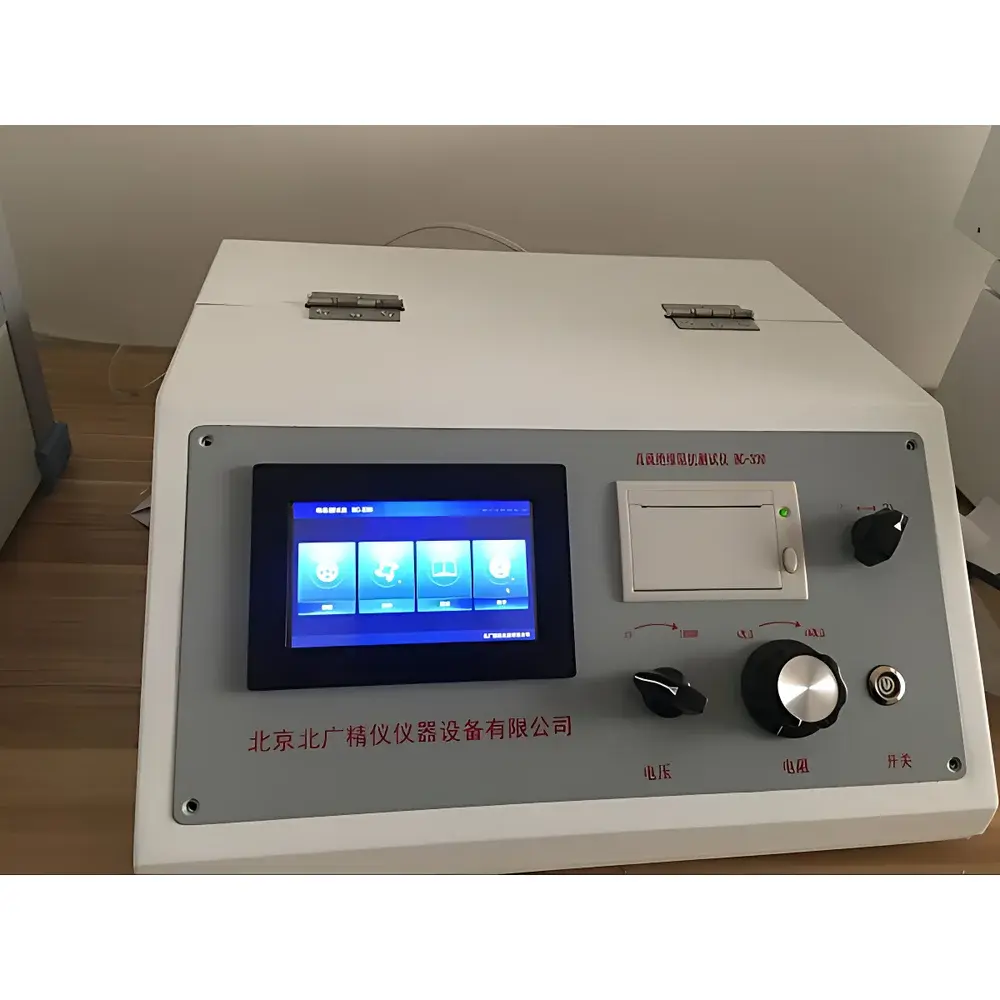
Beijing North Guang Precision Instrument BEST-330 Volume and Surface Resistivity Meter

| Brand | Beijing North Guang Precision Instrument |
|---|---|
| Origin | Beijing, China |
| Manufacturer Type | Direct Manufacturer |
| Product Origin | Domestic (China) |
| Model | BEST-330 |
| Price | USD 2,150 (approx.) |
| Resistance Range | 10⁶ Ω to 10²⁰ Ω |
| Current Range | 10⁻⁴ A to 10⁻¹⁸ A |
| Test Voltage | 10 V, 50 V, 100 V, 250 V, 500 V, 1000 V (6-step selectable) |
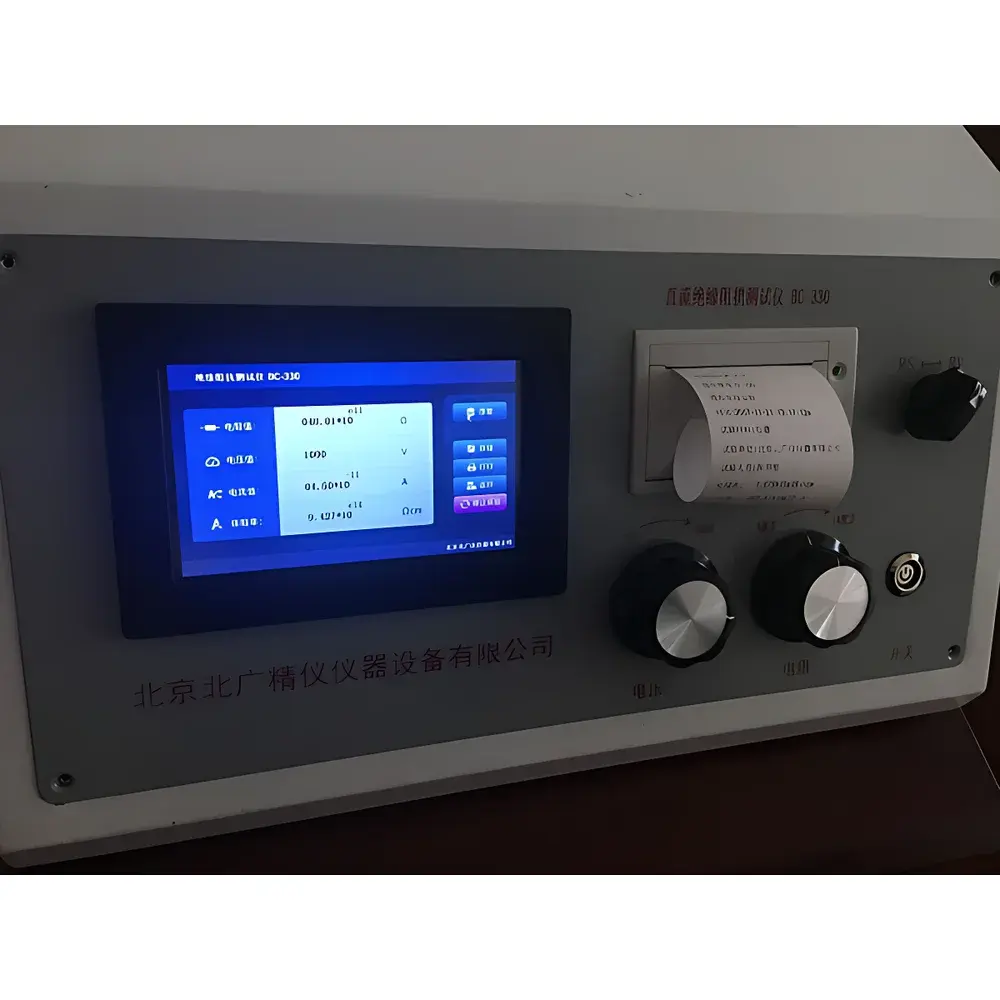
| Display | Capacitive Touchscreen with Real-time Voltage/Resistance/Current/Resistivity Readout |
| Data Storage | Up to 60 Auto-Timestamped Records (Date-Indexed) |
| Output | Thermal Printer (Built-in), USB Export Support |
| Power Supply | AC 220 V, 50 Hz, ~5 W |
| Compliance | GB/T 1410–2006, ASTM D257–99, GB/T 1692–2008, GB/T 22042–2008, GB/T 22043–2008, GJB 3007A–2009, IEC 62631-3-1 (equivalent principles) |
Ask about pricing, availability and specifications.
Overview
The Beijing North Guang Precision Instrument BEST-330 Volume and Surface Resistivity Meter is a precision high-resistance measurement system engineered for trace-level DC resistivity characterization of insulating and antistatic materials. It operates on the principle of constant-voltage DC biasing combined with guarded four-terminal sensing, enabling accurate separation of volume conduction from surface leakage paths—critical for evaluating bulk resistivity (ρv, in Ω·m) and surface resistivity (ρs, in Ω/sq) per standardized test geometries. Designed for laboratory and QC environments in electronics manufacturing, polymer R&D, textile safety certification, and ESD control validation, the instrument integrates a fully shielded test chamber with coaxial guarded electrodes to minimize stray capacitance and electromagnetic interference. Its architecture conforms to fundamental metrological requirements for high-impedance measurement, including input impedance >10¹⁵ Ω, guard-driven electrode configuration, and low-noise electrometer-grade current amplification with sub-femtoamp resolution.
Key Features
- Extended resistance measurement range from 10⁶ Ω to 10²⁰ Ω, supporting evaluation of ultra-high-resistivity polymers, ceramics, and antistatic coatings.
- Six programmable DC test voltages (10 V, 50 V, 100 V, 250 V, 500 V, 1000 V) compliant with ASTM D257–99 and GB/T 1410–2006 voltage selection criteria for material classification.
- Integrated thermal printer with date/time stamping; supports direct hardcopy output of resistance, resistivity, current, and test metadata without external software.
- Capacitive touchscreen interface with handwritten input capability and dropdown parameter selection for operator, material ID, test standard, and batch information.
- Onboard data logging stores up to 60 test records indexed by date; records include applied voltage, measured current, calculated resistivity, and electrode configuration flags.
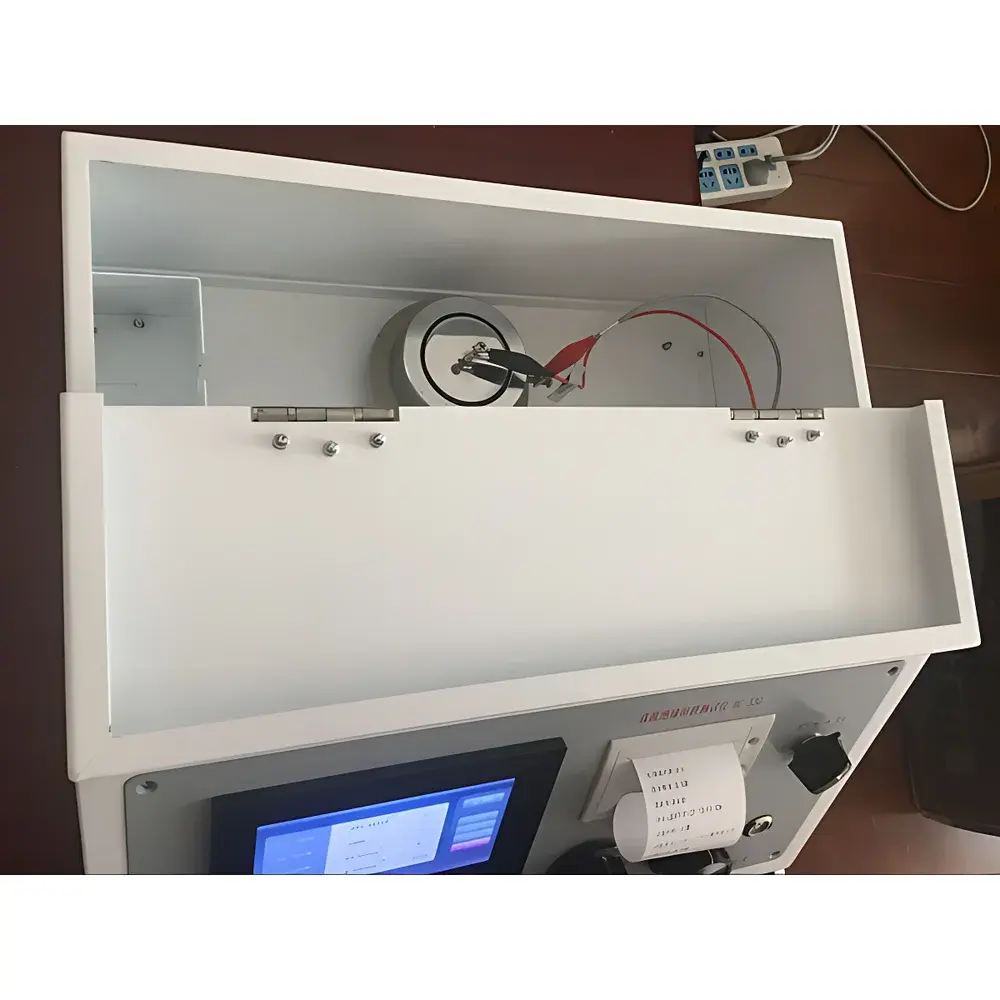
- Monolithic shielded enclosure integrating meter and guarded electrode chamber eliminates interconnect resistance artifacts and ensures stable guard potential integrity.
- Auto-zero and drift compensation algorithms maintain measurement stability; zero drift ≤4% of full scale per hour under controlled ambient conditions.
Sample Compatibility & Compliance
The BEST-330 accommodates solid dielectrics (e.g., molded plastics, laminates, elastomers), flexible films, woven/nonwoven textiles, footwear soles, flooring materials, and conductive/antistatic composites. Electrode configuration follows standardized geometry per GB/T 1410–2006: high-voltage electrode (ID = 146 mm), guarded measuring electrode (OD = 120 mm), guard ring width = 8 mm, and 2 mm gap between measuring and high-voltage electrodes. Surface finish of electrodes complies with Ra ≤ 1.6 µm to ensure reproducible contact resistance. The system meets technical verification criteria outlined in Q/TPGG 7–2008 (Enterprise Standard for High-Insulation Resistance Meters), including ±10% accuracy for R ≤ 10¹² Ω and ±20% for R > 10¹² Ω. It supports audit-ready documentation for GLP-compliant labs and aligns with ESD control frameworks per GJB 3007A–2009 and IEC 61340–2–3.
Software & Data Management
While standalone operation requires no PC, the included Windows-compatible software enables advanced data review, trend analysis across batches, and export to CSV or PDF. All stored records retain full traceability: timestamp, operator ID, material name, test voltage, electrode type flag, and raw current/resistance values. Audit trail functionality logs parameter changes and print events. Data files are digitally signed and timestamped to support FDA 21 CFR Part 11–aligned workflows where electronic records are subject to regulatory review. Calibration certificates and verification logs can be archived alongside test data, facilitating internal quality audits and third-party accreditation (e.g., CNAS, ISO/IEC 17025).
Applications
- Volume resistivity testing of insulating materials for aerospace wire insulation, transformer bushings, and encapsulants per ASTM D257 and GB/T 1692.
- Surface resistivity validation of ESD-safe work surfaces, garments (GB 12014, GB/T 20991), footwear (GB 4385), and cleanroom fabrics (GB/T 24249).
- Quality control of antistatic additives in polymeric compounds, conductive fillers in composites (GB/T 15738), and ceramic tiles (GB 26539).
- Temperature-dependent resistivity profiling when coupled with thermostatic baths (e.g., PVC cable insulation per GB/T 3048.5).
- Verification of grounding integrity in electronics assembly areas and semiconductor fabrication facilities per GJB 105–1998-Z and GB 50611–2010.
FAQ
What standards does the BEST-330 explicitly support?
It is configured and verified for GB/T 1410–2006, ASTM D257–99, GB/T 22042–2008, GB/T 22043–2008, GJB 3007A–2009, and GB/T 1692–2008—with electrode geometry and voltage steps aligned to each standard’s procedural requirements.
Can the instrument measure temperature-dependent resistivity?
Yes—when used with an external thermostatic bath and appropriate sample holders, it supports resistivity measurements across –10 °C to +100 °C, provided lead resistance and thermal EMF effects are compensated per GB/T 3048.5 methodology.
Is the built-in printer capable of generating calibration-compliant reports?
Each printed report includes date/time stamp, test voltage, measured current/resistance, calculated resistivity, operator ID, and electrode configuration—sufficient for first-level QA documentation and internal calibration verification.
How is electrical shielding implemented to ensure measurement fidelity?
The unit features a monolithic mu-metal–lined enclosure with continuous guard-ring drive, triaxial cabling, and active guarding of all high-impedance nodes—reducing leakage currents to <10⁻¹⁹ A and ensuring effective suppression of capacitive coupling.
What maintenance or calibration intervals are recommended?
Annual calibration against NIST-traceable high-resistance standards (e.g., Keysight B2987A or equivalent) is recommended; daily zero-check and periodic verification with 10¹² Ω and 10¹⁶ Ω reference resistors are advised per Q/TPGG 7–2008 Section 7.2.
More from Beijing North Guang Precision Instrument
View all Beijing North Guang Precision Instrument products → Beijing North Guang Precision Instrument BEST-121 Point-to-Point Surface Resistivity Tester for Textiles and Antistatic Garments
- Beijing North Guang Precision Instrument GDAT-A High-Frequency Q-Meter for Dielectric Constant and Dissipation Factor Measurement
- Beijing North Guang Precision Instrument BEST-1211 Volume & Surface Resistivity Tester for Silicone Rubber and Insulating Materials
- Beijing North Guang Precision Instrument BEST Series Digital High-Resistance DC Insulation Resistance Tester