Jingxin 4LQM-3SP4 Planetary Ball Mill

| Brand | Jingxin (Shanghai Jingxin Scientific Instrument Co., Ltd.) |
|---|---|
| Origin | Shanghai, China |
| Manufacturer Type | Direct Manufacturer |
| Instrument Type | Planetary Ball Mill |
| Sample Suitability | Hard, brittle, fibrous, and moderately adhesive materials |
| Final Particle Size | < 100 nm (wet grinding), < 1 µm (dry grinding) |
| Batch Capacity | 4 × 1000 mL jars (50–1500 mL per jar) |
| Jar Rotation Speed | 70–670 rpm |
| Sun Wheel Speed | 35–335 rpm |
| Transmission Ratio (Sun Wheel | Jar): 1 : 2 |
| Programmable Running Time | 0–3600 min |
| Pause Interval | 0–3600 s |
| Emergency Stop | Yes |
| Net Weight | 92.8 kg |
| Dimensions (L×W×H) | 770 × 500 × 580 mm |
| Jar & Media Materials | Stainless Steel (304/316), Tungsten Carbide (WC), Zirconia (ZrO₂), Alumina (Al₂O₃), Agate (SiO₂), PTFE, Nylon (PA), Polyurethane (PU), PP, MC Nylon |
Ask about pricing, availability and specifications.
Overview
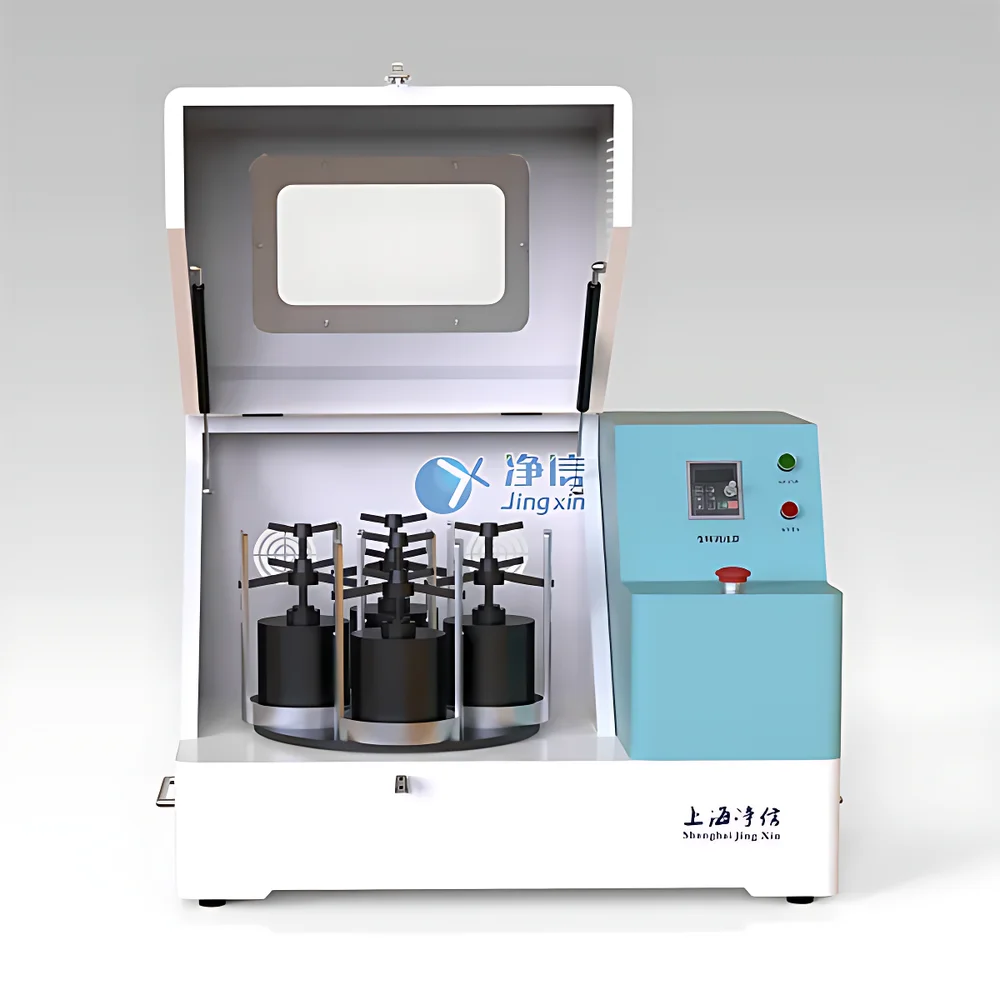
The Jingxin 4LQM-3SP4 Planetary Ball Mill is a high-energy, dual-axis mechanical alloying and nanomilling system engineered for reproducible, scalable sample preparation in research laboratories and quality control environments. It operates on the principle of planetary motion—where grinding jars rotate about their own axes while simultaneously revolving around a central sun wheel in opposite direction—generating centrifugal accelerations up to 23 g. This kinematic configuration subjects samples to intense impact, shear, and compressive forces between grinding media and jar walls, enabling efficient size reduction from millimeter-scale feedstock to sub-100 nm particles under wet grinding conditions or <1 µm under dry operation. Designed for rigorous daily use, the 4LQM-3SP4 integrates robust mechanical architecture with programmable process control, supporting both routine analytical sample homogenization and advanced materials synthesis—including mechanochemical synthesis of MOFs, solid-state battery cathode precursors, and nanostructured catalysts.
Key Features
- Four-jar configuration with independent jar mounting—enabling parallel processing of up to 4 × 1000 mL batches for improved throughput and statistical repeatability.
- Adjustable rotational speeds: sun wheel 35–335 rpm, jar 70–670 rpm, with fixed 1:2 transmission ratio ensuring precise kinetic energy delivery across all operating ranges.
- Dual-directional rotation programming—automatic reversal at user-defined intervals prevents particle agglomeration and ensures uniform energy distribution.
- Integrated LED blue-light illumination with auto-sensing activation for real-time visual inspection of grinding progress without interrupting operation.
- Emergency stop button compliant with IEC 60204-1; full electrical isolation and thermal overload protection for continuous-duty operation up to 60 minutes without duty-cycle interruption.
- Modular jar and media selection system compatible with 11 material options—including zirconia, tungsten carbide, stainless steel, PTFE, agate, alumina, and polyurethane—to prevent cross-contamination and support chemically aggressive or temperature-sensitive applications.
Sample Compatibility & Compliance
The 4LQM-3SP4 accommodates heterogeneous sample matrices spanning pharmaceutical actives (e.g., tablets, herbal powders), biological tissues (bone, plant biomass), inorganic ceramics (Al₂O₃, SiO₂), metallic alloys (Fe, Mg, Cu), polymers, and environmental solids (soil, sludge, fly ash). Its design conforms to CE marking requirements per Directive 2006/42/EC (Machinery Directive) and EN 61000-6-3 (EMC emissions). For regulated environments, the instrument supports GLP-compliant workflows when paired with external audit-trail-enabled data loggers. While not intrinsically certified for FDA 21 CFR Part 11, its programmable parameters (time, speed, direction, pause intervals) are fully documentable and exportable via USB interface for traceable SOP execution in QC/QA labs.
Software & Data Management
The 4LQM-3SP4 utilizes an embedded microcontroller-based interface with tactile rotary encoder and 4-digit LED display. All operational parameters—including run time, pause duration, forward/reverse cycle count, and speed setpoints—are stored in non-volatile memory and retain settings after power loss. Process logs (start/stop timestamps, actual rpm, total runtime) can be exported in CSV format via USB port for integration into LIMS or ELN platforms. Optional RS-232 or Ethernet modules (available as field-upgrade kits) enable remote monitoring and centralized fleet management in multi-instrument facilities.
Applications
- Pharmaceutical pre-formulation: micronization of APIs, excipient blending, amorphous solid dispersion development.
- Materials science: mechanical alloying of Ni–Fe–Cr superalloys, synthesis of nanocrystalline TiO₂ photocatalysts, graphene oxide exfoliation.
- Geochemical analysis: homogenization of rock, soil, and sediment samples prior to XRF, ICP-OES, or leaching assays.
- Environmental testing: comminution of heterogeneous waste streams (e.g., electronic scrap, municipal sludge) for representative subsampling.
- Academic research: solvent-free organic synthesis (mechanochemistry), cocrystal screening, polymer nanocomposite fabrication.
FAQ
What is the maximum recommended feed particle size for optimal performance?
Feed material should be ≤10 mm in largest dimension to ensure consistent energy transfer and avoid jar imbalance or premature media fracture.
Can the 4LQM-3SP4 operate under inert atmosphere or cryogenic conditions?
Yes—vacuum-sealed or gas-purged jars (optional accessories) allow operation under N₂ or Ar; low-temperature grinding is supported via externally mounted chiller units (−20 °C to +40 °C range).
Is validation documentation available for GMP environments?
Factory calibration certificates and IQ/OQ templates are provided upon request; PQ protocols must be developed in-house per site-specific SOPs.
How often does maintenance require media or jar replacement?
Under standard usage (≤4 hrs/day, stainless-steel media), jar and ball wear is negligible over 12 months; zirconia or WC components extend service life to >24 months with periodic visual inspection.
Does the system support unattended overnight operation?
Yes—the 3600-minute timer and auto-shutdown function enable safe extended runs; however, thermal monitoring is advised for exothermic reactions or high-load wet grinding.
More from Jingxin (Shanghai Jingxin Scientific Instrument Co., Ltd.)
View all Jingxin (Shanghai Jingxin Scientific Instrument Co., Ltd.) products → Jingxin JXFSTPRP-192CL High-Speed Cryogenic Grinding and Homogenization System
- Jingxin JX-CKSM-4WK 4-Channel Temperature-Controlled Single-Cell Suspension Preparation System
- Jingxin JX-24 High-Efficiency Automated Cryogenic Tissue Grinder
- Jingxin Tissuelyser-192 High-Throughput Cryogenic Tissue Homogenizer