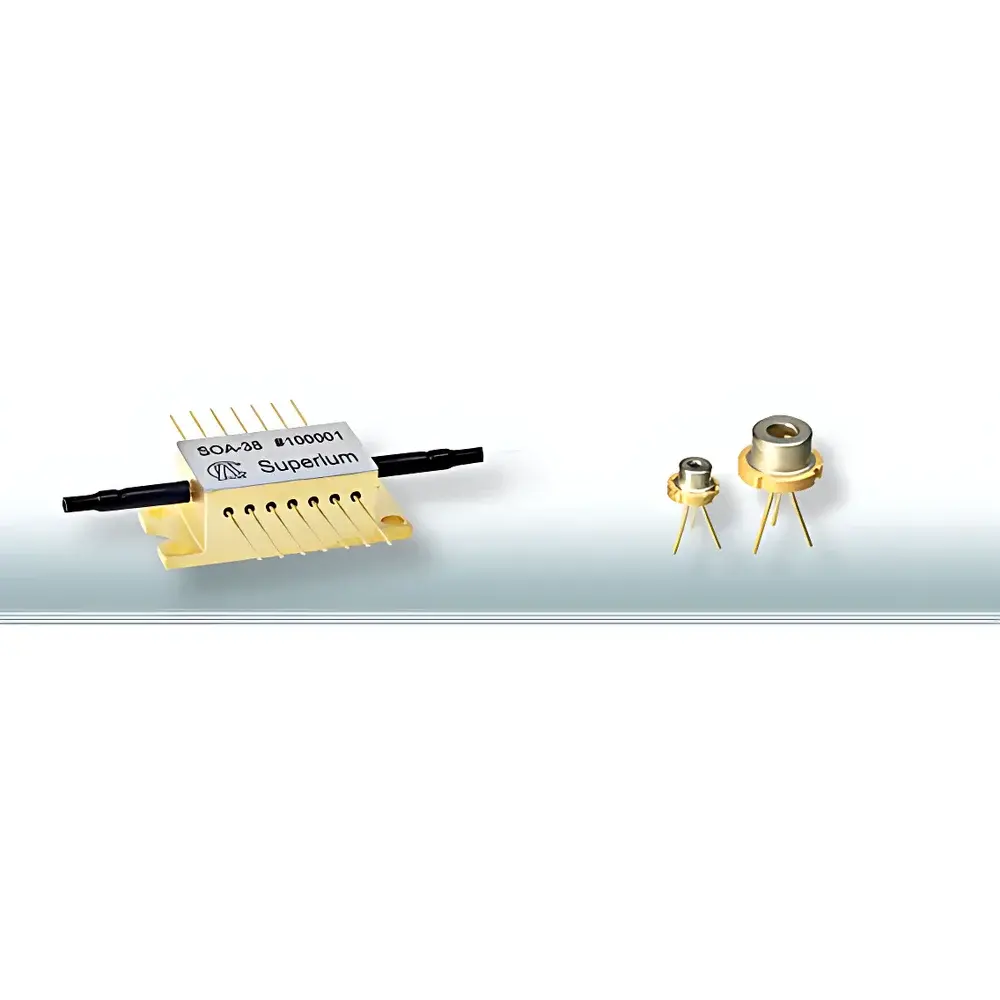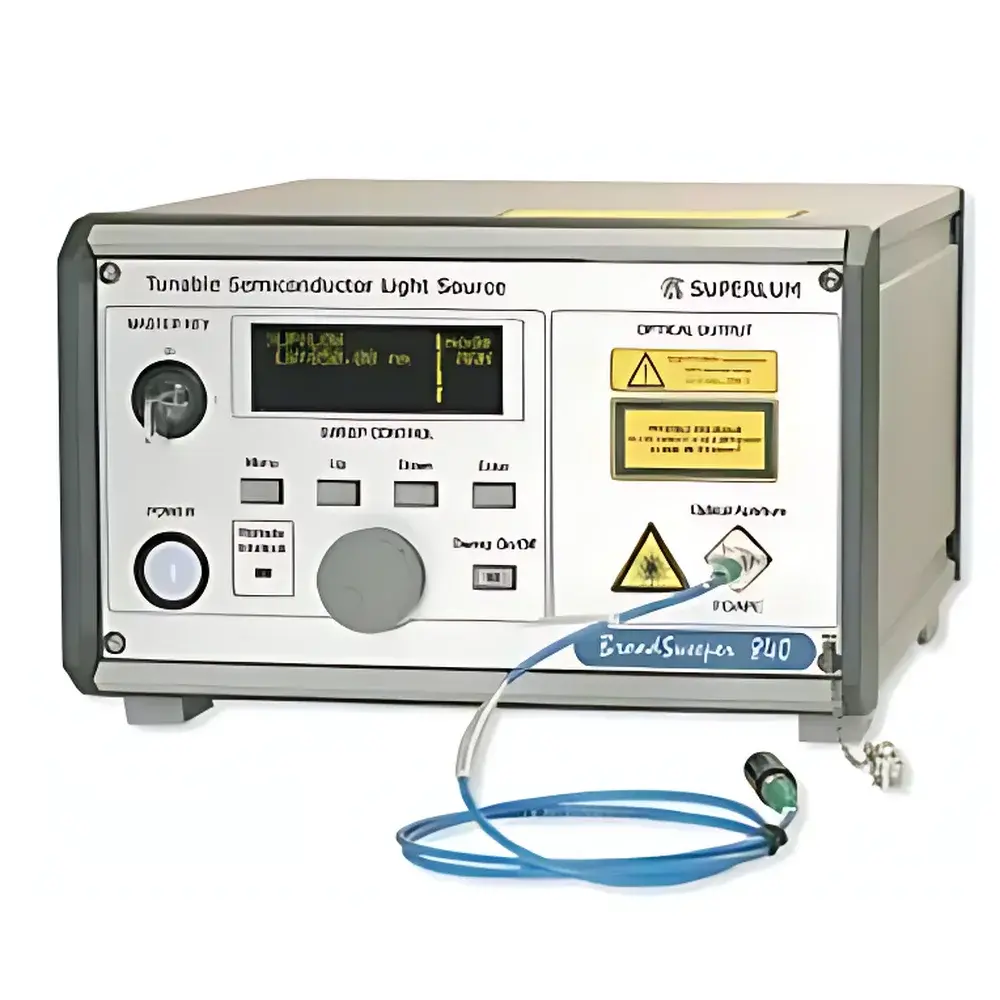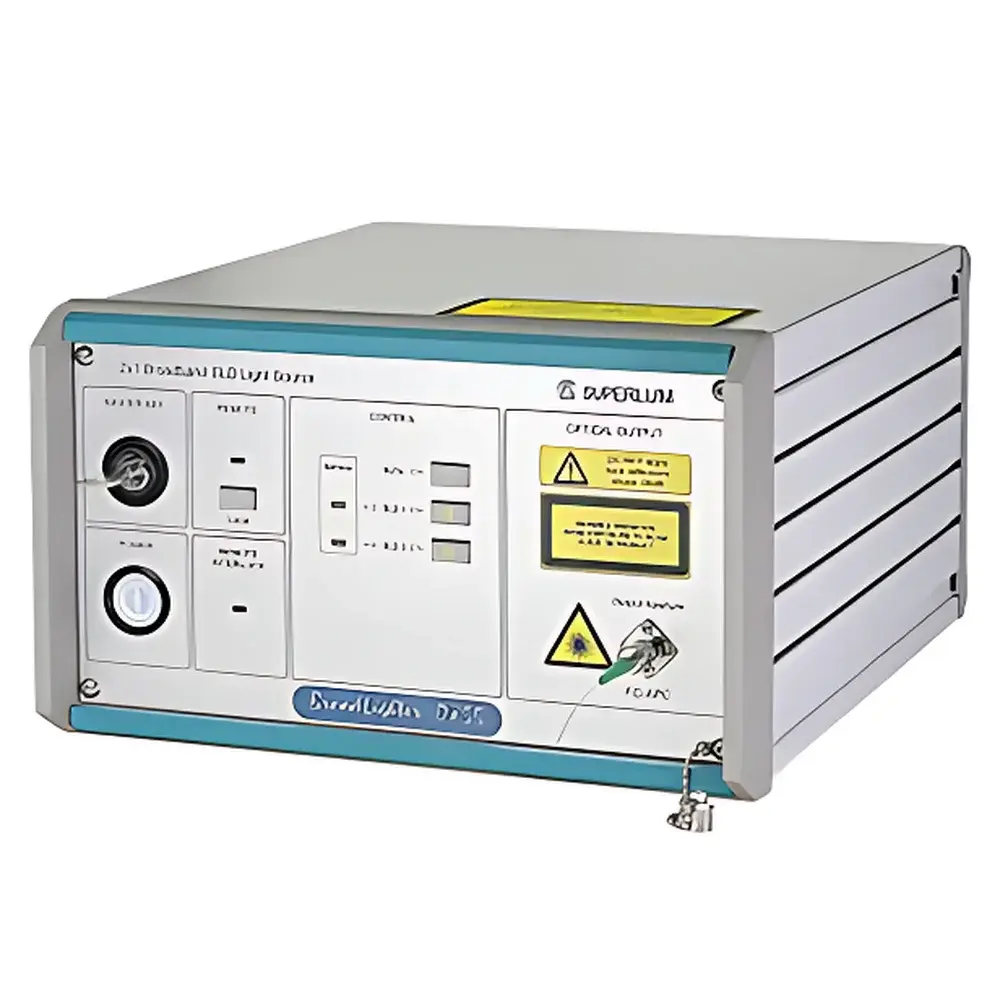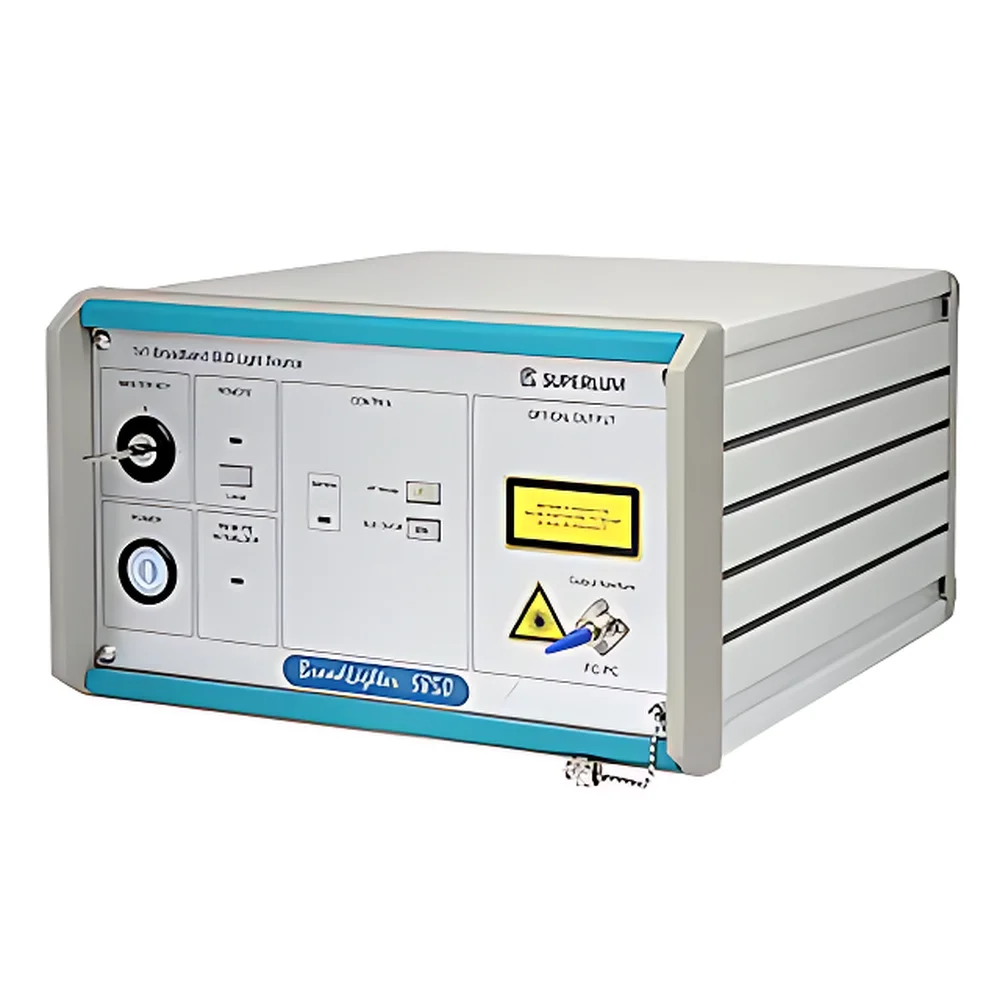
Superlum S-Series / D-Series / T-Series / Q-Series Broadband SLED Light Sources

| Brand | Superlum |
|---|---|
| Origin | Russia |
| Model Range | S-Series, D-Series, T-Series, Q-Series |
| Power Supply | 110 V AC or 220 V AC |
| Dimensions (S/D) | 254 × 158 × 318 mm |
| Dimensions (T/Q) | 470 × 157 × 327 mm |
| Weight (S/D) | 6.0 kg |
| Weight (T/Q) | 11.0 kg |
| Operating Temperature | 0 °C to +40 °C |
| Spectral Bands | 850 nm, 930 nm, 1300 nm |
| Output Configuration | Single-mode fiber-coupled (S/D), triple-fiber (T), quad-fiber (Q) |
| Coherence Length | < 20 µm (typical, wavelength-dependent) |
| Polarization Insensitive Optical Isolators | Standard on high-power variants |
| Control Interface | Analog modulation input |
Ask about pricing, availability and specifications.
Overview
Superlum S-Series, D-Series, T-Series, and Q-Series broadband superluminescent diode (SLED) light sources are engineered for precision optical metrology applications requiring low temporal coherence, high spectral power density, and exceptional radiometric stability. These benchtop instruments operate on the principle of amplified spontaneous emission (ASE) in semiconductor waveguides, delivering spectrally broad, spatially coherent, and temporally incoherent output—ideal for interferometric and coherence-gated measurement systems. Unlike lasers, SLEDs exhibit negligible mode structure and minimal coherence artifacts, making them indispensable for optical coherence tomography (OCT), white-light interferometry, and fiber-optic component characterization where coherence noise must be suppressed. Each series is optimized for distinct bandwidth, power, and channel-count requirements: the S-Series offers single-channel high-power operation; the D-Series integrates two spectrally offset SLED modules via a broadband fused-fiber coupler to extend effective bandwidth; the T-Series employs three independently tunable SLED emitters; and the Q-Series scales to four synchronized channels for ultra-broadband (>200 nm FWHM) spectral coverage across near-infrared windows (850 nm, 930 nm, 1300 nm).
Key Features
- Stable ASE-based broadband emission with spectral bandwidths up to 120 nm (FWHM), depending on central wavelength and series configuration
- Two operational modes: High-Power Mode (for measurement acquisition) and Low-Power Mode (for safe system alignment and calibration)
- Integrated polarization-insensitive optical isolators on all high-power variants to prevent back-reflection damage to SLED chips
- Thermoelectrically stabilized SLED modules with closed-loop temperature control ensuring ±0.05 °C thermal regulation
- Low-noise constant-current drivers with ripple < 10 µA RMS for intensity stability better than ±0.2 % over 8 hours
- Rugged aluminum chassis with EMI-shielded enclosure compliant with IEC 61326-1 for laboratory and industrial environments
- Front-panel LED indicators and status signaling via TTL-compatible digital outputs
Sample Compatibility & Compliance
All Superlum broadband light sources are compatible with standard single-mode fibers (SMF-28, HI1060, etc.) and integrate FC/APC or FC/PC connectors per customer specification. The devices meet electromagnetic compatibility (EMC) requirements per EN 61326-1:2013 and safety standards under IEC 61010-1:2010. They are designed for use in GLP-compliant laboratories and support audit-ready operation when paired with validated control software. While not FDA-cleared as medical devices, S- and D-Series units are widely deployed in Class I OCT development systems conforming to IEC 60601-2-66. All models comply with RoHS 2011/65/EU and REACH (EC) No. 1907/2006 directives. No laser classification applies—these are Class 1 LED-based products per IEC 60825-1:2014.
Software & Data Management
The T-Series and Q-Series include Superlum’s proprietary LightSource Control Software (LSCS), a Windows-based application supporting USB 2.0 communication for real-time parameter adjustment—including individual channel power scaling, modulation frequency selection (DC to 100 kHz), and thermal setpoint programming. LSCS logs timestamped operational data (temperature, drive current, output power estimates) in CSV format for traceability. For integration into automated test platforms, SCPI-like command sets and DLL libraries are provided for LabVIEW, Python (PySerial), and MATLAB environments. Firmware updates are performed via secure bootloader protocol with checksum validation. Audit trails—including user login, parameter changes, and session timestamps—are retained locally and exportable for ISO/IEC 17025 documentation workflows.
Applications
- Optical Coherence Tomography (OCT): Enables axial resolution down to ~5 µm (in tissue) through broad spectral bandwidth; used in ophthalmic, dermatological, and endoscopic OCT system development
- Fiber-Optic Component Characterization: Measures insertion loss, polarization-dependent loss (PDL), and group delay dispersion (GDD) of WDM filters, FBGs, circulators, and isolators
- White-Light Interferometry: Supports surface topography mapping and thin-film thickness metrology with sub-nanometer height resolution
- Fiber Metrology: Calibrates optical time-domain reflectometers (OTDRs) and chromatic dispersion analyzers across C- and O-bands
- Spectrometer Calibration: Provides stable, broadband reference spectra for NIST-traceable wavelength and irradiance calibration
FAQ
What is the typical coherence length of Superlum SLED sources?
Coherence length ranges from 15–25 µm (vacuum), depending on center wavelength and spectral bandwidth—e.g., ~22 µm at 1300 nm with 60 nm FWHM.
Can these sources be modulated externally?
Yes—S-, D-, and T/Q-Series accept analog voltage inputs (0–5 V) for direct intensity modulation up to 100 kHz; modulation linearity is >99.5 % over 0–90 % power range.
Do I need an external controller for basic operation?
No—all models are fully self-contained and operate directly from AC mains; only T/Q-Series require optional PC software for advanced multi-channel synchronization.
Are fiber pigtails replaceable in the field?
Standard FC/APC pigtails are factory-terminated and not user-replaceable; however, Superlum offers custom re-pigtail services with full recalibration and certification.
How is output power stability verified during manufacturing?
Each unit undergoes 72-hour burn-in with continuous monitoring of optical power (via integrated photodiode), temperature, and drive current; units failing ±0.3 % drift over 24 hours are rejected.
More from Superlum
View all Superlum products → Superlum SLD-HP-SM High-Power Superluminescent Diode Module
- Superlum SLD-261-MP / SLD-M381 / SLD-mCS / BS-785-1-HP* Broadband Light Sources for Spectral-Domain Optical Coherence Tomography (SD-OCT)
- Superlum SOA-332 to SOA-542 Series Semiconductor Optical Amplifiers
- Superlum S-series and D-series Benchtop Superluminescent Diode (SLD) Broadband Light Sources