
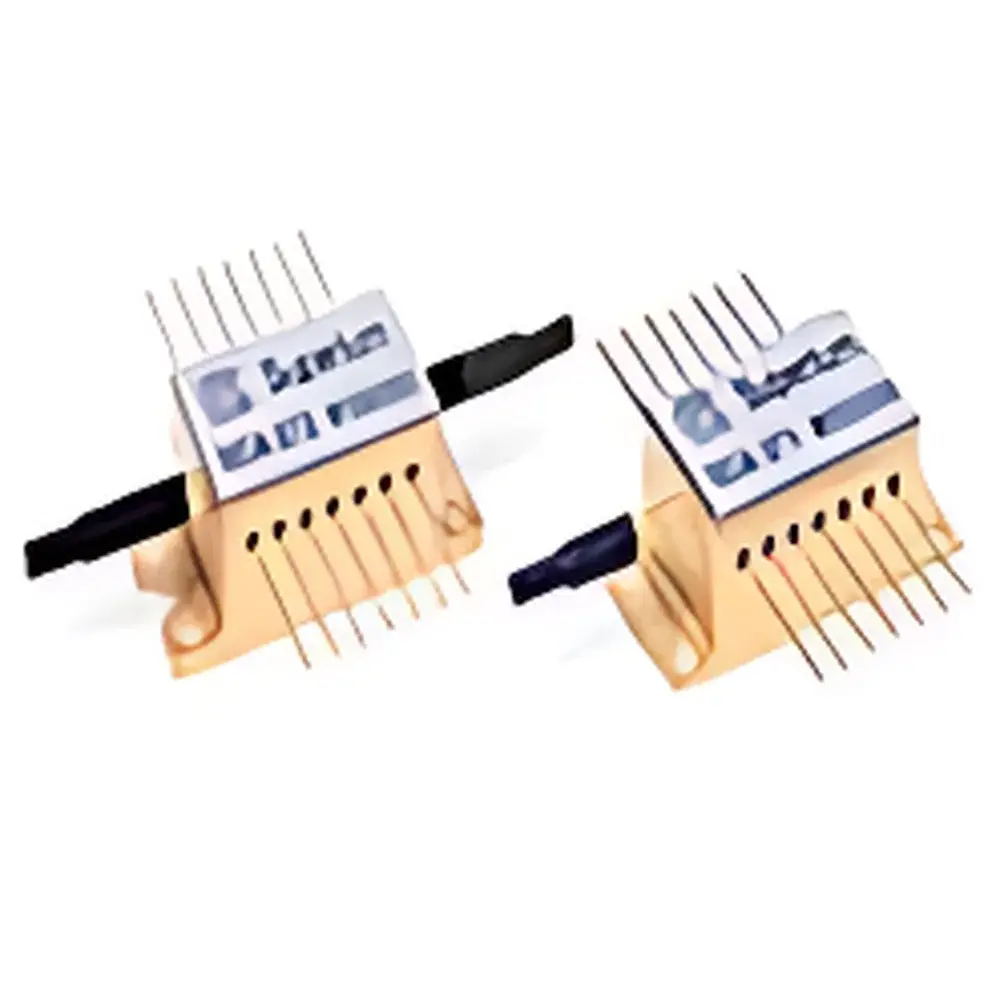
Superlum SOA-332 to SOA-542 Series Semiconductor Optical Amplifiers
| Brand | Superlum |
|---|---|
| Origin | Russia |
| Product Type | Semiconductor Optical Amplifier (SOA) |
| Wavelength Range | 780–1060 nm |
| Package | Butterfly with SM/PM Fiber Pigtail |
| Operating Current | 160–350 mA |
| Gain | 22–30 dB |
| Spectral Bandwidth (FWHM) | 20–95 nm |
| Compliance | RoHS-compliant, Telcordia GR-468-CORE qualified components |
Overview
The Superlum SOA-332 to SOA-542 series comprises a family of high-performance, broadband semiconductor optical amplifiers (SOAs) engineered for demanding applications in fiber-optic sensing, optical coherence tomography (OCT), swept-source laser systems, and laboratory-based photonics research. These devices operate on the principle of stimulated emission in a forward-biased semiconductor gain medium, providing moderate gain (22–30 dB) across a wide wavelength range from 780 nm to 1060 nm. Unlike erbium-doped fiber amplifiers (EDFAs), SOAs offer compact footprint, fast gain dynamics (<1 ns response time), polarization-sensitive or polarization-maintaining (PM) configurations, and compatibility with free-space or fiber-pigtailed integration. Each model is fabricated using strained quantum-well InGaAsP/InP heterostructures optimized for low noise figure (10 mW), and stable operation under constant-current biasing. Designed for use in Class 1 laser systems per IEC 60825-1, these SOAs are not standalone light sources but require external seed input—making them ideal as pre-amplifiers or inline boosters in low-coherence interferometric architectures.
Key Features
- Wavelength coverage spanning 780 nm to 1060 nm across 12 discrete models (e.g., SOA-332 at 785 nm, SOA-542 at 1060 nm)
- Gain values ranging from 22 dB to 30 dB, with spectral bandwidths (FWHM) between 20 nm and 95 nm depending on center wavelength and design
- Butterfly-style hermetically sealed package with integrated thermistor and TEC for precise temperature stabilization (±0.1 °C control)
- Single-mode (SM) or polarization-maintaining (PM) fiber pigtails available; standard connectorization: FC/APC or FC/PC
- Operating current range: 160–350 mA; maximum case temperature: +70 °C; storage temperature: –40 to +85 °C
- RoHS-compliant materials and Telcordia GR-468-CORE reliability testing performed on all active die and packaging assemblies
Sample Compatibility & Compliance
These SOAs are compatible with common low-power seed sources including superluminescent diodes (SLDs), distributed feedback (DFB) lasers, and tunable external-cavity lasers operating within their specified gain bandwidth. Integration into OCT systems requires attention to polarization alignment—PM-fiber versions (e.g., SOA-332-DBUT-PM) maintain extinction ratios >20 dB over temperature. All units comply with CE marking requirements for electromagnetic compatibility (EMC Directive 2014/30/EU) and low-voltage safety (LVD Directive 2014/35/EU). For regulated medical device development (e.g., OCT systems intended for clinical use), documentation packages include traceable calibration records, lot-specific MTRs (Material Test Reports), and conformity statements aligned with ISO 13485 quality system expectations.
Software & Data Management
While the SOA modules themselves are analog current-driven components without embedded firmware, they are routinely integrated into OEM systems controlled via LabVIEW, Python (PyVISA), or MATLAB environments using programmable current sources (e.g., Keithley 2400/2450, Thorlabs LDCxx series). Superlum provides comprehensive datasheets with L-I-V curves, gain-vs-wavelength plots, and thermal derating tables—each referenced to NIST-traceable optical power meters and OSA calibration standards. For GxP-aligned installations, audit trails for bias current settings, thermal setpoints, and operational logs can be implemented through third-party SCADA or electronic lab notebook (ELN) platforms compliant with FDA 21 CFR Part 11.
Applications
- Boosting optical power in fiber-based OCT engines while preserving axial resolution and sensitivity
- Compensating insertion loss in multi-channel interferometric sensor arrays (e.g., FBG or Michelson-type fiber sensors)
- Serving as gain elements in custom swept-source lasers with kHz–MHz tuning rates
- Enabling low-noise pre-amplification in time-domain reflectometry (OTDR) and distributed acoustic sensing (DAS) test benches
- Supporting university and national lab research in ultrafast optics, quantum photonics, and biophotonics where flexible, non-EDFA gain options are required
FAQ
Are these SOAs suitable for use in FDA-cleared medical devices?
Yes—when integrated into a validated system architecture with appropriate risk management (ISO 14971) and verification protocols, these components have been deployed in Class II OCT systems.
Do you provide PM-fiber versions with defined slow-axis alignment?
Yes—PM variants specify slow-axis orientation relative to the package reference mark (±2° tolerance); alignment documentation is included in shipment.
What is the typical noise figure for the SOA-472 (930 nm) model?
Measured noise figure is 6.2 dB ±0.4 dB at 25 dB small-signal gain, referenced to 300 K input noise floor.
Can these SOAs be operated in pulsed mode?
They support quasi-continuous wave (QCW) operation up to 1 MHz repetition rate with duty cycles ≤10%; full pulse shaping requires external modulation.
Is there a minimum order quantity (MOQ) for custom wavelength variants?
Standard models ship from stock; custom center wavelengths outside the listed 12 bands require minimum batch size of 25 units and 12-week lead time.





