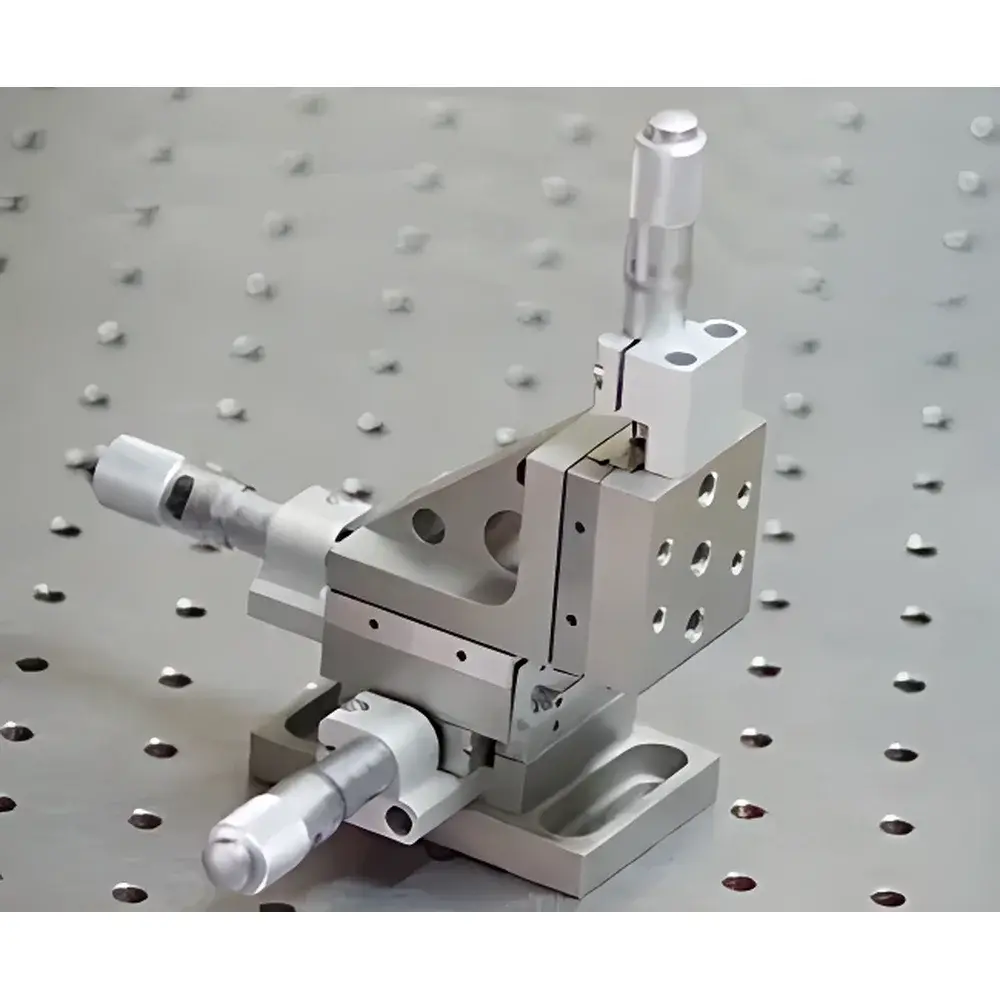
HTIMS304 Integrated Stainless Steel XYZ Translation Stage

| Brand | Han Ding / HT |
|---|---|
| Origin | Jiangsu, China |
| Manufacturer Type | Authorized Distributor |
| Product Category | Domestic |
| Model | HTIMS304 |
| Price | Upon Request |
| Type | Manual Translation Stage |
| Travel (X/Y/Z) | 13 mm |
| Guide Mechanism | High-Precision Crossed Roller Bearings |
| Drive | Differential Micrometer |
| Sensitivity | 0.002 mm |
| Material | Sandblasted Stainless Steel |
| Max Load | 7 kg |
| Weight | 1.3 kg |
| Handedness | Right-Handed (–R suffix) |
| Compliance | ISO 9001 Manufacturing Environment |
| Software Interface | None (Purely Manual Operation) |
Ask about pricing, availability and specifications.
Overview
The HTIMS304 Integrated Stainless Steel XYZ Translation Stage is a precision-engineered manual optical positioning platform designed for high-stability, multi-axis alignment in demanding laboratory and industrial metrology applications. Built upon the fundamental principle of orthogonal linear displacement via mechanical constraint and kinematic coupling, this stage delivers repeatable sub-micron positional control across three mutually perpendicular axes (X, Y, Z) within a compact monolithic housing. Unlike stacked or modular stage assemblies—which introduce cumulative orthogonality errors and mechanical compliance—the HTIMS304 employs an integrated structural architecture where all three axes are machined from a single stainless steel billet, ensuring inherent orthogonality, thermal homogeneity, and long-term dimensional stability. Its design conforms to core mechanical metrology requirements for optical alignment tasks including laser beam steering, interferometer cavity adjustment, fiber coupling optimization, and sensor calibration setups where environmental resilience and zero outgassing are critical.
Key Features
- Monolithic stainless steel construction with sandblasted surface finish—provides superior corrosion resistance, non-magnetic properties, and compatibility with UHV and cleanroom environments (ISO Class 5 and above).
- High-precision crossed roller bearings on all three axes—engineered for minimal wobble ( 12 N/µm).
- Differential micrometer drive (HTDM-13 compatible) with 0.002 mm resolution and spring-loaded backlash compensation—enables quantitative, repeatable positioning without manual nulling procedures.
- Integrated right-hand configuration (–R suffix) with standardized M4 and M6 tapped mounting holes—facilitates direct integration into Newport, Thorlabs, and custom optical breadboard systems.
- No external power or controller required—fully manual operation ensures electromagnetic immunity, zero EMI emission, and operational reliability in sensitive measurement environments such as cryogenic labs or MRI-adjacent setups.
Sample Compatibility & Compliance
The HTIMS304 supports optical components up to 7 kg—including lens mounts, mirror holders, photodetector modules, and micro-optical assemblies—with maintained positional fidelity under static load. Its stainless steel body meets ASTM F899 standard for wrought stainless steels used in precision instrumentation and complies with RoHS Directive 2011/65/EU for hazardous substance restriction. While not certified to ISO 10110 (optical element surface quality) or ISO 14644 (cleanroom particulate control) per se, its surface finish and material selection align with best practices for Class 1000 cleanroom-compatible hardware. The absence of lubricants or polymer seals eliminates hydrocarbon contamination risk—making it suitable for vacuum applications down to 1×10⁻⁶ mbar when properly baked.
Software & Data Management
The HTIMS304 operates exclusively in manual mode and does not incorporate electronic encoders, stepper motors, or digital interfaces. Consequently, it requires no firmware, driver installation, or software configuration. Position tracking is achieved solely through the calibrated differential micrometer scale (0–13 mm range, 0.002 mm graduation), with optional third-party optical encoders (e.g., Renishaw RESOLUTE™) mountable via user-defined bracketing. For traceable calibration records, users may log micrometer readings alongside environmental parameters (temperature, humidity) in accordance with GLP documentation protocols. No FDA 21 CFR Part 11 compliance is applicable due to the absence of electronic data generation or storage.
Applications
- Laser cavity alignment in Ti:sapphire and fiber laser systems requiring sub-5 µm beam pointing stability.
- Fiber-to-fiber or fiber-to-waveguide coupling in photonic integrated circuit (PIC) packaging and testing.
- Adjustment of reference mirrors in Michelson, Mach–Zehnder, and Twyman–Green interferometers.
- Positioning of detectors and apertures in spectral radiometry and quantum optics experiments.
- Stable platform for atomic force microscopy (AFM) sample stages where magnetic interference must be avoided.
- Calibration fixture for coordinate measuring machines (CMMs) and vision-based metrology systems.
FAQ
Is the HTIMS304 compatible with vacuum environments?
Yes—its all-stainless-steel construction, absence of adhesives or elastomers, and dry-running crossed roller bearings support operation in high vacuum (HV) and ultra-high vacuum (UHV) systems after proper cleaning and bake-out.
Can left-hand versions be supplied?
Yes—HTIMS304(L) is available upon request; all mechanical specifications remain identical except for mirrored micrometer orientation and mounting hole layout.
What is the recommended maintenance interval?
No scheduled maintenance is required; periodic inspection of micrometer threads and bearing surfaces for particulate accumulation is advised every 12 months in cleanroom use.
Does the stage include mounting hardware?
Standard delivery includes M4 cap screws and washers for base attachment; optical component mounting hardware is selected based on user-specific interface requirements (e.g., SM1, SM2, or custom flanges).
How is orthogonality verified during manufacturing?
Each unit undergoes laser interferometric verification of axis orthogonality using a Zygo GPI interferometer, with results documented in the出厂 calibration report (±0.5 arcsec maximum deviation per pair of axes).