
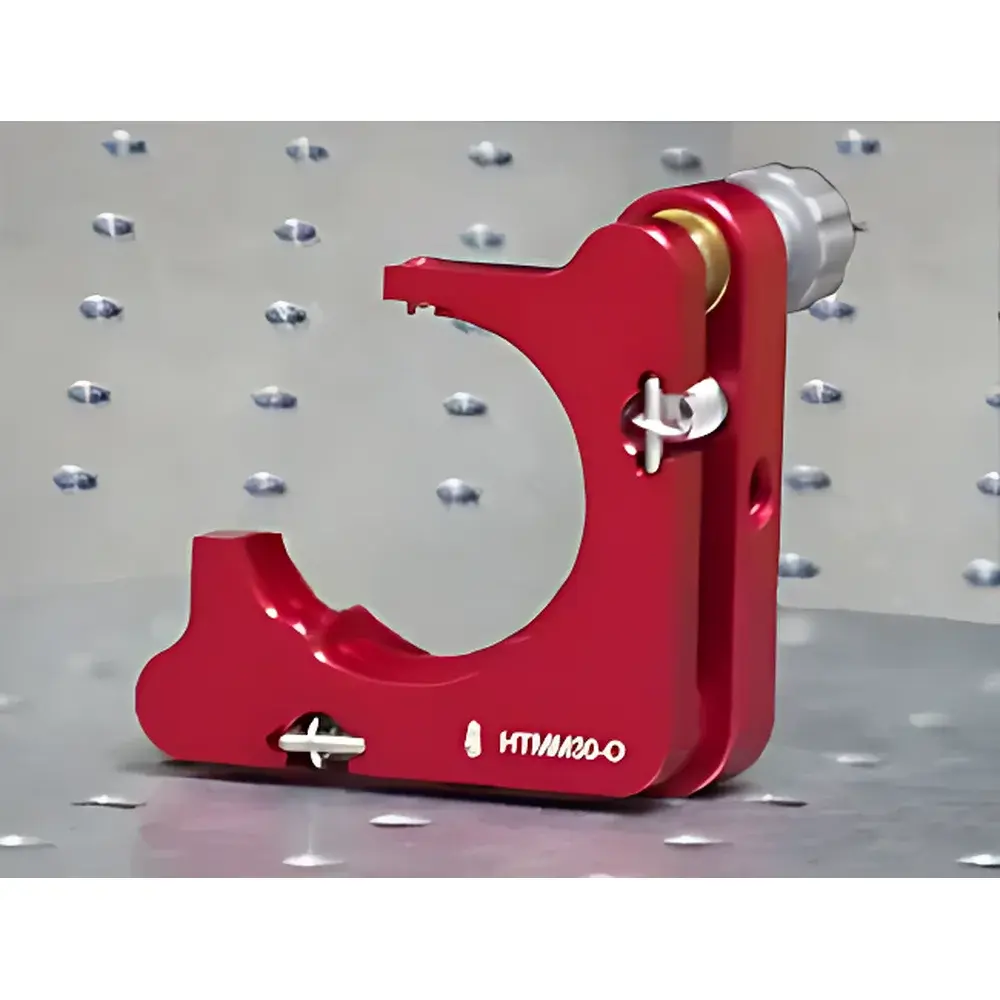
HTMM30-O Open-Type Two-Axis High-Stability Optical Mirror Mount
| Brand | Han Ding / HT |
|---|---|
| Origin | Jiangsu, China |
| Manufacturer Type | Authorized Distributor |
| Country of Origin | China |
| Model | HTMM30-O |
| Pricing | Available Upon Request |
Overview
The HTMM30-O is an open-type, two-axis kinematic optical mirror mount engineered for high mechanical stability and precise angular adjustment in demanding optical alignment applications. Designed around a rigid, low-profile aluminum alloy chassis with precision-machined kinematic interfaces, it employs differential micrometer drives (typically 100 µm/rev with 1 µm graduation) for independent, backlash-free control of pitch and yaw. Its open architecture eliminates obstructive side plates, enabling unimpeded access to the optical path and compatibility with spatially constrained setups—such as multi-beam interferometers, ultrafast laser beam combiners, or vacuum-compatible optical tables. The mount accepts optics up to 30 mm in diameter with a standard SM30-threaded retaining ring (M30×0.75), ensuring secure, centration-accurate clamping without induced stress or distortion. It operates on fundamental principles of kinematic constraint: three-point contact (two adjustable tip/tilt actuators + one fixed pivot point) guarantees deterministic, repeatable positioning with minimal hysteresis (< 2 arcsec over full range) and thermal drift < 3 µrad/°C under ambient lab conditions.
Key Features
- Open-frame design for unrestricted optical access and integration into dense optical layouts
- Two orthogonal, independently adjustable axes (pitch and yaw) with fine-pitch differential screws (100 µm/rev, engraved scale)
- SM30-threaded optic retention system (M30×0.75) compatible with standard 30 mm mirrors, windows, and beamsplitters
- High-stiffness 6061-T6 aluminum construction with black anodized finish for corrosion resistance and low outgassing
- Kinematic mounting geometry ensures sub-arcsecond repeatability and minimal center-of-rotation offset (< 0.1 mm)
- Integrated locking screws for coarse position fixation prior to fine adjustment
- No internal springs or elastomers—designed for long-term dimensional stability in vibration-sensitive environments
Sample Compatibility & Compliance
The HTMM30-O accommodates plano and wedged optics ranging from 25 mm to 30 mm in diameter and up to 12 mm in thickness, provided surface flatness meets λ/10 or better at 633 nm. It supports both protected aluminum and dielectric-coated substrates (e.g., fused silica, BK7, CaF₂). Mounting does not require adhesive bonding or epoxy; all adjustments remain fully reversible and non-damaging to coated surfaces. While not certified to ISO 9001 at the component level (as a distributor-supplied mechanical mount), the design adheres to widely accepted optical engineering practices referenced in ISO 10110-7 (surface imperfection tolerancing) and ANSI/OEOSC OP1.002 (optomechanical interface standards). It is routinely deployed in laboratories operating under GLP-compliant protocols for laser cavity alignment, spectroscopic calibration, and metrology-grade interferometric setup.
Software & Data Management
As a passive mechanical mount, the HTMM30-O requires no firmware, drivers, or software integration. All positional data are manually recorded via engraved micrometer scales and verified using external metrology tools—including autocollimators (e.g., Thorlabs AC100 series), digital theodolites, or laser tracker systems (e.g., Leica AT960). For labs implementing electronic logbooks or LIMS, angular settings may be documented alongside timestamps and operator IDs to satisfy audit requirements under 21 CFR Part 11 when used in regulated analytical workflows (e.g., reference beam alignment in FTIR validation). No proprietary configuration files or calibration certificates are generated or required.
Applications
- Precision alignment of cavity mirrors in CW and pulsed laser resonators (including Ti:sapphire, fiber, and DPSS systems)
- Beam steering and pointing stabilization in heterodyne interferometry and gravitational wave detector prototype setups
- Adjustment of dichroic filters and polarizing beamsplitters in multi-wavelength fluorescence microscopy platforms
- Mounting of reference optics in portable Raman spectrometers where thermal and mechanical robustness is critical
- Integration into custom-built optical coherence tomography (OCT) sample arms requiring minimal footprint and high rigidity
- Educational use in university optics labs for teaching kinematic design principles and error budget analysis
FAQ
What is the maximum recommended optic weight for stable operation?
For optimal dynamic stability and minimal creep under gravity loading, optics should not exceed 180 g. Heavier loads (>250 g) may reduce angular resolution and increase settling time after adjustment.
Is the mount vacuum-compatible?
Yes—the anodized aluminum body and stainless steel adjustment screws are compatible with medium vacuum (10⁻⁵ mbar) when baked to ≤80°C. Avoid silicone-based lubricants; dry-running micrometer threads are standard.
Can I retrofit this mount with motorized actuators?
The HTMM30-O does not include motorization provisions. However, its 4-40 UNC threaded adjustment ports accept third-party stepper motor couplers (e.g., Zaber T-CA series) with appropriate custom adapters—mechanical modifications void warranty.
Does it include a mounting base plate?
No. The mount features four M4 through-holes on 40 mm × 40 mm spacing for direct bolt-down to optical tables or breadboards. Base plates must be sourced separately per application requirements.
What tolerance is guaranteed on centering accuracy after mounting a 30 mm optic?
With proper torque control (0.3–0.5 N·m on retaining ring), radial decentering remains within ±7.5 µm relative to the SM30 thread axis, verified per ISO 10110-1 guidelines.




