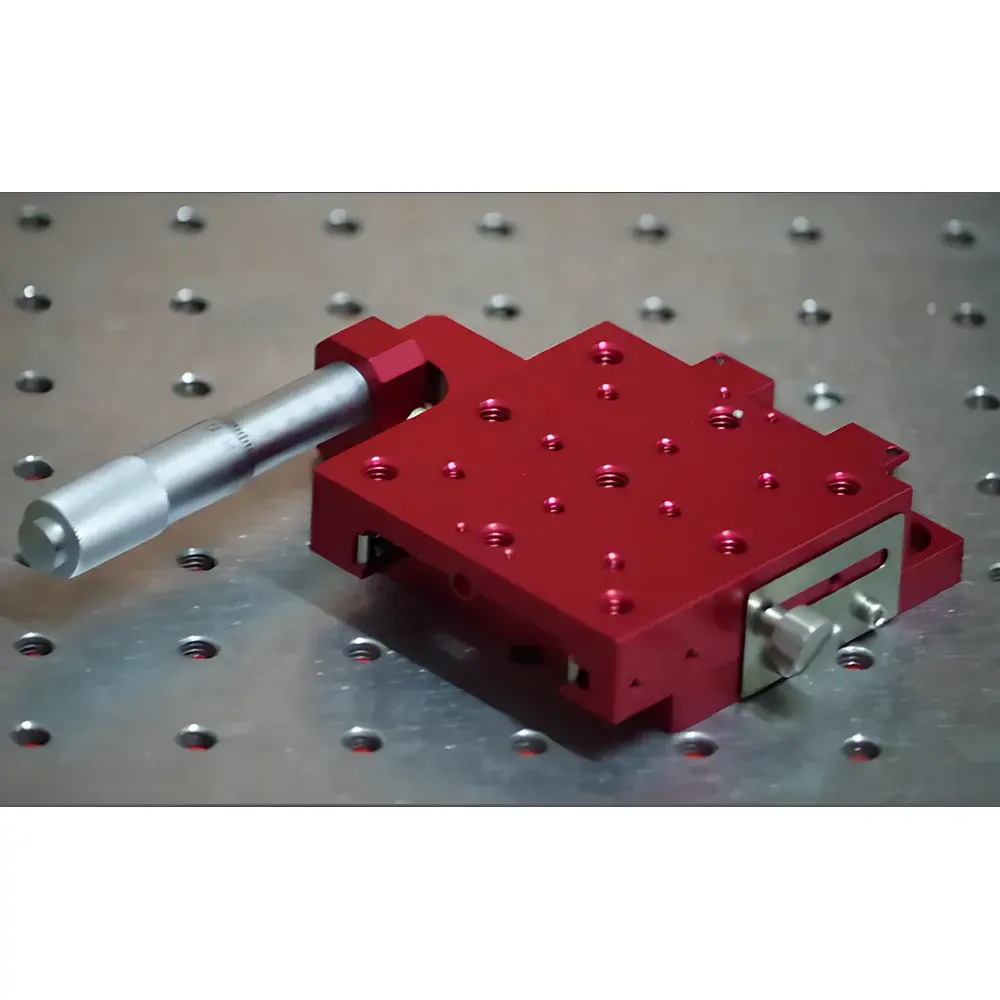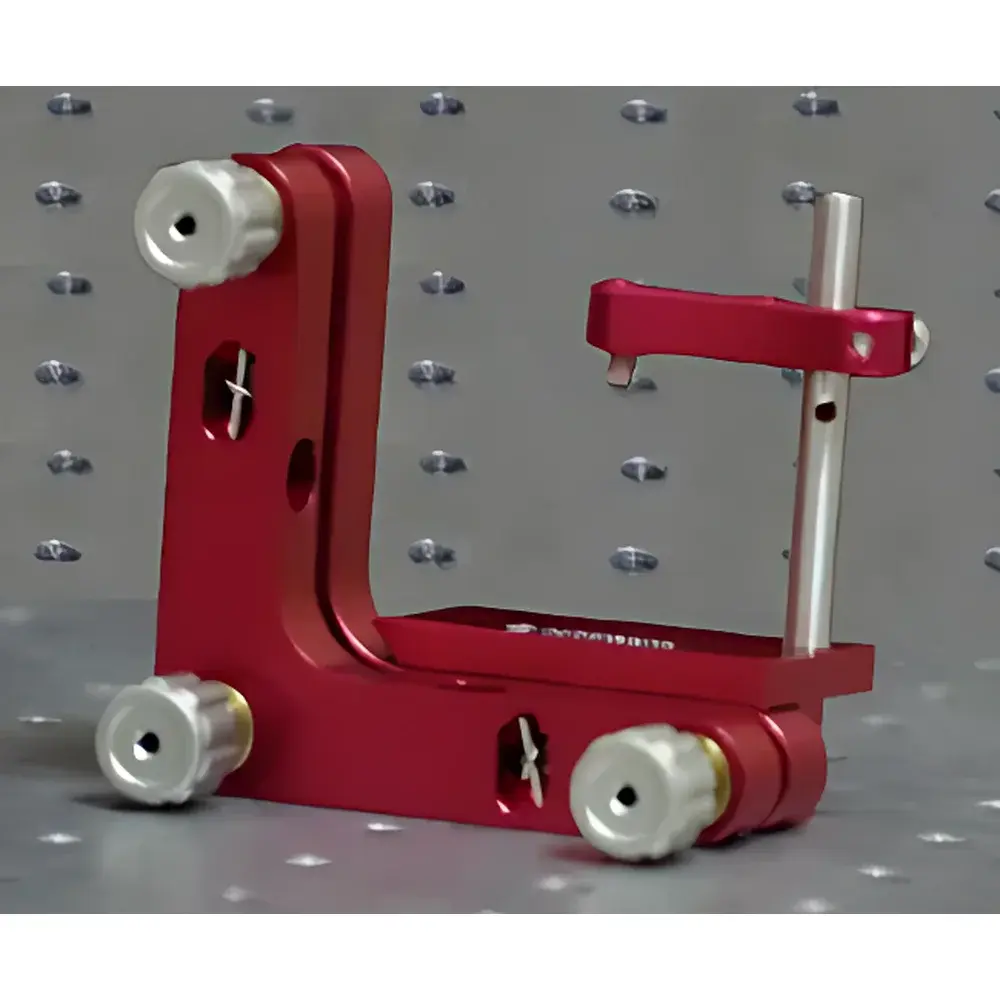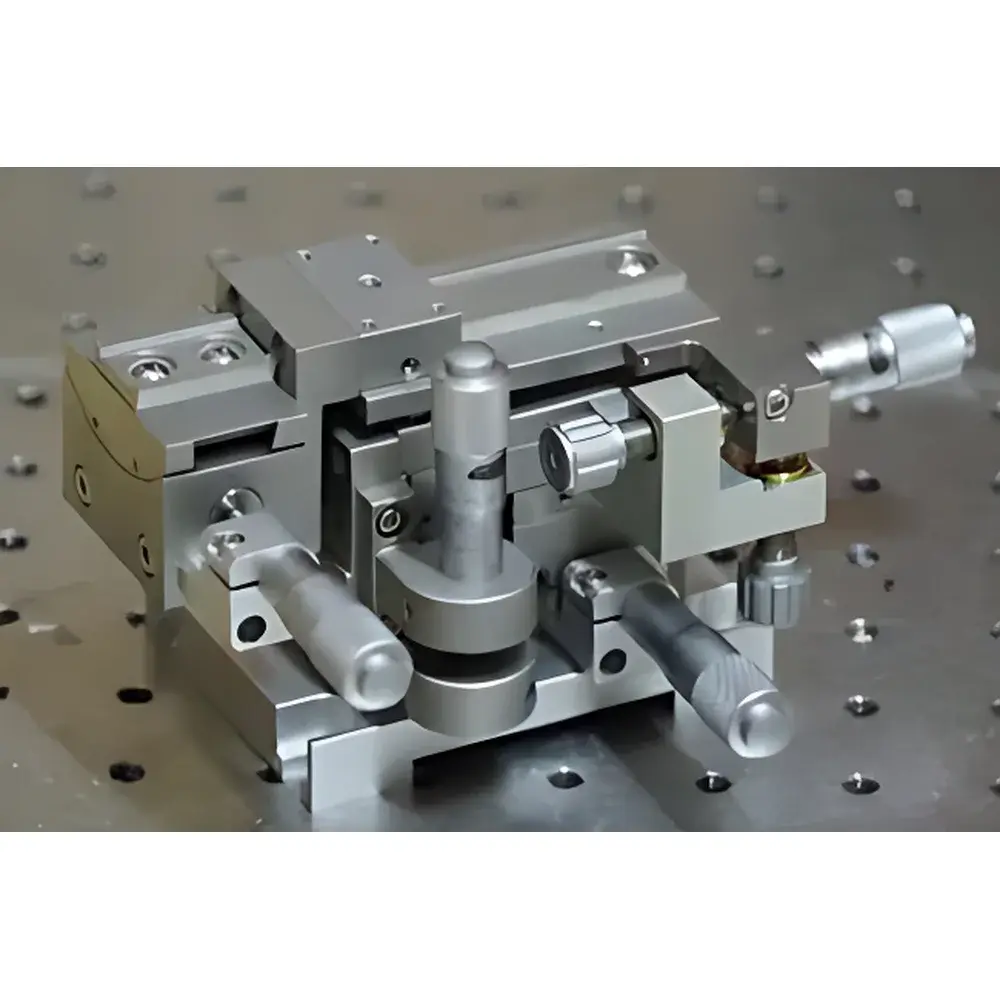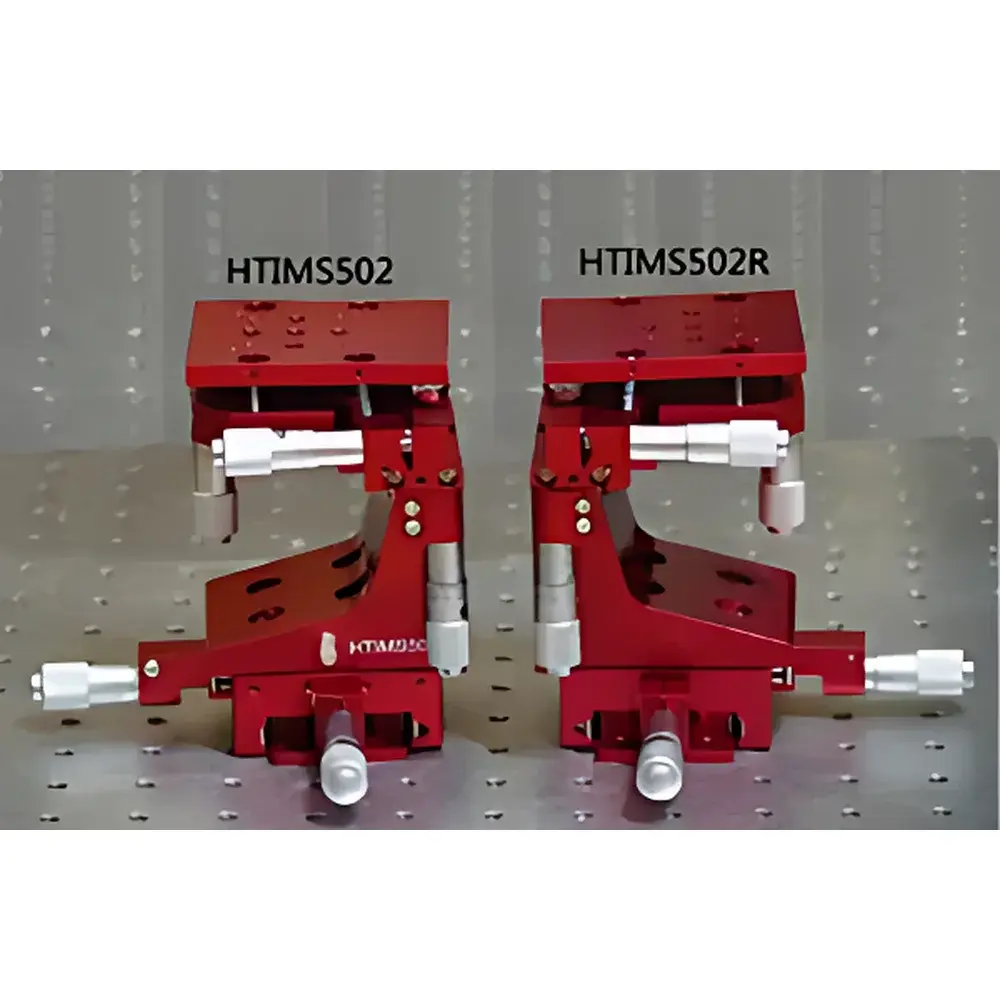
HTIMS502 Integrated 5-Axis Manual Translation and Rotation Stage (XYZθXθZ)

| Brand | HT |
|---|---|
| Model | HTIMS502 |
| Travel | X/Y/Z = 13 mm, θX/θZ = ±7° (fine adjustment), θY/θZ continuous rotation = 360° |
| Drive Mechanism | Differential micrometer |
| Sensitivity | 0.002 mm per division |
| Guide System | Precision linear ball-bearing rails with ground steel shafts |
| Load Capacity | 3.5 kg |
| Weight | 1.1 kg |
| Material | Anodized aluminum (red anodized finish) |
| Compliance | ISO 9001-manufactured components |
| Origin | Jiangsu, China |
| Product Type | Manual optical translation stage |
Ask about pricing, availability and specifications.
Overview
The HTIMS502 is an integrated, manually operated 5-axis optical positioning stage engineered for high-precision spatial alignment in demanding optical and photonics laboratories. Unlike stacked or modular multi-axis solutions, this monolithic design achieves true mechanical orthogonality across all motion axes—X, Y, Z translational movement and θX (pitch), θZ (yaw) angular adjustment—within a compact, rigid aluminum chassis. Its architecture follows classical kinematic principles for minimal Abbe error and crosstalk: each axis employs precision-ground steel shafts paired with preloaded linear ball bearings, ensuring repeatable sub-micron positioning stability under static and quasi-static loading conditions up to 3.5 kg. The stage does not incorporate motorized actuation or electronic feedback; instead, it relies on calibrated differential micrometers with 0.002 mm resolution and spring-loaded backlash compensation—making it suitable for applications where deterministic manual control, thermal stability, and electromagnetic immunity are prioritized over automation.
Key Features
- Monolithic 5-axis architecture (X, Y, Z, θX, θZ) with inherent orthogonality—no cumulative alignment error from stacked stages
- Precision linear ball-bearing guide system using hardened, ground stainless steel shafts for low-hysteresis, high-repeatability motion
- Differential micrometer drives with 0.002 mm graduation and integral tension-spring preload to eliminate backlash and ensure consistent tactile feedback
- Anodized aluminum construction (red finish) offering optimal stiffness-to-weight ratio (1.1 kg total mass) and corrosion resistance
- Continuous 360° rotation capability on both θY and θZ axes, with fine angular adjustment range of ±7° for pitch and yaw via dedicated micrometers
- Standardized mounting interface: M4 and M6 tapped holes on base and top plate conforming to common optical breadboard grid patterns (25 mm and 1 inch spacing)
Sample Compatibility & Compliance
The HTIMS502 is compatible with standard optical components including lenses, mirrors, fiber couplers, detectors, and small laser diodes. Its 13 mm linear travel and ±7° fine angular range support beam steering, focus optimization, and collimation alignment in free-space optical setups. The stage meets mechanical dimensional tolerances aligned with ISO 10110-7 (optical component mounting interfaces) and is manufactured under ISO 9001-certified processes. While inherently non-electronic and thus exempt from CE/UKCA electromagnetic compatibility directives, its material selection (anodized Al6061-T6) and surface treatment comply with RoHS 2011/65/EU Annex II substance restrictions. It is routinely deployed in environments requiring GLP-compliant documentation of manual alignment procedures—particularly in university teaching labs, metrology calibration workflows, and OEM optical subsystem integration where traceable, operator-controlled positioning is mandated.
Software & Data Management
As a purely manual mechanical device, the HTIMS502 does not include embedded electronics, firmware, or software interfaces. Position data is recorded manually using the engraved micrometer scales and documented in laboratory notebooks or LIMS-compatible spreadsheets. For digital workflow integration, users may pair the stage with external coordinate measurement systems (e.g., laser interferometers or vision-based metrology tools) whose output can be logged into compliant audit-trail systems satisfying FDA 21 CFR Part 11 requirements for electronic records. No proprietary drivers, SDKs, or configuration utilities are provided or required.
Applications
- Free-space optical alignment in interferometry, holography, and coherent beam combining setups
- Fiber-optic coupling optimization for single-mode pigtails and photonic integrated circuits
- Calibration of wavefront sensors and Hartmann-Shack arrays requiring precise tilt and decenter control
- Teaching laboratory experiments in geometrical optics, polarization manipulation, and laser cavity alignment
- OEM integration into portable spectroscopic or imaging platforms where EMI-free operation and zero power consumption are critical
- Alignment of micro-opto-electro-mechanical systems (MOEMS) and MEMS mirror assemblies during prototyping and testing
FAQ
Is the HTIMS502 compatible with vacuum environments?
No—standard anodization and lubricants are not UHV-rated; custom vacuum-compatible versions with dry-film lubrication and bare aluminum or stainless steel alternatives are available upon engineering consultation.
Can the stage be mounted vertically or inverted?
Yes—the symmetric structural design and balanced load distribution allow orientation flexibility; however, gravitational sag effects on fine angular adjustment should be verified experimentally at maximum payload.
What is the typical bidirectional repeatability across all axes?
Under controlled lab conditions (23 ± 1°C, <40% RH), repeatability is ≤ ±1.5 µm for linear axes and ≤ ±3 arcsec for fine angular adjustments, based on 10-cycle micrometer retrace testing per ISO 230-2 Annex B.
Are left-hand and right-hand configurations available?
Yes—HT offers mirrored pairs (LH/RH) as standard for stereo or dual-beam configurations; ordering requires explicit specification of handedness at quotation stage.
Does HT provide calibration certificates traceable to NIST or other national standards?
Traceable calibration reports (including micrometer scale verification and orthogonal deviation mapping) are available as optional add-ons per ISO/IEC 17025-accredited third-party providers upon request.