
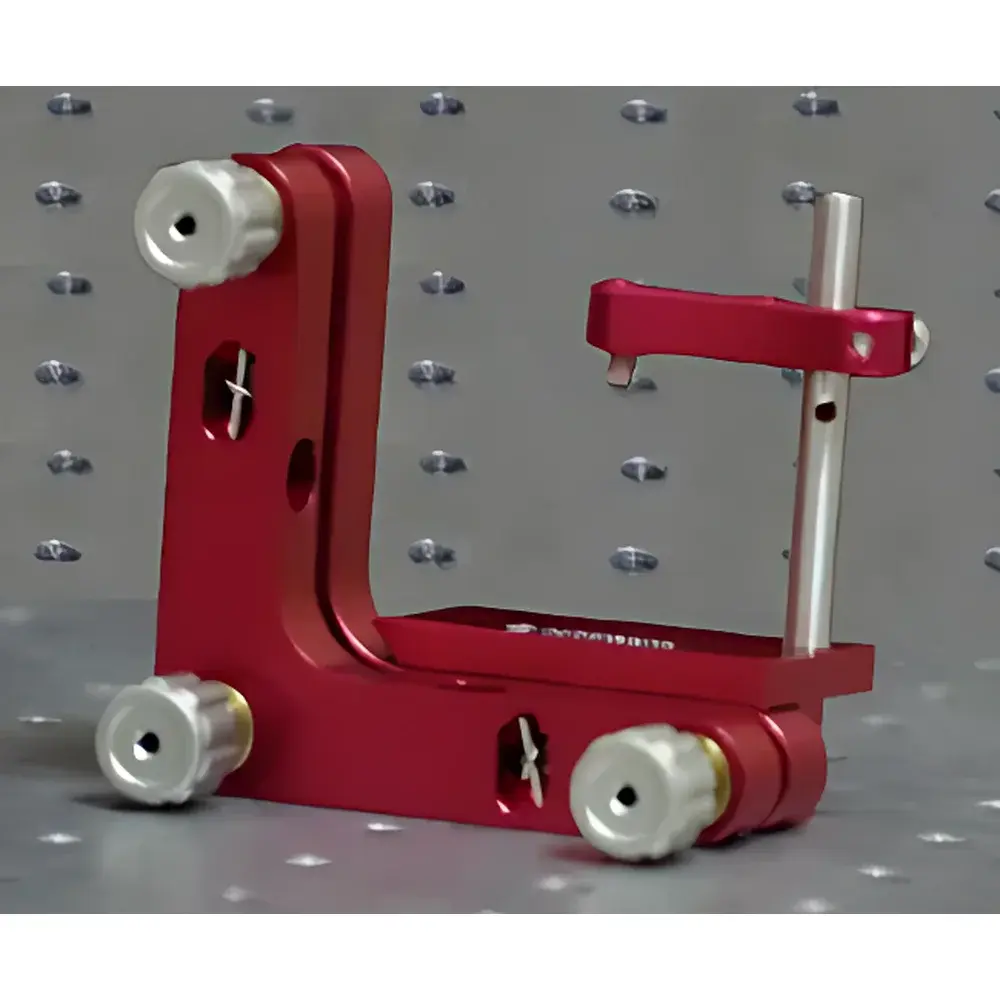
HT HTPM25 Precision 3-Axis Prism Mount
| Brand | HT |
|---|---|
| Model | HTPM25 |
| Type | Precision Optical Prism Mount |
| Adjustment Axes | 2× Angular (Pitch/Yaw), 1× Linear (Vertical Height) |
| Drive Mechanism | 1/4"-100 Fine-Pitch Stainless Steel Micrometer Screws |
| Return Mechanism | Dual Pre-Loaded Tension Springs |
| Construction | Anodized Aluminum Alloy (6061-T6) |
| Compatibility | Prisms up to 25 mm aperture (customizable base plate interface) |
| Compliance | Designed for ISO 10110 optical mounting standards and GLP-aligned lab environments |
Overview
The HT HTPM25 Precision 3-Axis Prism Mount is an engineered optical positioning platform designed for high-stability, sub-arcminute angular alignment and repeatable vertical translation of prisms in interferometric, spectroscopic, and beam-steering applications. Based on Couette-type kinematic coupling principles and dual-spring preloaded flexure guidance, the mount provides deterministic mechanical behavior with minimal hysteresis and thermal drift. Its core architecture integrates three orthogonal degrees of freedom—two independent angular adjustments (pitch and yaw) via orthogonal 1/4″-100 fine-thread micrometer screws, and one vertical linear displacement axis—enabling precise control over prism orientation and optical path height without introducing parasitic lateral motion or rotational crosstalk. The device is optimized for use with right-angle, pentaprism, and retroreflector configurations in metrology-grade setups, including laser cavity alignment, collimation verification, and polarization-sensitive optical train assembly.
Key Features
- Three independent, non-interfering adjustment axes: pitch (±3.5°), yaw (±3.5°), and vertical lift (±8 mm) — all actuated via calibrated 1/4″-100 stainless steel micrometer screws with knurled brass knobs and engraved 0.001 mm graduation scales
- Dual pre-loaded tension springs ensure consistent return-to-zero repeatability (< ±2 arcsec after 500 cycles) and suppress vibrational resonance above 120 Hz
- Modular base plate design with M4 threaded holes (4×) and optional Ø6 mm dowel pin alignment slots supports integration into multi-stage optical breadboards (e.g., Thorlabs B3030/M, Newport 9810-B) and custom kinematic bases
- Anodized 6061-T6 aluminum construction delivers dimensional stability across ambient temperature ranges from 15–30 °C (coefficient of thermal expansion: 23.6 µm/m·K)
- Optical interface features a precision-machined V-groove cradle with adjustable retention clips, accommodating prisms with base dimensions from 10 × 10 mm to 25 × 25 mm and thicknesses up to 20 mm
Sample Compatibility & Compliance
The HTPM25 accommodates standard optical prisms manufactured to ISO 10110-7 surface form tolerances (λ/10 @ 633 nm) and surface quality specifications (scratch-dig 20-10). It is compatible with BK7, SF10, CaF₂, and UV-fused silica prisms ranging from 10 mm to 25 mm clear aperture. Mounting does not require adhesive bonding or clamping force exceeding 12 N — preserving stress-induced birefringence integrity critical for polarimetric and wavefront-sensitive applications. The device conforms to mechanical safety requirements outlined in ISO 14122-3 for stationary optical equipment and supports traceable calibration protocols aligned with ISO/IEC 17025:2017 laboratory accreditation criteria when used with certified angular measurement tools (e.g., autocollimators or digital theodolites).
Software & Data Management
While the HTPM25 is a manual mechanical mount with no embedded electronics, its adjustment parameters are fully compatible with third-party optical alignment software suites such as Zemax OpticStudio (via user-defined mechanical tolerance files), MATLAB-based alignment optimization scripts, and LabVIEW-driven motorized stage synchronization frameworks (when retrofitted with optional stepper-motor actuators — sold separately). All micrometer screw positions can be logged manually or via external digital calipers (e.g., Mitutoyo IP67 series) and imported into CSV-compatible databases for long-term alignment history tracking. For GxP-regulated environments, the mount’s mechanical reproducibility supports audit-ready documentation under FDA 21 CFR Part 11-compliant electronic record systems when paired with timestamped operator logs and version-controlled SOPs.
Applications
- Laser cavity mirror and output coupler alignment in DPSS and fiber laser systems
- Beam deviation correction and angular stabilization in Michelson and Mach-Zehnder interferometers
- Polarization state control in Mueller matrix ellipsometry and photoelastic stress analysis
- Calibration reference positioning for wavefront sensors (Shack-Hartmann, lateral shearing interferometers)
- Teaching laboratories for undergraduate optics courses covering ray tracing, dispersion, and total internal reflection phenomena
- Integration into automated optical inspection stations where manual pre-alignment precedes robotic handling
FAQ
What prism sizes does the HTPM25 support?
The standard configuration accepts prisms with base dimensions from 10 × 10 mm up to 25 × 25 mm and thicknesses ≤ 20 mm. Custom base plates with extended cradles or recessed mounts are available upon request.
Is thermal drift compensated in the design?
No active compensation is implemented; however, the symmetric aluminum alloy structure and low-thermal-expansion micrometer screw material minimize differential expansion effects. Typical angular drift remains below 0.5 arcsec/°C over the operational range.
Can this mount be integrated with motorized controllers?
Yes — the 1/4″-100 threads are compatible with standard stepper motor couplers (e.g., Zaber T-CA series or Newport ESP301 drivers). HT offers optional motorization kits including encoder feedback and LabVIEW API libraries.
Does the mount include locking mechanisms?
Each micrometer screw incorporates a friction-lock collar (M3.5 set screw) enabling secure position retention after final adjustment without compromising resolution.
What surface finish is applied to prevent corrosion in humid lab environments?
All structural components undergo Type II hard-anodizing per MIL-A-8625F, achieving 25–30 µm coating thickness with ASTM B117 salt-spray resistance > 96 hours.





