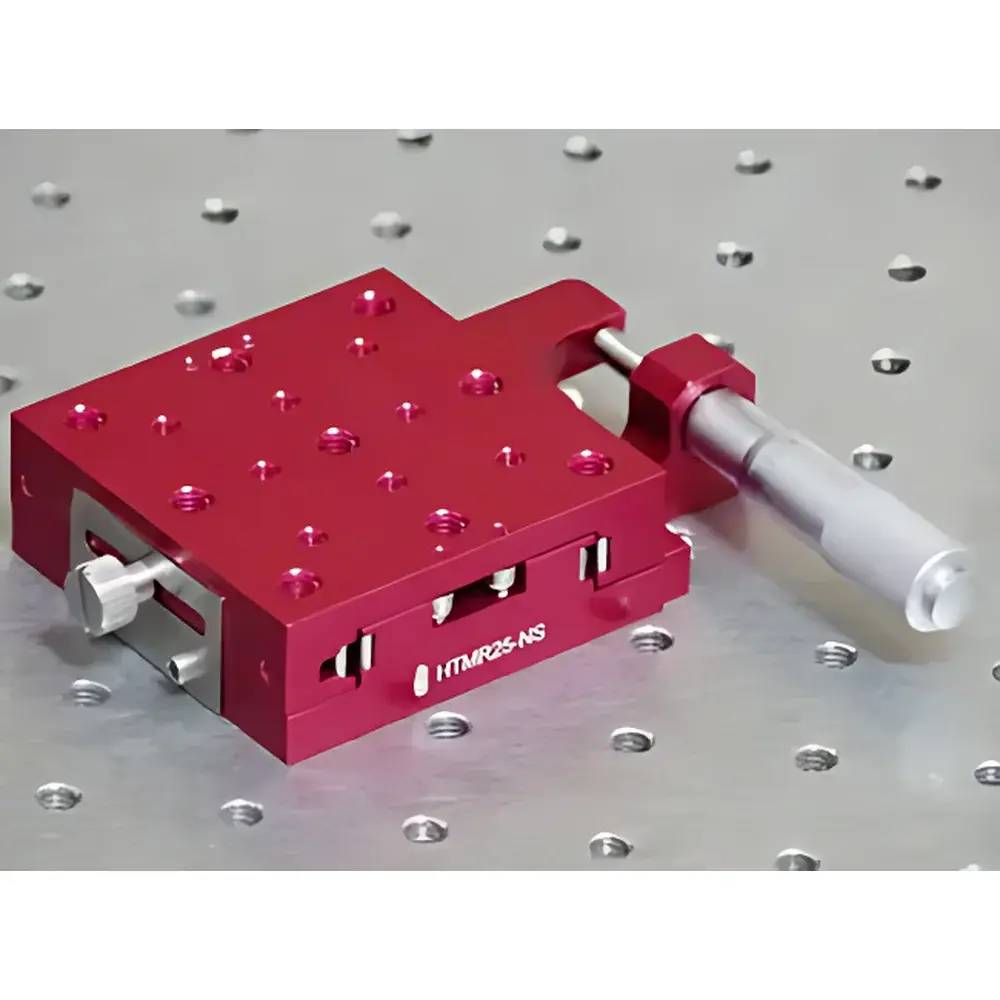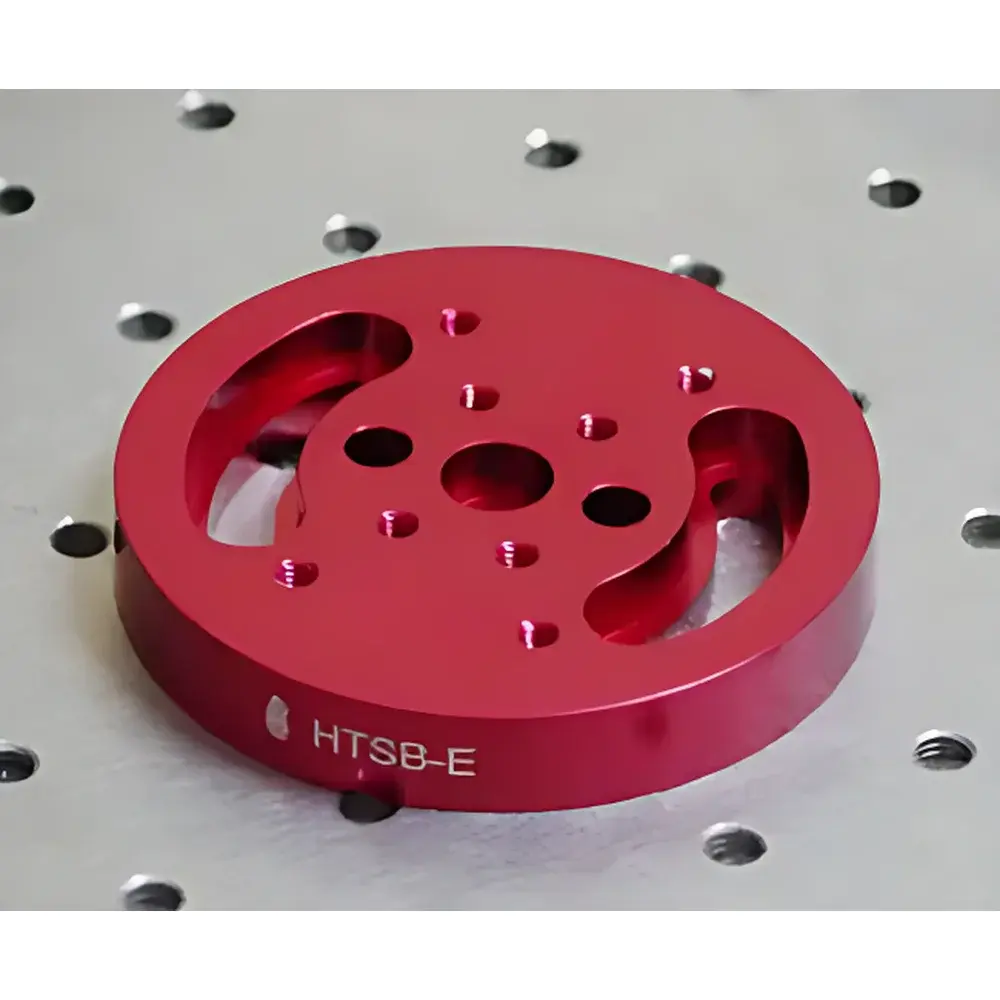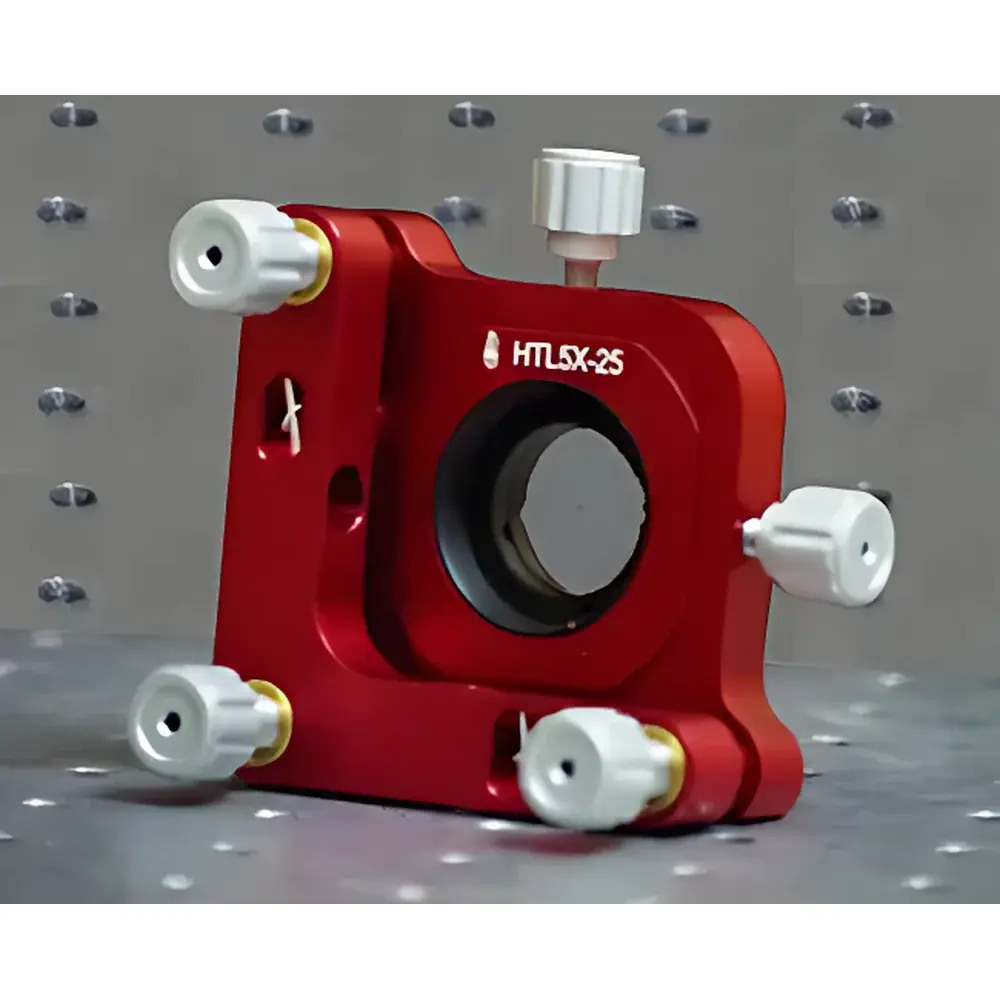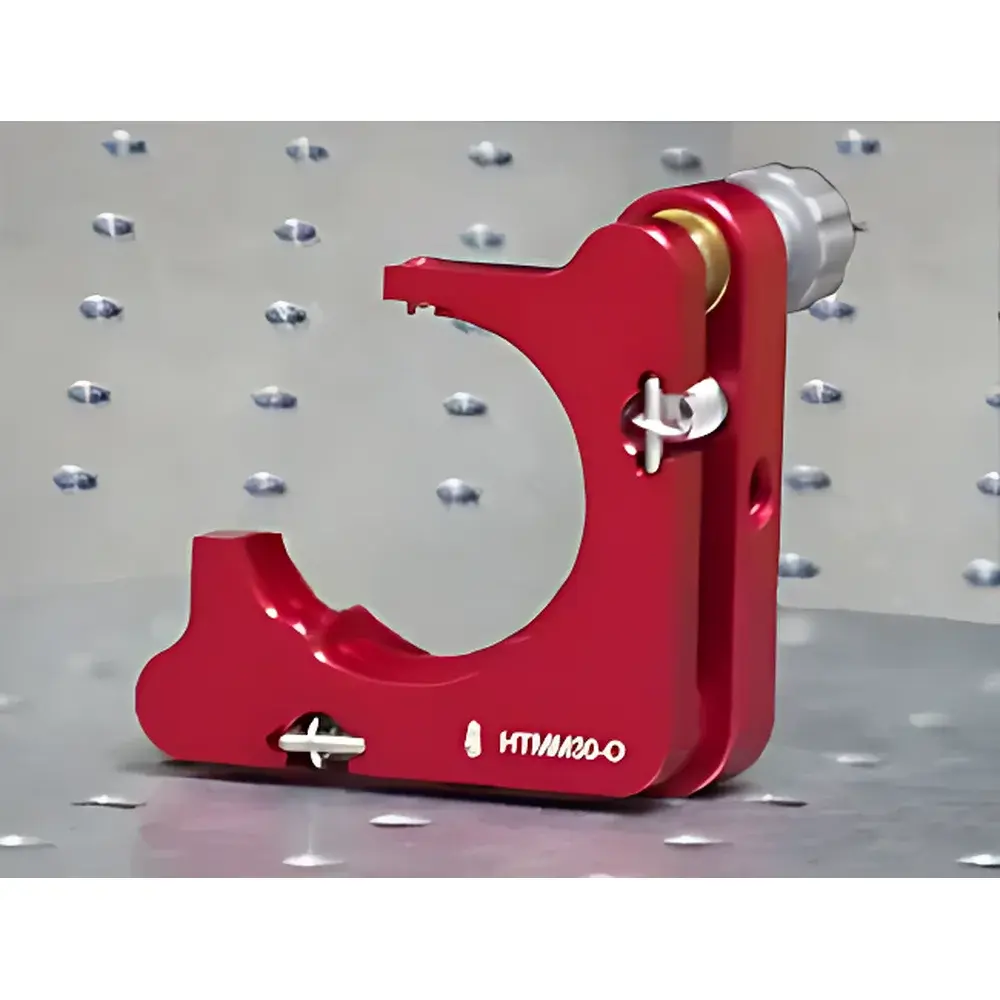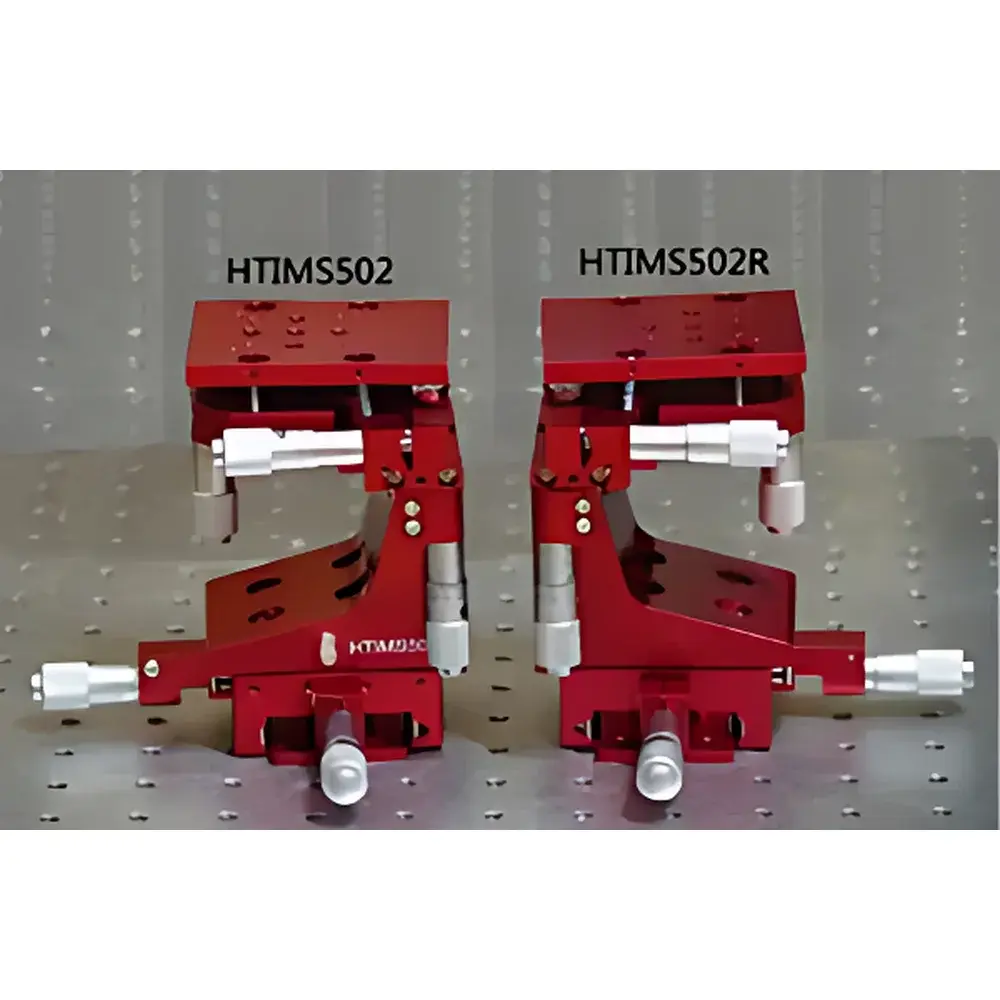
HTIMS502R Integrated XYZθXθZ Manual Multi-Axis Translation Stage (Right-Handed)

| Brand | Han Ding / HT |
|---|---|
| Origin | Jiangsu, China |
| Manufacturer Type | Authorized Distributor |
| Product Category | Domestic |
| Model | HTIMS502R |
| Type | Manual Translation Stage |
| Travel (XYZ) | 13 mm |
| Rotation (θX, θZ) | 360° continuous |
| Fine Adjustment Range | ±7° |
| Guide Mechanism | Precision Linear Ball Bearing Rails with Ground Steel Shafts |
| Drive | Differential Micrometer Head |
| Sensitivity | 0.002 mm per division |
| Material & Finish | Anodized Aluminum (Crimson Red) |
| Max Load Capacity | 3.5 kg |
| Weight | 1.1 kg |
| Compliance | Designed for ISO/IEC 17025-aligned optical alignment workflows |
| Software Interface | None (purely manual operation) |
Ask about pricing, availability and specifications.
Overview
The HTIMS502R is an integrated, right-handed, six-degree-of-freedom (6-DOF) manual translation stage engineered for high-precision optical alignment in research-grade laboratory environments. Unlike stacked or modular multi-axis assemblies, this monolithic design integrates orthogonal X-, Y-, and Z-axis linear translations with independent θX (pitch) and θZ (yaw) rotational degrees of freedom—enabling simultaneous spatial repositioning and angular orientation control without cumulative mechanical error from stacked stages. Its operational principle relies on kinematically constrained motion transmission via precision-ground steel shafts and recirculating linear ball bearings, ensuring minimal hysteresis and repeatable positioning within ±0.002 mm resolution per micrometer division. The stage is optimized for applications demanding sub-microradian angular stability and micron-level positional fidelity—such as laser beam steering, interferometer cavity alignment, fiber coupling optimization, and micro-optical component metrology.
Key Features
- Monolithic 6-DOF architecture: Co-located X/Y/Z linear axes and θX/θZ rotations in a single compact housing (130 × 130 × 85 mm), eliminating inter-stage misalignment and thermal drift.
- Precision-guided motion system: Dual parallel ground steel shafts paired with preloaded linear ball bearing carriages deliver straightness ≤1.5 µm over full 13 mm travel and angular deviation <5 arcsec per degree of rotation.
- Differential micrometer drive (HTDM-13 compatible): Enables fine adjustment resolution of 0.002 mm per graduation; integrated tension spring return eliminates backlash and ensures consistent zero-reference repeatability.
- Anodized aluminum construction (Crimson Red finish): Lightweight (1.1 kg), non-magnetic, corrosion-resistant, and thermally stable (CTE ≈ 23.1 × 10⁻⁶ /°C), suitable for cleanroom and vibration-sensitive setups.
- Bidirectional symmetry: Right-handed configuration follows ISO 80000-2 coordinate convention; left-handed counterpart (HTIMS502L) available for mirrored optical layouts.
Sample Compatibility & Compliance
The HTIMS502R supports optical components up to 3.5 kg—including lens mounts, mirror holders, fiber launchers, and photonic integrated circuit (PIC) carriers—with M4 and M6 tapped mounting holes distributed across all base and top plates. It complies with mechanical interface standards defined in ISO 10110-7 (optical element mounting) and aligns with best practices for GLP-compliant optical bench integration. While inherently manual (no motorization or encoder feedback), its deterministic motion behavior satisfies traceability requirements under ISO/IEC 17025 when used with calibrated micrometer readouts and documented adjustment logs. Surface flatness (≤2 µm over 100 mm) and perpendicularity (<10 arcsec between X-Y-Z planes) are verified during final assembly and certified per internal QA protocol HT-QA-042.
Software & Data Management
The HTIMS502R operates exclusively in manual mode and does not incorporate electronic actuation, position sensing, or digital connectivity. As such, it requires no firmware, drivers, or software installation. All positional data must be recorded manually or via external metrology tools (e.g., autocollimators, laser interferometers, or CCD-based alignment cameras). For laboratories operating under FDA 21 CFR Part 11 or EU Annex 11 requirements, users may integrate the stage into validated SOPs using paper-based or ELN-linked logbooks that capture operator ID, timestamp, micrometer readings, and environmental conditions (temperature, humidity) at each adjustment step.
Applications
- Laser cavity alignment in ultrafast amplifier systems requiring simultaneous beam height, angle, and pointing correction.
- Fiber-to-chip coupling in silicon photonics R&D, where sub-micron lateral and angular alignment directly impacts insertion loss and back-reflection.
- Calibration of optical test benches for ISO 10110 surface inspection, supporting reference standard placement with known tilt and decenter errors.
- Multi-angle spectroscopic sample presentation in ellipsometry and reflectometry setups, enabling precise incidence angle sweeps from 0° to 90°.
- Alignment of quantum optics components—such as atomic vapor cells, EOMs, and single-photon detectors—where magnetic neutrality and low outgassing are critical.
FAQ
Is the HTIMS502R compatible with vacuum environments?
No—standard anodized aluminum construction is not vacuum-rated; optional stainless steel variants (HTIMS502R-SS) are available upon request for UHV-compatible configurations (≤10−9 mbar).
Can I retrofit stepper motor actuators to this stage?
Not recommended—the monolithic structure lacks provisions for motor mounting, cable routing, or encoder integration; use HTIMS-M series motorized equivalents instead.
What is the maximum allowable torque on the θX and θZ axes?
Static torque limit is 0.8 N·m; exceeding this may deform the cross-roller contact surfaces and degrade angular repeatability.
Does the stage include locking mechanisms?
Yes—each axis features dual-point friction-locking screws (M3) with knurled knobs, providing >15 N holding force without introducing parasitic tilt.
Are calibration certificates provided with shipment?
A factory-verified dimensional conformance report (including travel linearity and orthogonality measurements) is included; NIST-traceable calibration is available as an add-on service (lead time: 10 business days).