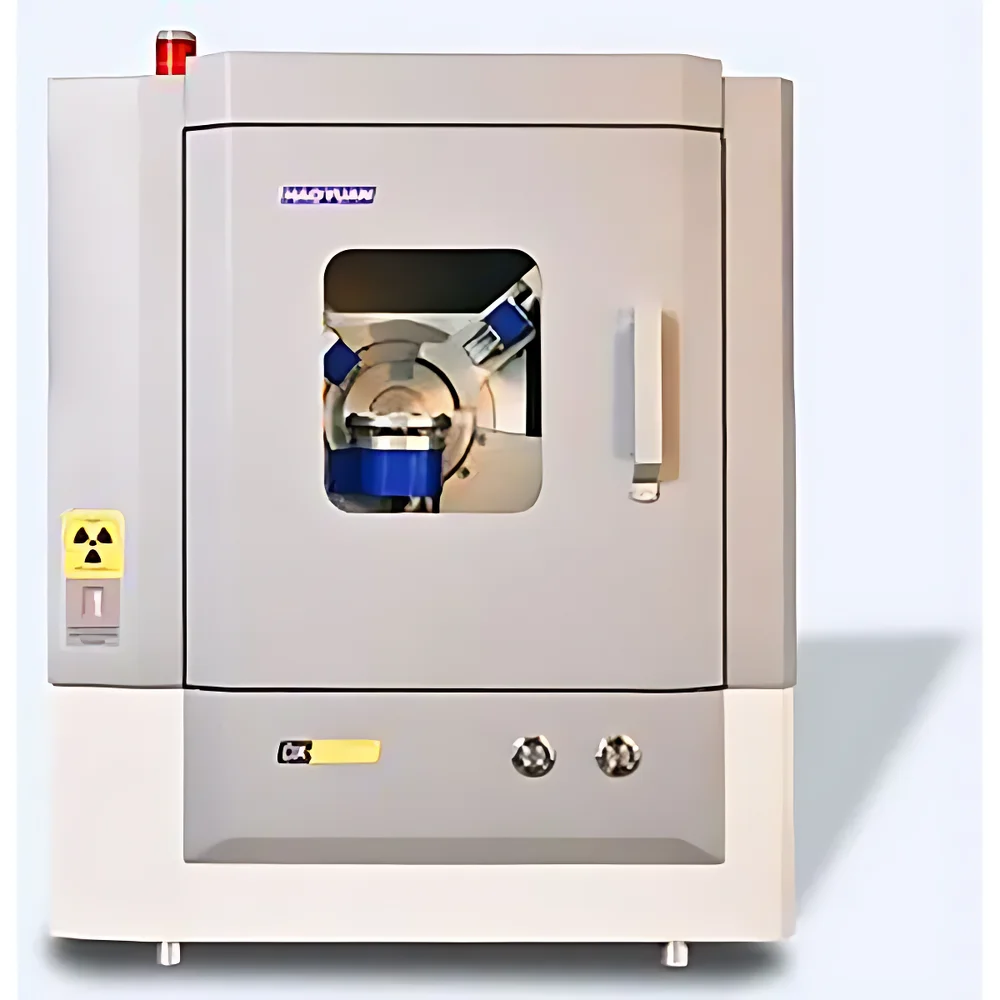
HY DX-27mini Benchtop X-ray Diffractometer

| Origin | Liaoning, China |
|---|---|
| Manufacturer Type | Distributor |
| Origin Category | Domestic (China) |
| Model | DX-27mini |
| Instrument Type | X-ray Crystal Orientation Analyzer |
| Power Options | 600 W (40 kV, 15 mA) or 1200 W (40 kV, 30 mA) |
| X-ray Tube | Metal-ceramic, Cu anode, 2.4 kW nominal power, focal spot 1 × 10 mm |
| Cooling | Air or water-cooled (≥2.5 L/min) |
| Goniometer Geometry | Horizontal θs–θd configuration, radius 150 mm |
| Scan Modes | Continuous and step scanning |
| Angular Range (θs/θd coupled) | –3° to 150° |
| Minimum Step Size | 0.0001° |
| Angular Reproducibility | ±0.0005° |
| Angular Positioning Speed | 1500°/min |
| Energy Resolution | <25% (FWHM at Mn Kα) |
| Detector | Sealed proportional counter or high-speed 1D semiconductor detector |
| Linear Count Rate | ≥5 × 10⁵ cps (proportional), ≥9 × 10⁷ cps (1D semiconductor) |
| Control System | Dell commercial laptop, Windows 7 OS |
| Software | Integrated instrument control (X-ray generator HV/current, shutter, tube aging protocol), goniometer motion control, real-time data acquisition, peak detection (auto/manual), background subtraction, smoothing, intensity integration, centroid calculation, peak amplification, spectral overlay |
| Data Analysis | Phase identification & quantification, α₁/α₂ stripping, whole-pattern fitting (WPF), selective peak fitting, FWHM & crystallite size analysis (Scherrer, Williamson–Hall), unit cell refinement, biaxial stress calculation, indexing of diffraction lines, multi-plot & 3D visualization, calibration, background modeling, standardless quantitative analysis, XRD pattern simulation |
| Radiation Shielding | Lead + lead-glass enclosure |
| System Stability | ≤1% RSD over 8 h |
| Sample Handling | Auto-sampler for up to 6 samples per batch |
| Dimensions (W×D×H) | 600 × 410 × 670 mm |
Ask about pricing, availability and specifications.
Overview
The HY DX-27mini Benchtop X-ray Diffractometer is an engineered solution for routine crystallographic characterization in industrial quality control laboratories. Based on Bragg’s law and powder X-ray diffraction (XRD) principles, it delivers precise phase identification, quantitative phase analysis, and structural parameter extraction—including lattice parameters, crystallite size, microstrain, and residual stress—without requiring synchrotron or floor-standing instrumentation. Designed specifically for high-throughput environments in catalyst manufacturing, titanium dioxide (TiO₂) pigment production, cement formulation, and pharmaceutical solid-state development, the DX-27mini integrates a robust metal-ceramic Cu-target X-ray tube, high-stability goniometry, and dual-detector compatibility into a compact footprint (600 × 410 × 670 mm). Its horizontal θs–θd sample geometry ensures consistent sample alignment and minimizes preferred orientation effects during measurement of flat, irregular, or pelletized specimens.
Key Features
- High-stability X-ray source: Metal-ceramic Cu anode tube rated at 2.4 kW nominal power, with selectable operating modes (40 kV / 15 mA or 40 kV / 30 mA), enabling flexible balance between resolution and throughput.
- Precision goniometer: 150 mm radius diffractometer with angular reproducibility of ±0.0005° and positioning speed up to 1500°/min—engineered for long-term mechanical stability and thermal drift compensation.
- Dual-detector support: Compatible with sealed proportional counters (linear count rate ≥5 × 10⁵ cps) and high-efficiency 1D silicon strip detectors (≥9 × 10⁷ cps), allowing optimization for either high-resolution qualitative work or rapid quantitative screening.
- Integrated radiation safety: Fully interlocked lead and lead-glass shielding system compliant with IEC 61000-6-4 and national radiation protection regulations; measured scatter dose rate ≤1 μSv/h at 5 cm from housing surface.
- Benchtop automation: Optional 6-position auto-sampler enables unattended sequential analysis, reducing operator dependency and improving inter-sample repeatability under GLP-aligned workflows.
- Thermal management flexibility: Supports both forced-air and recirculating water cooling (≥2.5 L/min), permitting deployment in controlled lab environments or near production lines without dedicated HVAC infrastructure.
Sample Compatibility & Compliance
The DX-27mini accepts standard 25 mm or 32 mm diameter sample holders, accommodating powders, pressed pellets, thin films, and bulk metallic or ceramic specimens. Its horizontal sample stage design minimizes gravitational settling artifacts and supports analysis of low-density materials such as zeolites, MOFs, and pharmaceutical co-crystals. All hardware and software modules are designed to support audit-ready documentation per FDA 21 CFR Part 11 requirements—including electronic signatures, secure user access levels, and immutable audit trails for instrument parameters, acquisition logs, and processing history. The system meets ISO 17025-relevant criteria for analytical instrument qualification (AIQ), including installation qualification (IQ), operational qualification (OQ), and performance qualification (PQ) protocols aligned with ASTM E1420 and ISO 13121 standards for XRD-based phase analysis.
Software & Data Management
Control and analysis are unified within a Windows 7–based platform comprising two tightly integrated modules: HY-XRD Control Suite and HY-XRD Analysis Studio. The control suite manages real-time operation of high-voltage supply, filament current, shutter sequencing, tube conditioning cycles, and synchronized goniometer motion—supporting continuous, step-scan, and time-resolved acquisition modes. The analysis studio implements industry-standard algorithms for peak search (with Savitzky–Golay smoothing), background modeling (polynomial or iterative convex hull), full-pattern Rietveld refinement (WPF), and crystallite size/strain deconvolution using Williamson–Hall or size–strain plot methods. Export formats include CIF, XYE, CSV, and PDF reports compliant with internal SOPs and external regulatory submissions. Data integrity is enforced via encrypted project files, version-controlled processing histories, and configurable metadata tagging (operator ID, sample ID, date/time stamp, instrument configuration snapshot).
Applications
- Catalyst R&D and QC: Identification of active phases (e.g., γ-Al₂O₃, Pt/CeO₂), quantification of amorphous content, and monitoring of sintering-induced crystallite growth during thermal aging.
- Titanium dioxide manufacturing: Differentiation of rutile/anatase/brookite polymorphs, assessment of surface coating crystallinity, and detection of trace iron oxide impurities affecting whiteness index.
- Cement and clinker analysis: Quantitative determination of alite (C₃S), belite (C₂S), tricalcium aluminate (C₃A), and tetracalcium aluminoferrite (C₄AF) using reference intensity ratio (RIR) or internal standard methods.
- Pharmaceutical solid-state characterization: Polymorph screening, hydrate/solvate identification, crystallinity assessment of milled APIs, and stability-indicating monitoring of solid-form transitions during accelerated storage.
- Metallurgical QC: Residual stress mapping in welded joints, texture analysis of rolled alloys, and phase fraction verification in heat-treated steels and superalloys.
FAQ
Is the DX-27mini compliant with international radiation safety standards?
Yes—the instrument conforms to IEC 61000-6-4 and GBZ 117–2020 (Chinese national standard for X-ray equipment radiation protection), with verified scatter radiation ≤1 μSv/h under normal operating conditions.
Can the system perform Rietveld refinement for quantitative phase analysis?
Yes—HY-XRD Analysis Studio includes whole-pattern fitting (WPF) functionality supporting Rietveld refinement with user-defined structural models, profile shape functions (Pseudo-Voigt, Thompson–Cox–Hastings), and constrained or unconstrained parameter optimization.
What sample preparation methods are recommended for optimal data quality?
For powders: gentle back-loading into zero-background silicon or quartz holders; for tablets: uniform pressure (10–15 tons) with binder-free compaction; for thin films: mounting on low-diffraction substrates with minimal beam divergence.
Does the software support 21 CFR Part 11 compliance for regulated industries?
Yes—audit trail logging, role-based access control, electronic signature capability, and data immutability features are fully implemented and validated per laboratory SOP requirements.
Is remote instrument monitoring or troubleshooting supported?
The control software supports secure remote desktop access via IT-approved VPN channels; however, no cloud-based telemetry or automatic firmware updates are enabled by default to maintain data sovereignty and network segmentation integrity.