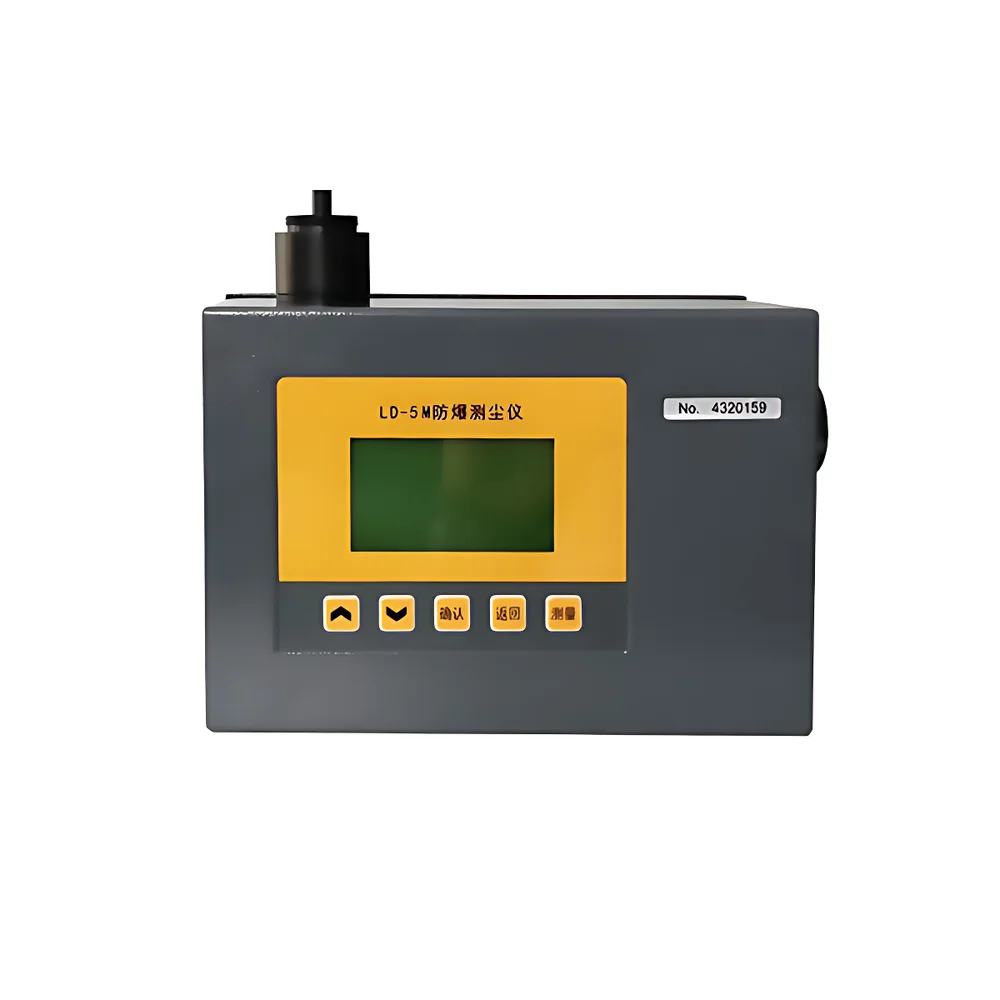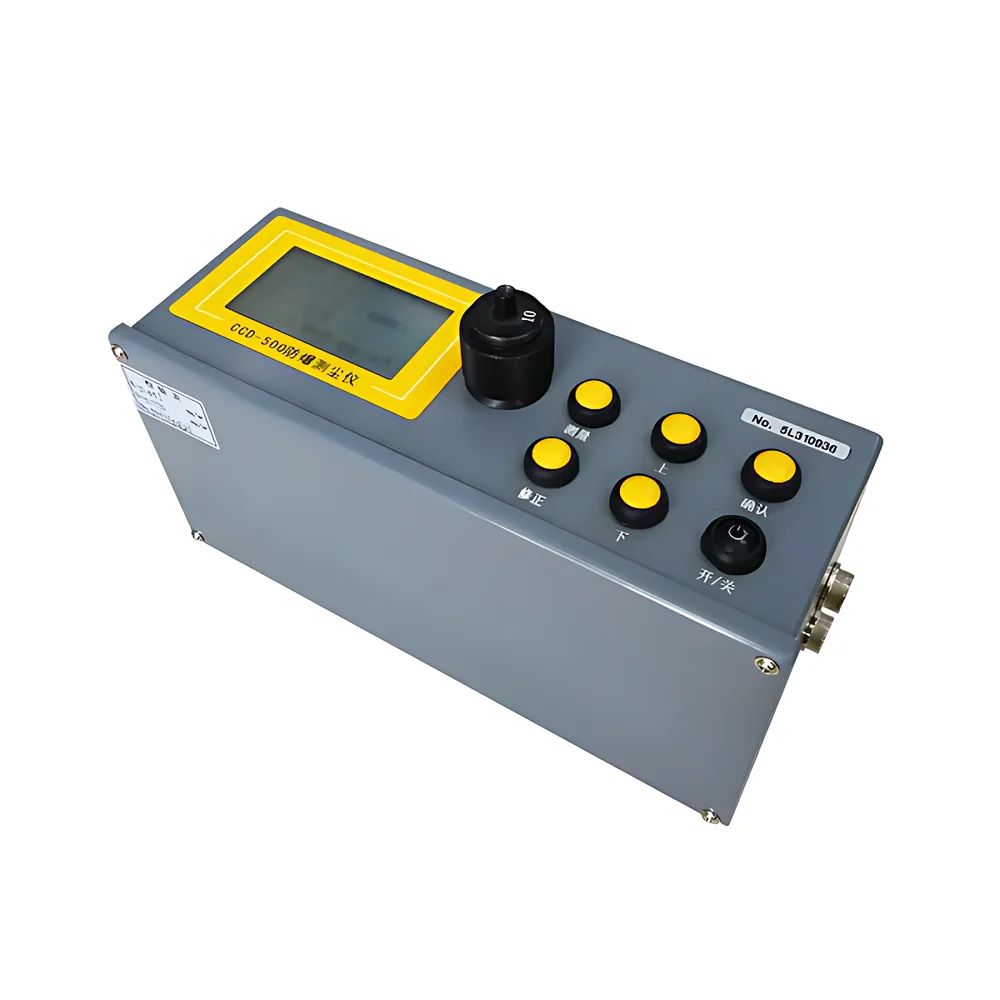
JZCCW CCD-500 Intrinsically Safe Laser Scattering Dust Monitor

| Brand | JZCCW |
|---|---|
| Origin | Beijing, China |
| Manufacturer Type | Direct Manufacturer |
| Region of Origin | Domestic (China) |
| Model | CCD-500 Intrinsically Safe Dust Monitor |
| Price | Upon Request |
| Measurement Range | 0.01–500 mg/m³ and 0.01–1000 mg/m³ |
| Detection Sensitivity | 0.01 mg/m³ |
| Repeatability Error | ±2% |
| Indication Accuracy | ±15% |
| Standard Sampling Time | 1 min (configurable from 0.1 min to user-defined duration) |
| Data Storage | Cyclic memory for 999 measurement records |
| Output Interfaces | Aviation-style RS485 and RS232 connectors |
| Operating Temperature | 0–40 °C |
| Relative Humidity | <90% RH (non-condensing) |
| Power Supply | Dedicated rechargeable Li-ion battery pack with proprietary AC adapter |
Ask about pricing, availability and specifications.
Overview
The JZCCW CCD-500 Intrinsically Safe Laser Scattering Dust Monitor is an industrial-grade, certified explosion-proof particulate matter analyzer engineered for continuous or spot monitoring of airborne dust concentrations in hazardous environments. Based on the principle of Mie scattering, the instrument employs a stable semiconductor laser source to illuminate suspended particles; the intensity and angular distribution of scattered light are quantitatively correlated to mass concentration via factory-calibrated algorithms traceable to NIST-traceable reference aerosols. Designed in strict compliance with GB 3836.1–2010 (IEC 60079-0) and GB 3836.4–2010 (IEC 60079-11) for intrinsic safety (Ex ib IIB T4 Gb), the CCD-500 is approved for use in Zone 1 and Zone 2 explosive gas atmospheres—common in coal mines, chemical processing plants, grain silos, pharmaceutical manufacturing suites, and metal powder handling facilities. Its real-time response enables immediate detection of exceedances relative to occupational exposure limits (OELs) such as those defined by OSHA PELs, ACGIH TLVs®, or China’s GBZ 2.1–2019.
Key Features
- Intrinsically safe design certified to Ex ib IIB T4 Gb per GB 3836.4–2010, eliminating ignition risk in flammable gas/vapor environments
- Dual-range selectable measurement capability: 0.01–500 mg/m³ and 0.01–1000 mg/m³, optimized for both ambient air quality screening and high-concentration industrial process monitoring
- High-sensitivity optical path with 0.01 mg/m³ detection limit, enabling reliable quantification of low-level respirable dust fractions
- Repeatability of ±2% under controlled laboratory conditions, supporting trend analysis and comparative exposure assessment
- User-configurable sampling duration (0.1–60 minutes), facilitating alignment with regulatory sampling protocols (e.g., NIOSH Method 0600, ISO 7708)
- Ruggedized housing with IP54-rated ingress protection, suitable for field deployment in dusty, humid, or vibration-prone settings
- Integrated audible and visual alarm system triggered when preset concentration thresholds are exceeded
Sample Compatibility & Compliance
The CCD-500 is validated for measurement of total suspended particulates (TSP), respirable dust (RD), and inhalable dust fractions across a broad aerodynamic size distribution (typically 0.3–100 µm). It does not differentiate particle composition but provides mass concentration data consistent with gravimetric reference methods when calibrated against polydisperse test aerosols (e.g., Arizona Road Dust, ISO 12103-1 A2). The device complies with metrological requirements per JJG 846–2015 (Chinese national verification regulation for light-scattering dust meters) and supports audit-ready documentation for GLP and GMP-aligned operations. While not FDA 21 CFR Part 11–compliant out-of-the-box, its data output architecture permits integration into validated enterprise systems via RS485/RS232 serial protocols.
Software & Data Management
Data acquisition and reporting are supported through standardized ASCII-based serial communication protocols over RS485 (modbus RTU) and RS232 interfaces. The instrument stores up to 999 timestamped records—including date/time stamp, concentration value, sampling duration, and alarm status—in non-volatile cyclic memory. Raw output is compatible with third-party SCADA platforms, LabVIEW, or custom Python/Node-RED ingestion pipelines. Optional PC software (provided separately) enables export to CSV, generation of time-series plots, and batch reporting aligned with ISO 5725 precision metrics. All stored data retain firmware-version metadata to support traceability during internal audits or regulatory inspections.
Applications
- Real-time monitoring of coal dust in underground mining ventilation shafts and conveyor transfer points
- Process dust control in cement kiln feed zones, limestone grinding mills, and biomass pelletizing lines
- Occupational hygiene surveys in foundries, welding bays, and abrasive blasting enclosures
- Environmental compliance verification at construction site perimeter monitoring stations
- Preventive maintenance support for baghouse filter integrity testing and cyclone separator efficiency evaluation
- Emergency response deployment during dust explosion incident investigations (per NFPA 652 guidance)
FAQ
Is the CCD-500 suitable for measuring PM2.5 or PM10 specifically?
No—the CCD-500 reports total mass concentration without size-selective inlet separation. For regulatory PM2.5/PM10 compliance, pairing with a certified impactor (e.g., GK2.06 or BGI SCC1.06) is required.
Does the instrument require annual recalibration?
Yes. Per JJG 846–2015, verification against traceable reference aerosols is recommended every 12 months or after any physical shock, optical window contamination, or firmware update.
Can the CCD-500 be integrated into a central DCS or PLC network?
Yes—via RS485 Modbus RTU, it supports read-only register access for concentration, alarm status, battery level, and sampling timer, enabling seamless HMI visualization.
What is the expected service life of the laser diode and photodetector assembly?
Under normal operating conditions (≤8 h/day, 0–40 °C), the optical module maintains specification performance for ≥30,000 hours, equivalent to approximately 10 years of typical industrial use.
Is the battery pack replaceable in the field?
Yes—the sealed Li-ion battery pack is user-swappable using standard Torx tools; replacement kits include calibration checksum restoration utilities.