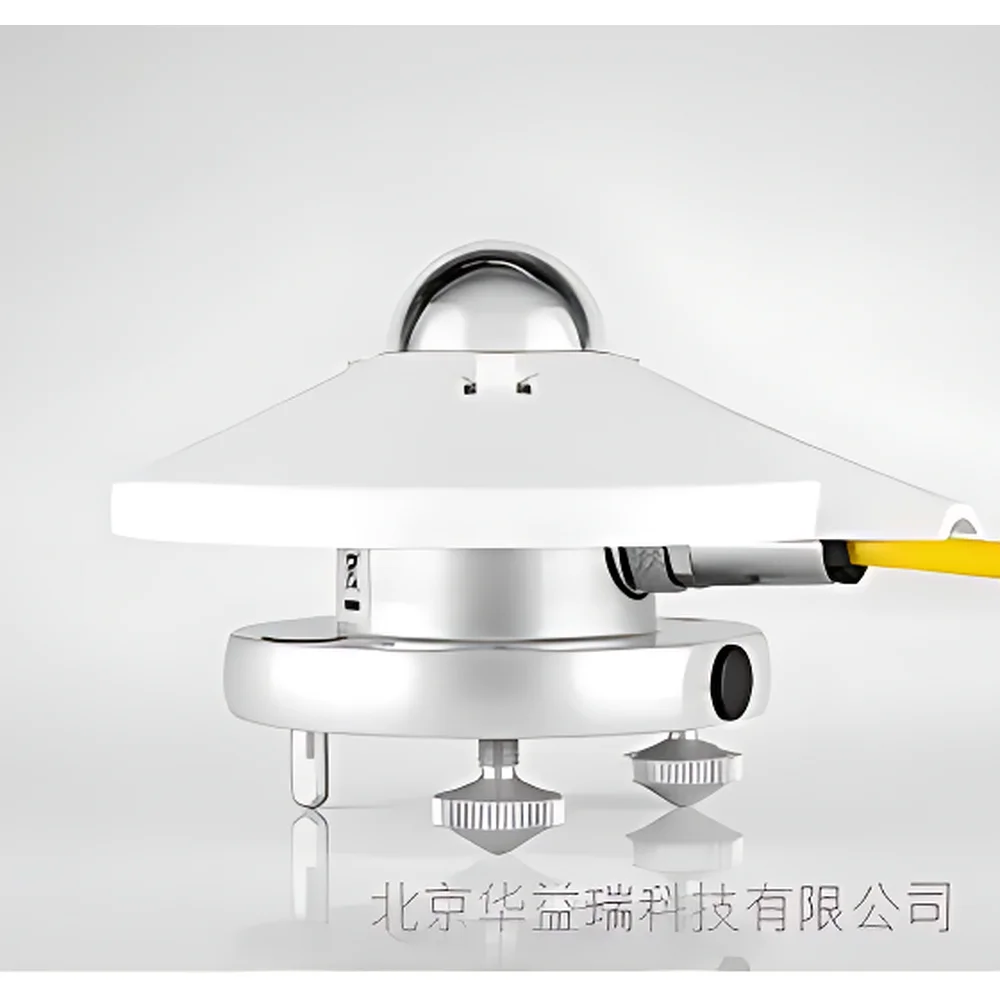
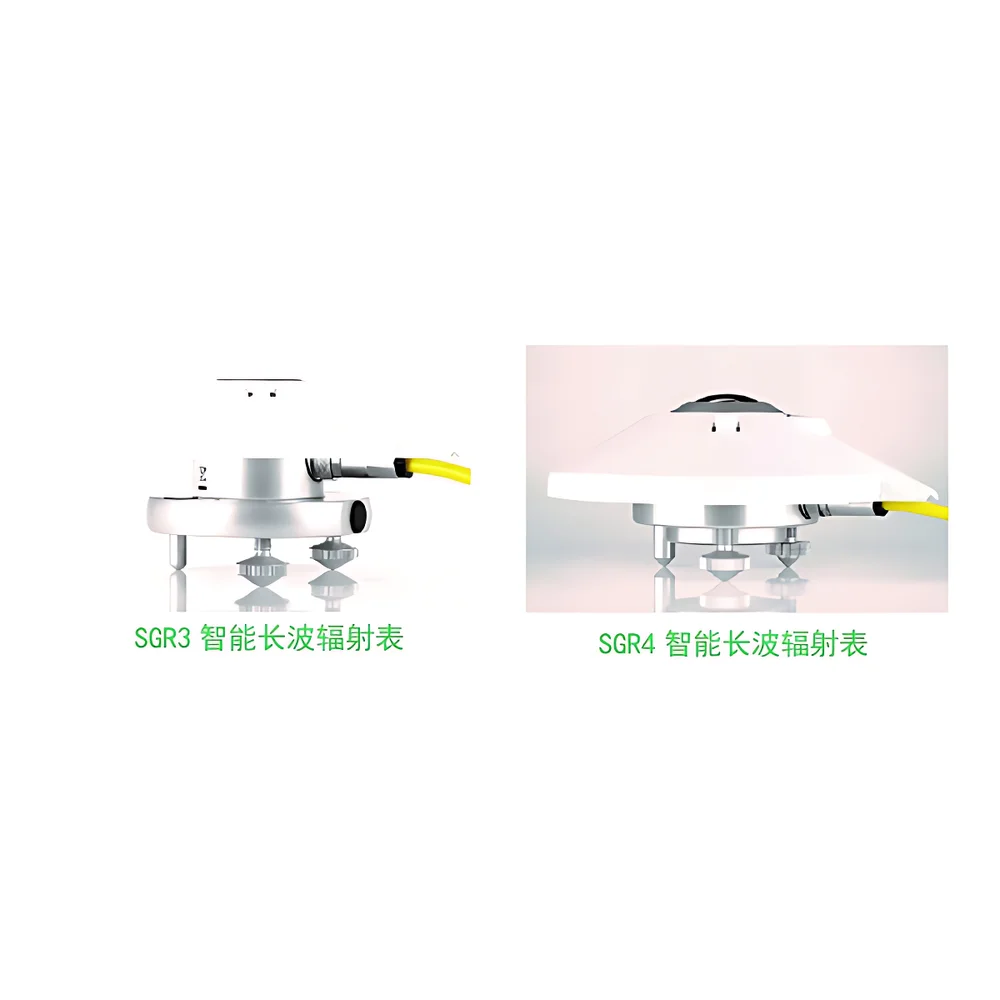
NR01 Net Radiometer by Kipp & Zonen

| Brand | Kipp & Zonen |
|---|---|
| Origin | Netherlands |
| Model | NR01 |
| Operating Principle | Thermopile-based passive radiometry |
| Temperature Range | -40 to +80 °C |
| Global Shortwave (SW) Measurement Range | 0–2000 W·m⁻² |
| Longwave (LW) Measurement Range | 0–2000 W·m⁻² |
| SW Spectral Range | 305–2800 nm |
| LW Spectral Range | 4500–50000 nm |
| SW Calibration Traceability | World Radiometric Reference (WRR) |
| LW Calibration Traceability | NIST |
| SW Sensor Classification | ISO 9060:2018 Secondary Standard |
| Integrated Pt100 Temperature Sensor | Yes (user-selectable) |
| LW Dome Heater Power | 5 W @ 12 V DC |
| Heater-Induced Offset | <15 W·m⁻² at 1000 W·m⁻² solar irradiance |
| Dew Prevention | Active thermostatically controlled dome heating |
Ask about pricing, availability and specifications.
Overview
The NR01 Net Radiometer, engineered by Kipp & Zonen in the Netherlands, is a precision four-component pyrgeometer/pyranometer system designed for continuous, high-fidelity measurement of surface radiation balance. It operates on the fundamental principle of thermopile-based passive radiometry: incident electromagnetic energy across defined spectral bands induces a temperature gradient across thermoelectric junctions, generating microvolt-level output signals linearly proportional to net radiant flux. The instrument comprises two upward-facing and two downward-facing sensors—two shortwave (SW) and two longwave (LW)—mounted on a single rigid frame with precise angular alignment. This configuration enables simultaneous acquisition of incoming and outgoing solar (shortwave) and terrestrial (longwave) radiation, permitting direct calculation of net radiation (Rn = SW↓ − SW↑ + LW↓ − LW↑), a critical variable in surface energy budget modeling, micrometeorology, and climate monitoring networks.
Key Features
- Four-sensor integrated architecture ensures synchronized temporal sampling and spatial co-location, minimizing inter-sensor calibration drift and alignment-induced uncertainty.
- Passive thermopile detection elements—no internal amplification or active electronics—guarantee intrinsic stability, low power consumption, and immunity to electromagnetic interference.
- ISO 9060:2018 Secondary Standard-class shortwave sensors deliver traceable spectral response and directional (cosine) error performance compliant with global radiation network requirements.
- Longwave sensors feature thermally stabilized silicon domes with integrated NIST-traceable calibration, covering the atmospheric window (4.5–50 µm) essential for accurate sky and surface temperature derivation.
- Dome heating system operates via regulated 12 V DC input (5 W nominal), actively suppressing dew, frost, and condensation without introducing significant radiative offset (<15 W·m⁻² under 1000 W·m⁻² solar load).
- Integrated Pt100 resistance thermometer (user-selectable configuration) enables concurrent blackbody temperature measurement of the LW sensor dome—critical for real-time correction of longwave emissivity and sky temperature computation.
Sample Compatibility & Compliance
The NR01 is compatible with standard meteorological mounting hardware (e.g., leveling plates, adjustable booms, and solar trackers) and interfaces seamlessly with industry-standard data loggers (e.g., Campbell Scientific CR series, Delta-T DL6, or custom SCADA systems) via millivolt analog outputs (typically ±15 mV full scale per channel). Its mechanical design conforms to WMO No. 8 guidelines for radiation instrument exposure and siting. Calibration certificates include full uncertainty budgets aligned with ISO/IEC 17025:2017 requirements and are traceable to primary standards: WRR for shortwave and NIST for longwave. The instrument meets CE marking requirements and is suitable for deployment in GLP-compliant environmental monitoring stations, eddy covariance flux towers, and long-term climate observatories operating under IPCC AR6 or GCOS protocols.
Software & Data Management
While the NR01 itself is a passive analog sensor, its data integration supports rigorous scientific workflows. Raw thermopile voltages are converted to physical units using manufacturer-provided sensitivity coefficients (µV per W·m⁻²) and applied with documented linearization corrections. When deployed with compliant data loggers, measurements support automated QA/QC flagging (e.g., out-of-range checks, heater status logging, and thermal equilibrium validation). For regulatory applications—including those subject to EPA Method IO-3 or EU INSPIRE metadata standards—the system supports audit-ready data provenance when paired with timestamped, calibrated, and heater-status-annotated datasets. Optional post-processing scripts (Python/Matlab) are available from Kipp & Zonen for net radiation partitioning, sky emissivity estimation, and surface temperature inversion per Brutsaert (1975) or Crawford & Duchon (1999) formulations.
Applications
- Surface energy balance closure studies in agricultural, forest, and urban canopy research.
- Validation of satellite-derived radiation products (e.g., CERES, GERB, or CM SAF LSA SAF).
- Input forcing and evaluation for land surface models (LSMs) including Noah-MP, CLM, and SURFEX.
- Long-term climate trend analysis within BSRN (Baseline Surface Radiation Network) and GAW (Global Atmosphere Watch) sites.
- Performance monitoring of solar PV farms and concentrated solar power (CSP) installations where albedo and thermal re-radiation impact yield modeling.
- Boundary layer meteorology and turbulence studies requiring high-temporal-resolution radiation divergence estimates.
FAQ
Does the NR01 require external power for signal measurement?
No—the thermopile sensors are entirely passive and generate their own voltage output. Only the dome heater requires 12 V DC power.
Can the Pt100 sensor be replaced or recalibrated in the field?
The Pt100 is factory-integrated and calibrated as part of the LW sensor assembly; replacement or field recalibration is not supported—full unit recalibration at an accredited Kipp & Zonen service center is required.
What is the recommended recalibration interval?
Kipp & Zonen recommends recalibration every two years for research-grade applications, or annually for compliance-critical deployments (e.g., BSRN-certified stations).
Is the NR01 suitable for marine or coastal environments?
Yes—its anodized aluminum housing and marine-grade stainless-steel fasteners provide corrosion resistance; however, optional conformal coating and enhanced sealing are advised for persistent salt-laden exposure.
How is heater-induced radiation offset corrected in post-processing?
The specified offset (<15 W·m⁻² at 1000 W·m⁻²) is deterministic and can be subtracted as a fixed bias term when heater status is logged; advanced users may apply temperature-dependent correction functions provided in the technical manual.