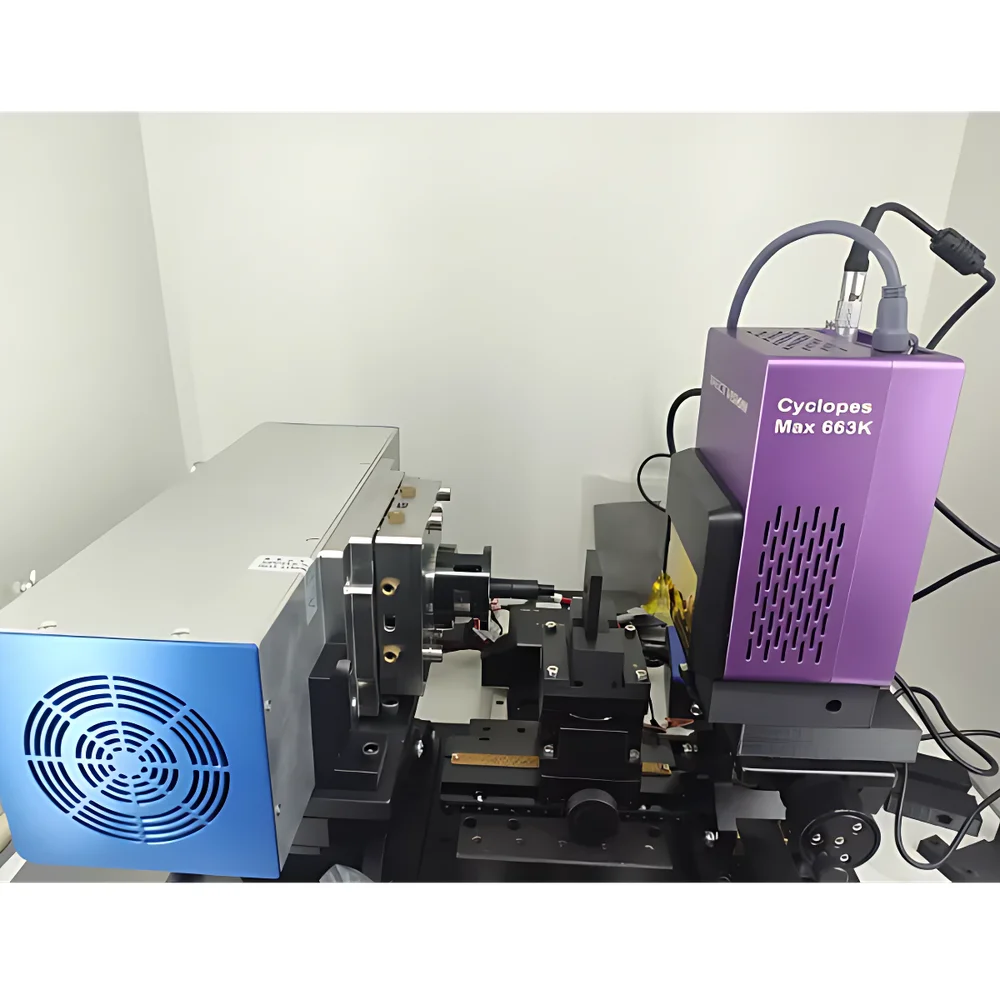
Raying DX2900C In Situ Battery X-ray Diffractometer with Fast 2D Detection

| Brand | Raying |
|---|---|
| Origin | Jiangsu, China |
| Manufacturer Type | Authorized Distributor |
| Country of Origin | China |
| Model | DX2900C |
| Price | Upon Request |
| X-ray Source | Cu/Mo anode, 50 W (50 kV / 1 mA) |
| Microfocus Brightness | 5.0 × 10⁹ ph/s |
| Detectors | Frame-Gridding Max663K (1152 × 576 px, 70 µm/pixel) or Dectris Eiger2 250K (512 × 512 px, 75 µm/pixel) |
| In Situ Accessories | Be-window coin-cell, pouch-cell, and custom electrochemical cells |
| Environmental Modules | Heating, pressure control, and gas-tight atmosphere chambers |
| Compliance | CE, ISO/IEC 17025–compatible operation environment |
Ask about pricing, availability and specifications.
Overview
The Raying DX2900C is a purpose-engineered laboratory-scale in situ X-ray diffractometer optimized for time-resolved structural characterization of electrochemical energy storage systems. It employs conventional sealed-tube X-ray generation coupled with high-brightness polycapillary focusing optics and fast-readout 2D area detectors to deliver synchrotron-like temporal resolution—enabling continuous, quantitative powder diffraction measurements at sub-10-second intervals during battery cycling. Unlike conventional θ–2θ scanning diffractometers, the DX2900C captures full Debye–Scherrer rings in a single exposure, permitting real-time monitoring of phase evolution, lattice parameter shifts, crystallite size changes, and amorphous content variation under dynamic electrochemical conditions. Its modular mechanical architecture supports integration into glovebox environments and compatibility with standard potentiostat/galvanostat systems via TTL synchronization triggers.
Key Features
- High-brightness microfocus X-ray source: Polycapillary optic delivering >5.0 × 10⁹ photons per second at sample position—50× greater flux than comparable 50 W benchtop 2D diffractometers.
- Dual-detector interchangeability: Supports both Frame-Gridding Max663K (1152 × 576 pixels, 70 µm pixel pitch) and Dectris Eiger2 R 250K (512 × 512 pixels, 75 µm pixel pitch), enabling optimization between spatial resolution and frame rate.
- Electrochemically compatible in situ cell interface: Includes beryllium-window coin-cell holders, flexible pouch-cell clamps, and customizable cell mounts with integrated current collectors and feedthroughs for voltage/current monitoring.
- Environmental control expansion: Optional heating stage (up to 200 °C), pneumatic pressure module (0–10 bar), and hermetic gas chamber (N₂, Ar, O₂, CO₂) with mass flow controllers for operando studies under realistic operating conditions.
- Integrated safety architecture: Interlocked lead–acrylic shielding enclosure with real-time X-ray emission sensor, status-indicating LED panel, adjustable internal LED illumination, and observation window compliant with IEC 61010-1 and ANSI N43.3 radiation safety standards.
Sample Compatibility & Compliance
The DX2900C accommodates a broad spectrum of battery chemistries—including Li-ion (e.g., LFP, NMC, Si-anodes), Na-ion (e.g., layered oxides, Prussian blue analogs), Zn-ion (e.g., vanadates, manganese oxides), and solid-state configurations (e.g., sulfide, oxide, polymer electrolytes). All in situ accessories maintain electrical isolation and thermal stability during galvanostatic or potentiostatic cycling. The system operates within ISO/IEC 17025-aligned quality frameworks; raw 2D diffraction images are timestamped, detector-gain calibrated, and stored with metadata (voltage, current, temperature, pressure) for traceable data provenance. Instrument control and data acquisition comply with ALCOA+ principles (Attributable, Legible, Contemporaneous, Original, Accurate, Complete, Consistent, Enduring, Available) for GLP/GMP-regulated battery development workflows.
Software & Data Management
Raying’s proprietary acquisition software provides synchronized triggering between electrochemical instruments (BioLogic, Gamry, Ivium) and detector exposure sequences. Real-time ring integration, azimuthal averaging, and peak tracking are performed using open-format HDF5-based data containers. Integrated tools support background subtraction, polarization correction, Lorentz factor normalization, and Rietveld refinement via external interfaces (GSAS-II, TOPAS, FullProf). All processing scripts are version-controlled and exportable as Jupyter notebooks for audit-ready reproducibility. Data archiving follows FAIR principles (Findable, Accessible, Interoperable, Reusable), with optional integration into enterprise LIMS or ELN platforms via RESTful API.
Applications
- Operando phase mapping during charge/discharge of layered cathodes (e.g., Ni-rich NMC degradation pathways)
- Quantification of solid-electrolyte interphase (SEI) crystallinity evolution in Li-metal anodes
- Tracking of reversible Na⁺ insertion/extraction in tunnel-structured MnO₂
- In situ monitoring of Zn²⁺ coordination changes in aqueous zinc vanadate batteries
- Thermal runaway onset detection via abrupt lattice expansion and phase decomposition kinetics
- Pressure-dependent polymorphic transitions in solid-state electrolytes (e.g., LLZO, LATP)
FAQ
What X-ray wavelengths are supported?
Cu Kα (1.5418 Å) and Mo Kα (0.7107 Å) anodes are standard; wavelength selection is determined by anode material and optimized for resolution vs. penetration depth trade-offs.
Can the system be installed inside an argon-filled glovebox?
Yes—the detector, sample stage, and in situ cells are fully compatible with inert-atmosphere gloveboxes; beam path is maintained via Be-windowed X-ray feedthroughs.
Is remote operation and monitoring supported?
Full GUI-based remote access is enabled via secure VNC or RDP; real-time detector live view, experiment queue management, and alarm notifications are available through web dashboard.
Does the software support automated batch processing of time-series datasets?
Yes—scriptable pipelines enable unattended integration, peak fitting, and unit-cell parameter extraction across hundreds of sequential frames with configurable QC thresholds.
What maintenance intervals are recommended for the X-ray tube and detector?
X-ray tube lifetime exceeds 5,000 hours under nominal 50 W operation; detector calibration verification is recommended every 6 months or after major environmental relocation.
More from Raying
View all Raying products → Raying Multi-PD Multi-Position Powder Sample Holder for Rigaku SmartLab X-ray Diffractometers
- Multi-TM Automated 8-Position Transmission Sample Holder for Rigaku SmartLab X-ray Diffractometers
- Raying Multi-Position Sample Holder for X-Ray Diffractometers
- Multi-TF Thin-Film Multi-Position Sample Holder for Rigaku SmartLab X-ray Diffractometers