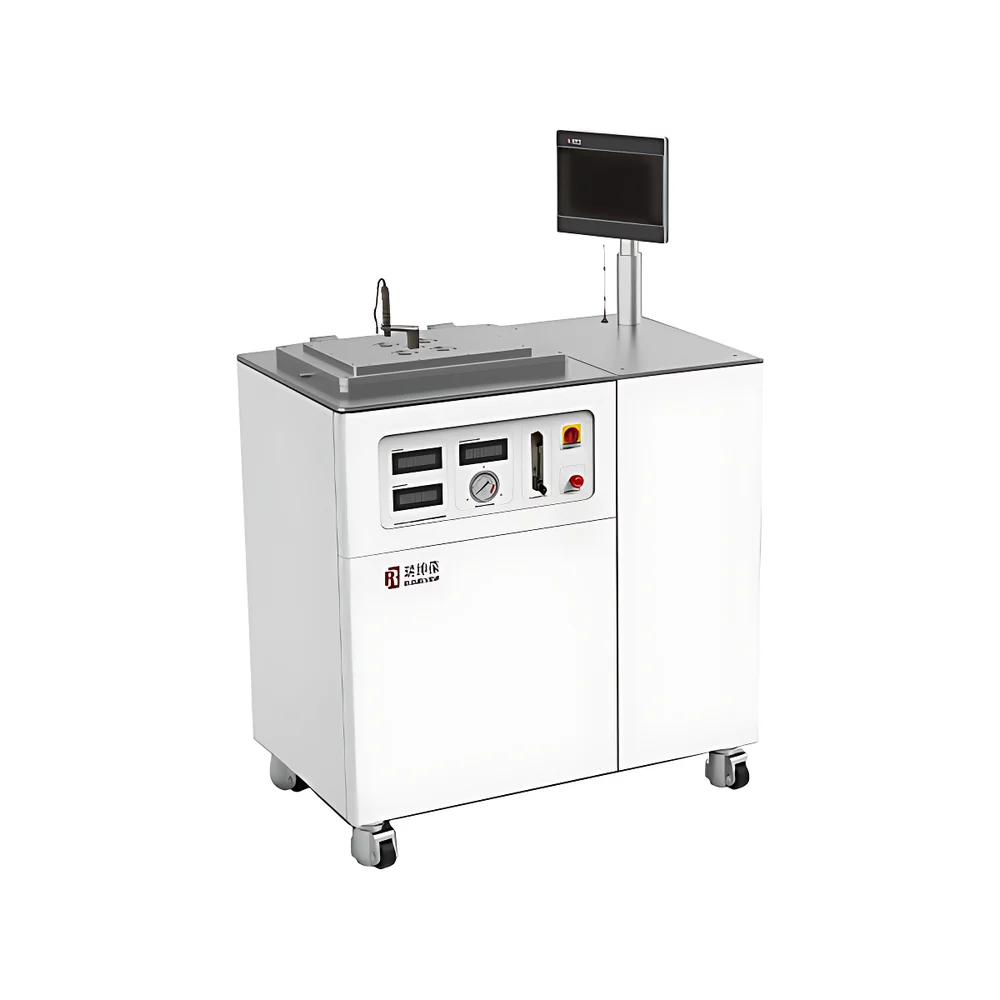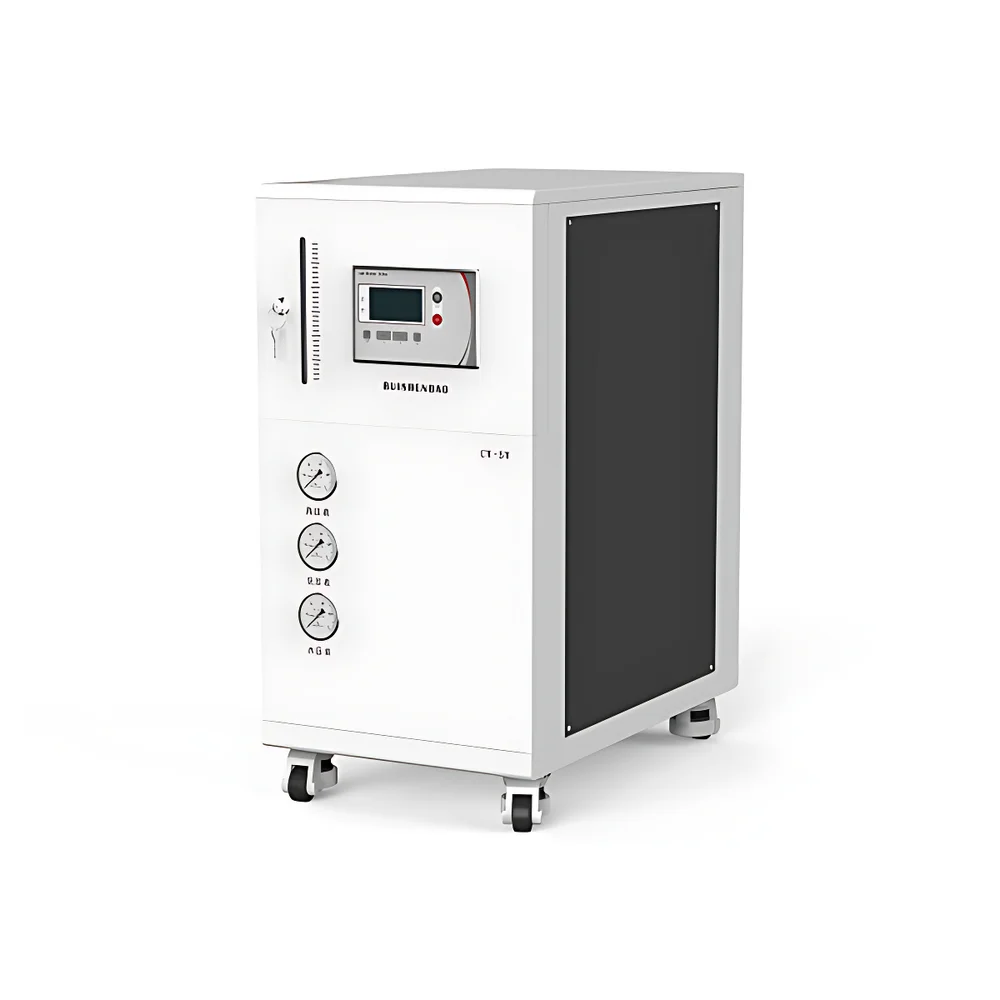
Ruishenbao CW-W Integrated Water-Cooled Chiller for XRD Systems

| Brand | Ruishenbao |
|---|---|
| Model | CW-W |
| Type | Integrated Water-Cooled Circulating Chiller |
| Application | Cooling Support for X-ray Diffractometers (XRD) and Other High-Heat-Load Analytical Instruments |
| Origin | Tianjin, China |
| Cooling Capacity Range | 5–25 kW |
| Temperature Control Range | 5–35 °C |
| Temperature Stability | ±0.1 °C to ±2 °C (model-dependent) |
| Flow Rate | 3–110 L/min |
| Refrigerant | R22 |
| Power Supply | AC 380 V, 3-phase, 50 Hz |
| Water Tank Volume | 35–140 L |
| Protection Features | Compressor overload, high/low pressure, anti-freeze, and delayed start protection |
| Compliance | Designed for laboratory integration per IEC 61000-6-3 (EMC), ISO 13849-1 (functional safety architecture), and GLP-compliant operational logging capability |
Ask about pricing, availability and specifications.
Overview
The Ruishenbao CW-W is an integrated water-cooled circulating chiller engineered specifically to provide stable, high-capacity thermal management for demanding analytical instrumentation—most notably benchtop and floor-standing X-ray diffractometers (XRD). Unlike air-cooled alternatives, the CW-W leverages a closed-loop water circuit connected directly to the instrument’s internal cooling jacket or heat exchanger, enabling precise temperature regulation of critical XRD components including the X-ray tube anode, detector electronics, and goniometer drive systems. Its core thermodynamic architecture employs a hermetic rotary compressor (imported brand), copper-aluminum microchannel condenser and evaporator assemblies, and optimized refrigerant charge management to deliver rapid thermal response and minimal temperature drift under variable load conditions. The system operates within a controlled water temperature range of 5–35 °C, with model-specific stability tolerances from ±0.1 °C (for high-resolution crystallography applications) up to ±2 °C (for routine phase identification), ensuring consistent diffraction peak intensity, angular reproducibility, and long-term tube lifetime.
Key Features
- Integrated water-cooled design: Eliminates need for external cooling towers or dry coolers; requires only clean municipal water supply and gravity-fed drain connection.
- High-efficiency rotary compressor: Imported unit with low vibration signature and extended service life (>30,000 hours MTBF), minimizing mechanical interference with sensitive XRD measurements.
- Precision temperature control: PID-regulated digital controller with real-time monitoring via backlit LCD interface; supports both setpoint hold and ramp-hold profiles.
- Dual-stage flow optimization: Adjustable pump speed and pressure-compensated flow path ensure consistent coolant delivery across varying system backpressures (0.1–0.55 MPa).
- Multi-layer safety architecture: Includes compressor thermal overload cutout, refrigerant high/low pressure switches, anti-freeze logic (prevents sub-zero coolant freezing), and 3-minute compressor restart delay to prevent short-cycling.
- Modular scalability: Available in four standard capacities (CW-5W, CW-8W, CW-12W, CW-25W) to match XRD power dissipation requirements—from 1.8 kW sealed-tube sources to 18 kW rotating-anode systems.
Sample Compatibility & Compliance
The CW-W is certified for seamless integration with major XRD platforms including Bruker D2 PHASER, Rigaku MiniFlex, PANalytical Empyrean, and Thermo Scientific ARL EQUINOX series. It meets essential electromagnetic compatibility (EMC) requirements per IEC 61000-6-3 for laboratory environments and incorporates fail-safe interlocks compatible with OEM XRD emergency stop circuits. While not classified as medical or pharmaceutical production equipment, its temperature logging functionality—including timestamped setpoint, actual temperature, flow rate, and fault codes—supports adherence to GLP documentation standards. Optional RS485 Modbus RTU or Ethernet TCP/IP interfaces enable remote monitoring and audit-trail generation aligned with FDA 21 CFR Part 11 data integrity expectations when paired with validated LIMS or ELN systems.
Software & Data Management
The CW-W operates autonomously via its embedded controller but supports external supervision through optional communication modules. The standard LCD interface provides real-time visualization of operating parameters and diagnostic codes (e.g., “E03” = low flow alarm, “E12” = high discharge pressure). With the RS485 interface, users can integrate chiller status into centralized lab infrastructure monitoring platforms using Modbus register mapping (holding registers 40001–40020 cover temperature, flow, compressor state, and error history). For regulated environments, optional software packages support CSV export of continuous 1-second interval logs, configurable alarm thresholds, and electronic signature-enabled configuration changes—facilitating traceability during QA/QC audits or method validation studies.
Applications
Beyond XRD, the CW-W serves as a primary cooling solution for a broad spectrum of heat-intensive analytical tools requiring stable thermal baselines. These include X-ray fluorescence spectrometers (XRF), X-ray photoelectron spectrometers (XPS), scanning electron microscopes (SEM) with cold stages, transmission electron microscopes (TEM) equipped with liquid nitrogen-free cryo-stages, nuclear magnetic resonance (NMR) consoles with high-field magnet shimming systems, and plasma-based instruments such as ICP-OES and ICP-MS. In materials science labs, it cools molecular beam epitaxy (MBE) substrate holders and MOCVD reactor chill plates; in semiconductor R&D, it maintains thermal equilibrium in ion beam etchers and vacuum brazing furnaces. Its ability to deliver sub-ambient coolant (down to 5 °C) using optional glycol-water mixtures further extends utility to laser-based systems and high-power optical benches.
FAQ
What is the minimum inlet water temperature required for stable operation?
The CW-W requires a clean, deionized or softened municipal water supply with inlet temperature between 10–30 °C. Operation below 10 °C may trigger anti-freeze lockout; above 30 °C reduces maximum achievable cooling capacity by ~1.2% per °C deviation from nominal 20 °C ambient reference.
Can the CW-W be used with non-aqueous heat transfer fluids?
Yes—by specifying the optional organic carrier fluid kit (ethylene glycol/water blend), users can extend low-temperature operation to 5 °C while mitigating corrosion and scaling risks in hard-water regions.
Is remote firmware update supported?
Firmware updates require physical USB connection and authorized service technician access; no over-the-air or network-based update capability is provided for security and regulatory compliance reasons.
How does the CW-W handle transient thermal loads during XRD scanning?
Its dedicated refrigeration circuit and oversized condenser surface area allow sustained response to 30% step-load increases within <45 seconds, maintaining temperature deviation within ±0.3 °C during typical 2θ scan sequences lasting ≤120 minutes.