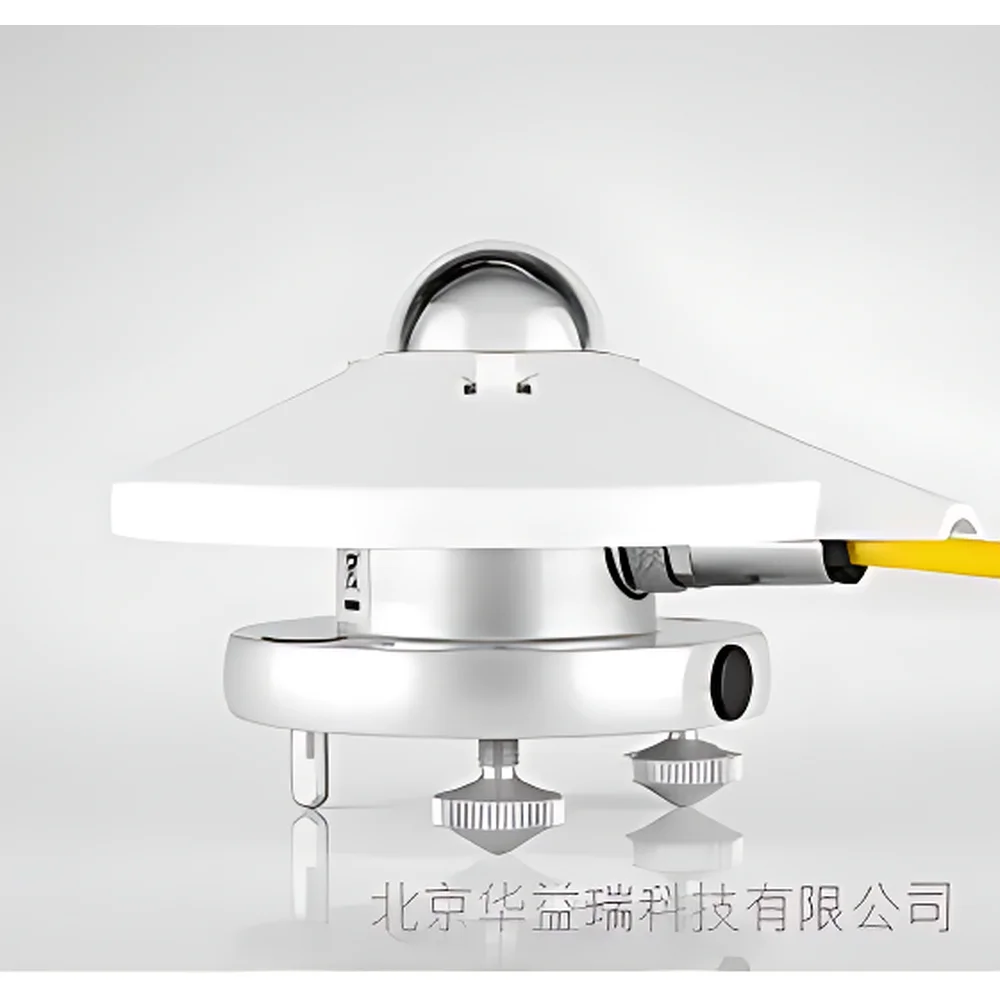
Kipp & Zonen NR-LITE Net Radiometer

| Brand | Kipp & Zonen |
|---|---|
| Origin | Netherlands |
| Model | NR-LITE |
| Spectral Range | 0–100 µm |
| Sensitivity | 10 µV/(W·m⁻²) |
| Output Range | −25 to +25 mV |
| Asymmetry Error | ±20% |
| Measurement Range | −2000 to +2000 W·m⁻² |
| Response Time (1/e) | 20 s |
| Operating Temperature | −30 to +70 °C |
| Directional Error | <30 W·m⁻² (at 0–60° zenith angle, 1000 W·m⁻² irradiance) |
| Housing Material | PTFE-coated surface |
Ask about pricing, availability and specifications.
Overview
The Kipp & Zonen NR-LITE Net Radiometer is a precision-calibrated, dual-thermopile instrument engineered for continuous outdoor measurement of net radiation—the algebraic sum of all incoming and outgoing shortwave (solar) and longwave (terrestrial and atmospheric infrared) radiation fluxes. Based on the principle of differential thermopile detection, the NR-LITE integrates an upward-facing sensor that captures hemispherical incident radiation (direct beam, diffuse sky radiation, and downwelling longwave) and a downward-facing sensor that measures reflected shortwave and upwelling longwave emitted from the underlying surface. The analog output signal—proportional to the net radiative balance—is generated by internal subtraction of the two thermopile voltages, enabling real-time quantification of energy exchange at the Earth’s surface. Designed for long-term deployment in unsheltered environments, the NR-LITE conforms to the physical definition of net radiation (Q*) as used in surface energy balance modeling, micrometeorology, and climate monitoring networks.
Key Features
- Dual-thermopile architecture with matched, factory-calibrated sensors for simultaneous upward and downward radiation measurement
- PTFE-coated optical surfaces providing high solar reflectance stability, hydrophobicity, and resistance to UV degradation over extended field exposure
- Wide spectral response covering 0–100 µm—encompassing full solar (0.3–3 µm), near-infrared (3–4 µm), and terrestrial thermal infrared (4–100 µm) bands
- Robust aluminum housing with integrated leveling bubble and mounting interface compatible with standard meteorological masts and cross-arms
- Low thermal mass design ensuring a 20-second (1/e) response time—sufficient for capturing diurnal cycles and transient cloud effects without excessive lag
- Operational tolerance across −30 °C to +70 °C ambient conditions, validated for use in arctic tundra, alpine stations, and subtropical agricultural zones
Sample Compatibility & Compliance
The NR-LITE is intended for use with natural and engineered surfaces including bare soil, vegetated canopies, snowpacks, asphalt pavements, and building envelopes. Its measurement geometry complies with ISO 9060:2018 classification for secondary standard pyranometers and pyrgeometers, and its net radiation derivation aligns with the methodology specified in ASTM E1918-21 (Standard Test Method for Measuring Solar Reflectance of Horizontal and Low-Sloped Surfaces). While not intrinsically compliant with IEC 61724-1 for PV system monitoring, it is routinely deployed in co-located validation studies supporting BSRN (Baseline Surface Radiation Network) and FLUXNET protocols. The device meets CE marking requirements for electromagnetic compatibility (EN 61326-1) and environmental robustness (EN 60529 IP67 ingress protection for the sensor body).
Software & Data Management
The NR-LITE outputs a low-impedance analog voltage signal (−25 to +25 mV), compatible with industry-standard data loggers including Campbell Scientific CR series, Onset HOBO RX3000, and Delta-T DL6. When integrated into systems supporting IEEE 1451.2 or SDI-12 protocols via external signal conditioning, the sensor supports automated calibration traceability and metadata tagging. For regulatory or QA/QC applications, users may configure data acquisition software (e.g., LoggerNet, ProSoft Configuration Builder) to enforce audit trails, timestamped zero-offset verification, and wind-speed-correction routines where concurrent anemometry is available. Although the NR-LITE itself does not embed firmware or digital communication, its analog interface ensures compatibility with GLP- and GMP-aligned data acquisition workflows when paired with Part 11-compliant logging platforms.
Applications
- Agricultural meteorology: Quantifying evapotranspiration (ET) for irrigation scheduling using energy balance models (e.g., METRIC, SEBAL)
- Urban climatology: Assessing surface heat storage and anthropogenic heat fluxes in building energy simulations
- Transportation infrastructure: Monitoring pavement temperature gradients and freeze-thaw risk in highway condition assessment systems
- Ecosystem research: Supporting eddy covariance towers by closing the surface energy budget (Rn = H + LE + G)
- Climate observation networks: Contributing to long-term trend analysis of surface radiation budgets under changing cloud cover and aerosol loading
FAQ
What is the recommended mounting height for optimal spatial representativeness?
For most land-surface applications, install the NR-LITE at 1.5 m above ground level. This height balances boundary layer sampling depth with minimization of local obstructions while satisfying the 10:1 radius-to-obstruction-height rule for shadow-free operation.
How should wind-induced signal drift be addressed?
The NR-LITE exhibits measurable sensitivity to convective cooling under high wind speeds (>5 m/s), which may introduce asymmetry errors. Co-located wind speed measurement allows application of empirical correction factors published in Kipp & Zonen Technical Note TN-042; no onboard compensation is provided.
Is routine recalibration required?
Kipp & Zonen recommends laboratory recalibration every two years for research-grade deployments. Field verification using shaded/unshaded comparisons or intercomparison with reference-grade instruments (e.g., CNR4) is advised annually.
Can the NR-LITE be used under snow cover?
Yes—the PTFE surface resists snow adhesion and permits reliable measurement of upwelling longwave from snowpacks. However, ensure the downward-facing sensor remains free of accumulated snow through periodic visual inspection or automated heating accessories (not included).
Does the NR-LITE comply with WMO guidelines for radiation monitoring?
It satisfies WMO No. 8 “Guide to Meteorological Instruments and Methods of Observation” Category B requirements for net radiometers when installed per IEC 61727-1:2020 and maintained with documented cleaning and leveling procedures.