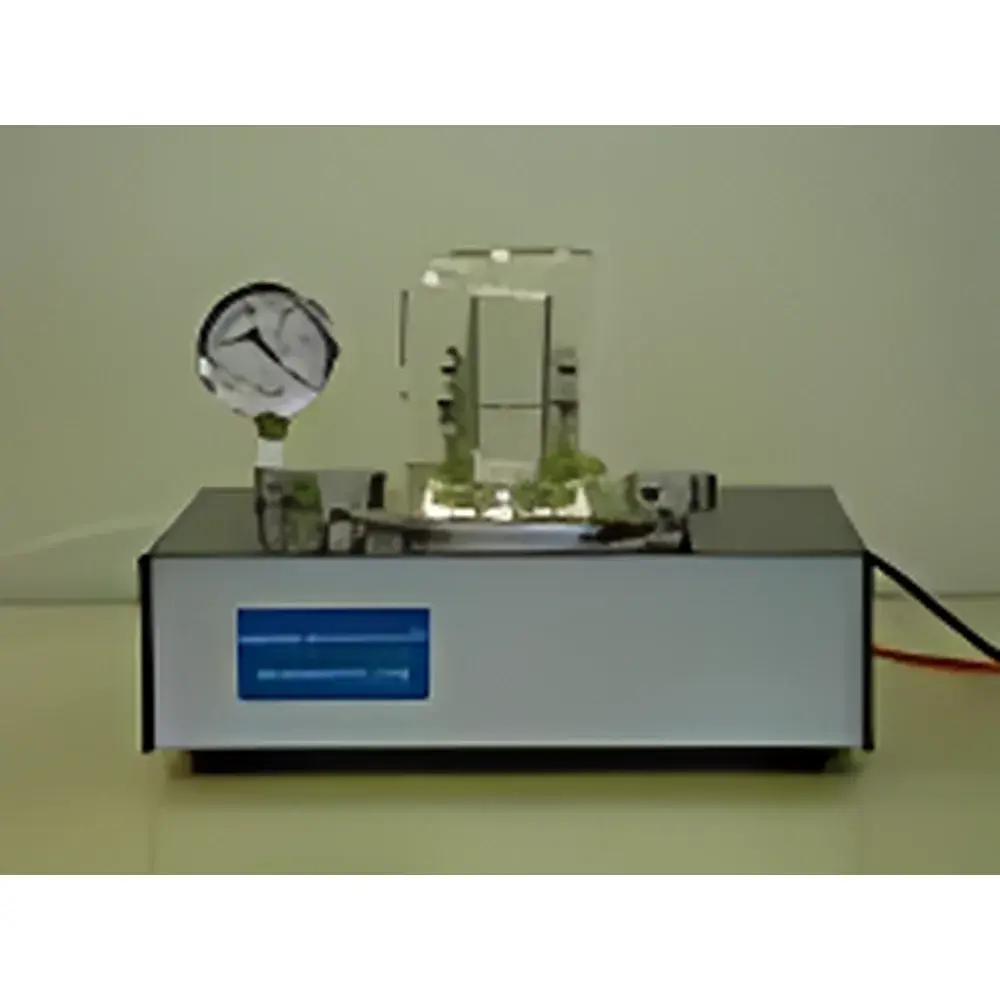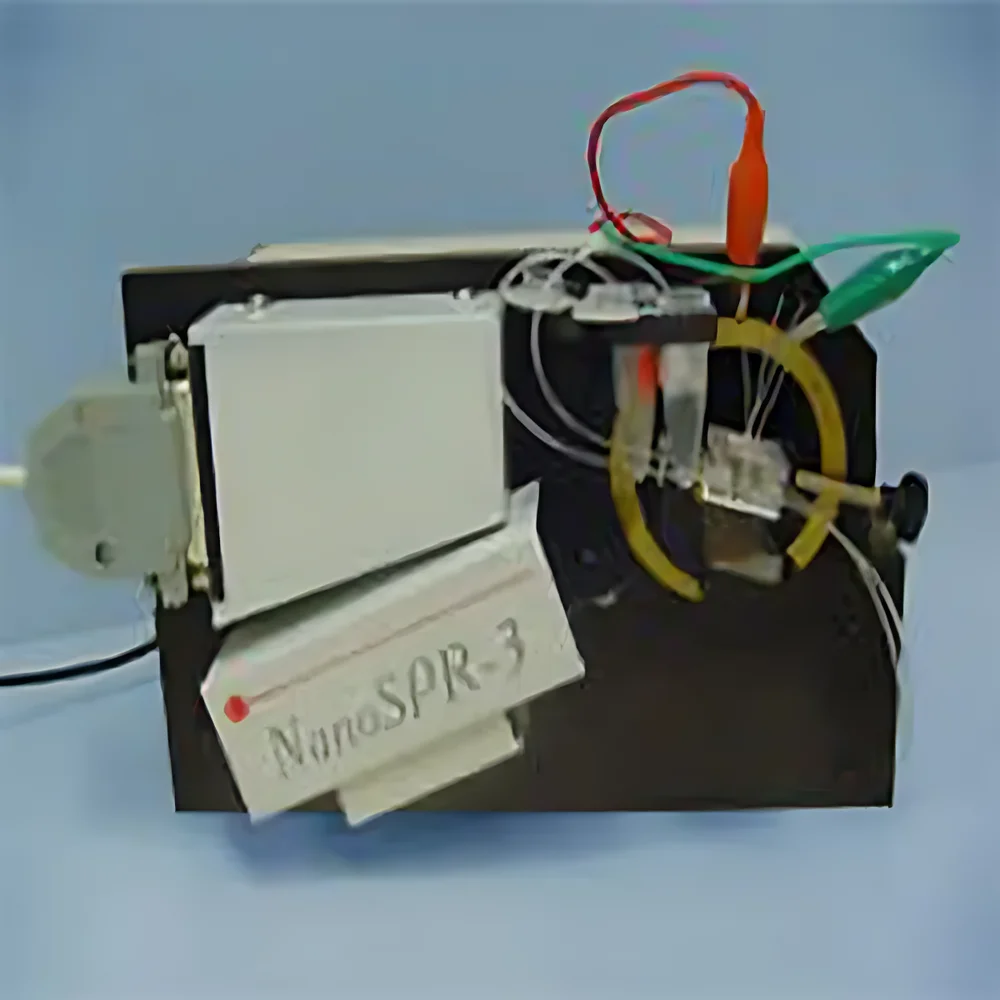
Microphase SPR Surface Plasmon Resonance Analyzer

| Brand | Microphase |
|---|---|
| Origin | Japan |
| Model | SPR |
| Flow Cell Volume | ~20 µL |
| Light Source | Low-Power Laser Diode (630–670 nm) |
| Angular Scan Range | 17° |
| Angular Resolution | 0.003° |
| Detection Mode | Dual-Channel Parallel or Differential Measurement |
| Environmental Compatibility | Liquid and Gaseous Media |
| Interface Options | Analog Signal Input Port |
| Design | Open Architecture for Multimodal Integration |
Ask about pricing, availability and specifications.
Overview
The Microphase SPR Surface Plasmon Resonance Analyzer is a compact, benchtop optical biosensing platform engineered for label-free, real-time monitoring of biomolecular interactions at solid–liquid or solid–gas interfaces. It operates on the fundamental principle of surface plasmon resonance—a collective oscillation of free electrons at a metal–dielectric interface excited by p-polarized light under total internal reflection conditions. When incident light strikes a thin gold film (typically 45–50 nm) deposited on a glass prism at the resonant angle, energy coupling occurs, resulting in a sharp dip in reflected intensity. This resonance angle shifts linearly with changes in the local refractive index within the evanescent field (~200 nm penetration depth), enabling quantitative detection of mass changes—down to sub-monolayer coverage—on the sensor surface. Unlike bulk-phase techniques such as ELISA or ITC, SPR provides continuous kinetic profiling (ka, kd, KD) without molecular labeling, preserving native conformation and binding stoichiometry. The system is optimized for applications requiring high temporal resolution, low sample consumption, and compatibility with physiological or non-aqueous environments.
Key Features
- Open optical architecture with unobstructed access to the sensor chip surface—enabling concurrent integration with fluorescence microscopy, electrochemical potentiostats, surface-enhanced Raman spectroscopy (SERS), atomic force microscopy (AFM), scanning electron microscopy (SEM), and Fourier-transform infrared (FT-IR) spectrometers.
- Dual-channel configuration supports reference-subtracted measurements to eliminate bulk refractive index drift, temperature fluctuations, and non-specific adsorption artifacts—critical for high-fidelity kinetic analysis in complex matrices (e.g., serum, food extracts, fermentation broths).
- Low-power laser diode (630–670 nm) ensures stable illumination with minimal photothermal perturbation and extended source lifetime; wavelength selection balances plasmon excitation efficiency and compatibility with common bioconjugation chemistries.
- High-precision angular scanning mechanism achieves 0.003° resolution over a 17° range—sufficient to resolve sub-ng/cm² mass changes corresponding to <1% surface coverage variation for typical proteins (MW 10–150 kDa).
- Microfluidic flow cell with ~20 µL dead volume minimizes reagent consumption and enables rapid buffer exchange (<30 s), supporting high-throughput screening of ligand–analyte pairs under controlled laminar flow conditions.
- Analog input port allows synchronized acquisition of auxiliary signals (e.g., pH, conductivity, redox potential), facilitating correlative studies of binding events alongside environmental parameters.
Sample Compatibility & Compliance
The Microphase SPR analyzer accommodates a broad range of sample types—including purified proteins, nucleic acids, glycans, small-molecule inhibitors, whole cells, exosomes, and food-grade emulsifiers or allergens—in both aqueous buffers and volatile organic solvents (e.g., ethanol, isopropanol). Sensor chips are compatible with standard gold-coated glass substrates functionalized via thiol-based self-assembled monolayers (SAMs), carboxymethyl dextran, or nitrocellulose coatings. The instrument meets essential requirements for GLP-compliant workflows: audit-trail-enabled software logging, user-access controls, electronic signatures (per FDA 21 CFR Part 11 readiness), and traceable calibration protocols aligned with ISO/IEC 17025 guidance for analytical instrumentation validation. While not certified for clinical diagnostics, its performance characteristics align with ASTM E2980–14 (Standard Guide for SPR Biosensor Characterization) and ISO 20776-1 for in vitro diagnostic device evaluation frameworks.
Software & Data Management
Acquisition and analysis are performed using Microphase’s proprietary SPR Control Suite, a Windows-based application supporting real-time sensorgram visualization, global fitting of association/dissociation phases using 1:1 Langmuir, bivalent analyte, or heterogeneous ligand models, and batch processing of multi-cycle kinetics. Raw angular data are stored in HDF5 format with embedded metadata (timestamp, flow rate, temperature, user ID), ensuring FAIR (Findable, Accessible, Interoperable, Reusable) data principles. Export options include CSV, Excel, and industry-standard Biacore-compatible .txt formats for cross-platform validation. Software modules support automated regeneration sequence programming, concentration series dilution mapping, and statistical outlier detection based on residual analysis—facilitating reproducible method transfer across laboratories.
Applications
This SPR platform is routinely deployed in academic and industrial research settings for: characterization of protein–protein affinity in food allergen cross-reactivity studies; real-time monitoring of enzyme–inhibitor binding during functional ingredient development; screening of antimicrobial peptides against bacterial membrane mimics; quantification of lectin–carbohydrate interactions in plant-based dairy alternatives; and kinetic profiling of antibody–antigen binding in quality control of monoclonal antibody therapeutics. Its gas-phase capability also supports catalytic surface science investigations—such as CO oxidation on supported metal nanoparticles—where interfacial adsorption dynamics govern reaction selectivity.
FAQ
What sample volumes are required per injection?
Typical injections use 30–50 µL at flow rates of 5–30 µL/min; the 20 µL flow cell volume ensures efficient mass transport while minimizing dispersion.
Can the system be used with opaque or turbid samples?
Yes—SPR is insensitive to sample opacity or light scattering, making it suitable for crude lysates, homogenized food matrices, or colloidal suspensions without centrifugation or filtration.
Is temperature control available?
The base unit operates at ambient temperature; optional Peltier-controlled stage (±0.1°C stability) is available for thermodynamic binding studies.
How is sensor surface regeneration validated?
Regeneration efficacy is assessed via baseline stability across ≥5 consecutive binding–regeneration cycles; acceptable drift is ≤0.5 m° in resonance angle between cycles.
Does the system support custom sensor chip fabrication?
Yes—the open fluidic interface and standardized Kretschmann geometry allow integration of user-fabricated chips (e.g., graphene oxide, Ni–Au bimetallic, or peptide-nanowire hybrids) with appropriate optical coupling alignment.
More from Microphase
View all Microphase products → Microphase Model 15 Magnetron Sputtering System
- Microphase MPCVD-50 Microwave Plasma Chemical Vapor Deposition System for Carbon Nanotube Synthesis
- Microphase MPCVD-Graphene Microwave Plasma Chemical Vapor Deposition System
- Microphase MPCNT-Basic Chemical Vapor Deposition System for Carbon Nanotube Synthesis