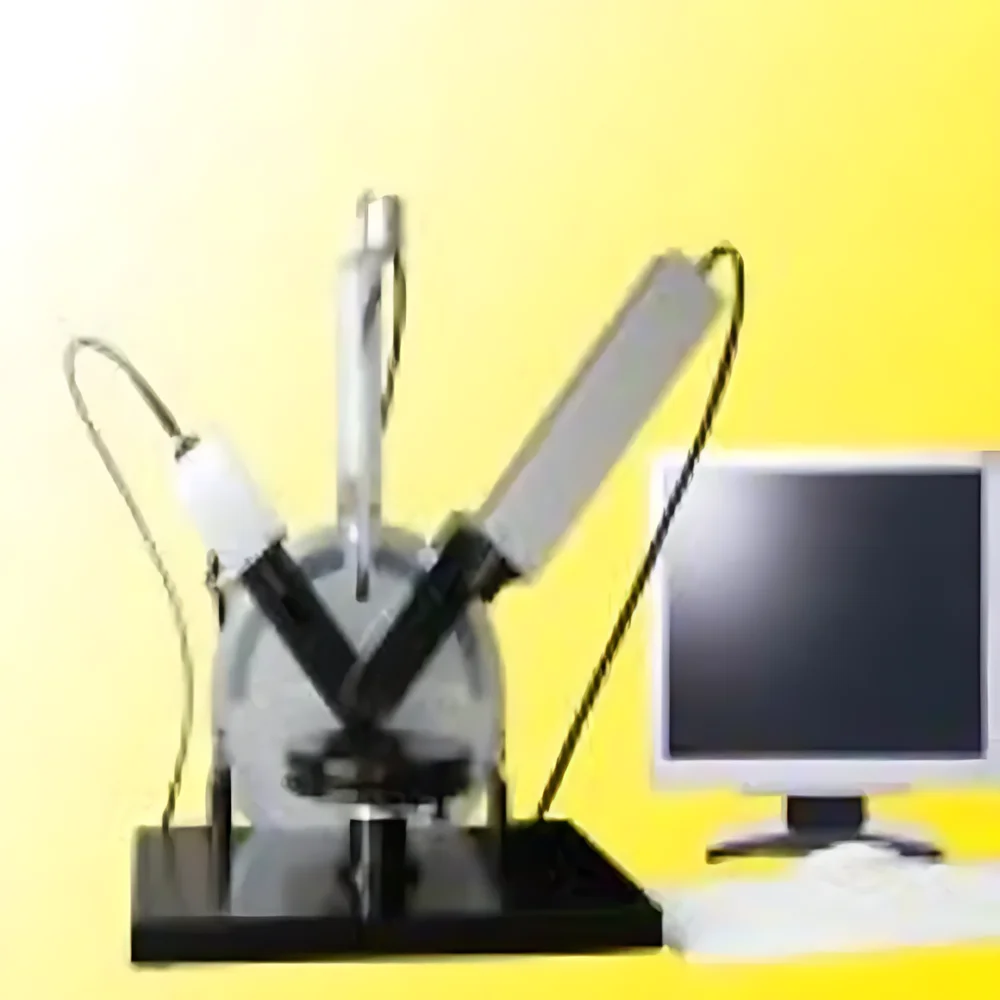
Microphase 16 Spectral Response / IPCE / Quantum Efficiency Measurement System

| Brand | Microphase |
|---|---|
| Origin | Japan |
| Manufacturer Type | Authorized Distributor |
| Product Origin | Imported |
| Model | 16 |
| Price Range | USD 14,000 – 28,000 |
| Wavelength Range | 300–1100 nm / 1100–1400 nm / 1100–1700 nm |
| Monochromator Bandwidth | 5 nm (adjustable) |
| Modulation Frequency | ≥4 Hz |
| Repeatability | ±1% |
| Control Interface | Computer-controlled via USB/Ethernet |
| Calibration | NIST-traceable wavelength and irradiance standards |
| Temperature Control | Integrated Peltier stage (−10 °C to +80 °C, ±0.1 °C stability) |
Ask about pricing, availability and specifications.
Overview
The Microphase 16 Spectral Response / IPCE / Quantum Efficiency Measurement System is a precision optical instrumentation platform engineered for quantitative characterization of photovoltaic (PV) devices under monochromatic illumination. It operates on the principle of modulated photocurrent spectroscopy—where incident monochromatic light, generated by a computer-controlled dual-grating monochromator, is chopped at a stable frequency (≥4 Hz) and directed onto the device under test (DUT). The resulting AC photocurrent is measured synchronously using lock-in amplification, enabling high signal-to-noise ratio detection even at low light intensities. This methodology directly supports measurement of external quantum efficiency (EQE), internal quantum efficiency (IQE), incident photon-to-current efficiency (IPCE), spectral responsivity (A/W), and reflectance-corrected quantum yield. Designed for research-grade solar cell development—including perovskite, silicon heterojunction (HJT), CIGS, organic PV (OPV), and tandem architectures—the system meets foundational metrological requirements for traceable, reproducible optoelectronic characterization in academic labs, national institutes, and industrial R&D centers.
Key Features
- Dual-grating monochromator with user-adjustable spectral bandwidth (5 nm FWHM), ensuring high wavelength resolution and minimal stray light across UV–NIR ranges (300–1700 nm)
- Integrated filter wheel with calibrated bandpass filters and stray-light suppression optics, enabling spectral range switching and background noise reduction
- Automated wavelength calibration using built-in mercury-argon lamp reference lines (e.g., 365.0 nm, 404.7 nm, 435.8 nm, 546.1 nm, 696.5 nm)
- Simultaneous measurement of device photocurrent response and incident light intensity via calibrated Si/InGaAs photodiodes with NIST-traceable responsivity data
- Real-time calculation and export of EQE, IPCE, IQE (with optional reflectance module), spectral responsivity, and normalized spectral mismatch factors
- Peltier-based temperature-controlled sample stage (−10 °C to +80 °C, ±0.1 °C stability) for thermal-dependent quantum efficiency studies under controlled ambient conditions
- Fully automated measurement sequences—including dark current subtraction, bias light integration, and multi-point spectral scans—with configurable dwell time and averaging
Sample Compatibility & Compliance
The Microphase 16 accommodates standard PV device formats: rigid and flexible substrates up to 150 mm × 150 mm, including wafer-scale cells, mini-modules, and encapsulated test coupons. Electrical interfacing supports 2-, 3-, and 4-terminal configurations with guarded triaxial connections for low-noise current measurement down to picoampere levels. Optical alignment is facilitated by kinematic mounts compatible with standard optical tables (M6 or 1/4″-20 threaded holes). The system complies with ASTM E1021 (Standard Test Methods for Spectral Responsivity Measurements of Photovoltaic Devices), IEC 60904-8 (Photovoltaic devices — Part 8: Measurement of spectral response of a photovoltaic (PV) device), and ISO/IEC 17025 requirements for calibration traceability. All irradiance calibrations are referenced to NIST SRM 2270 (Si photodiode) and SRM 2271 (InGaAs photodiode), with full uncertainty budgets documented per GUM (Guide to the Expression of Uncertainty in Measurement).
Software & Data Management
The system is operated via Microphase QEMaster v4.x—a Windows-based application supporting instrument control, real-time data visualization, batch processing, and report generation in PDF, CSV, and XML formats. Software architecture includes role-based access control, electronic signature capability, and audit trail logging compliant with FDA 21 CFR Part 11 for regulated environments. Measurement protocols are fully scriptable using Python API (PyQEMaster), enabling integration into automated testing workflows and LIMS environments. Raw lock-in amplifier outputs, wavelength-stamped photocurrents, and reference diode signals are stored with metadata (date/time, operator ID, environmental conditions, calibration IDs), ensuring full GLP/GMP traceability. Exported datasets conform to PVLIB-compatible spectral format (Wavelength [nm], EQE [-], Uncertainty [%]) for cross-platform modeling and simulation.
Applications
- Quantitative EQE/IPCE mapping of single-junction and multi-junction solar cells for spectral loss analysis
- IQE derivation via concurrent reflectance measurement (optional integrating sphere accessory)
- Temperature-dependent quantum efficiency studies for carrier recombination mechanism analysis
- Validation of optical modeling (e.g., transfer matrix method simulations) against experimental spectral response
- Quality assurance of anti-reflection coatings, passivation layers, and textured surfaces
- Calibration and verification of reference cells used in solar simulator spectral mismatch correction
- Research on emerging absorber materials—including perovskites, quantum dots, and 2D semiconductors—under sub-bandgap and hot-carrier excitation regimes
FAQ
What wavelength ranges does the Microphase 16 support, and how are they selected?
The system covers three discrete spectral bands: 300–1100 nm (Si-optimized), 1100–1400 nm (extended InGaAs), and 1100–1700 nm (broadband InGaAs). Range selection is automated via motorized filter wheel and detector switching; no manual hardware reconfiguration is required.
Is the system capable of measuring internal quantum efficiency (IQE)?
Yes—when paired with an optional reflectance measurement module (integrating sphere + calibrated reference standard), the software computes IQE using the formula: IQE(λ) = EQE(λ) / (1 − R(λ)), where R(λ) is the spectrally resolved reflectance.
How is calibration traceability maintained?
All spectral and radiometric calibrations are performed using NIST-traceable standards: SRM 2270 (Si photodiode), SRM 2271 (InGaAs photodiode), and Hg-Ar lamp for wavelength verification. Calibration certificates include expanded uncertainties (k=2) and are valid for 12 months under normal operating conditions.
Can the system operate under bias illumination?
Yes—the integrated LED bias light source (470 nm or 630 nm, adjustable 0–100 mW/cm²) enables quasi-steady-state photoconductivity measurements and Voc-dependent EQE analysis per IEC 60904-8 Annex B.
What electrical safety and grounding provisions are included?
The system features isolated analog front-end circuitry, grounded Faraday shielding around the detector chamber, and compliance with IEC 61010-1 for measurement category CAT II, pollution degree 2, and overvoltage category II environments.