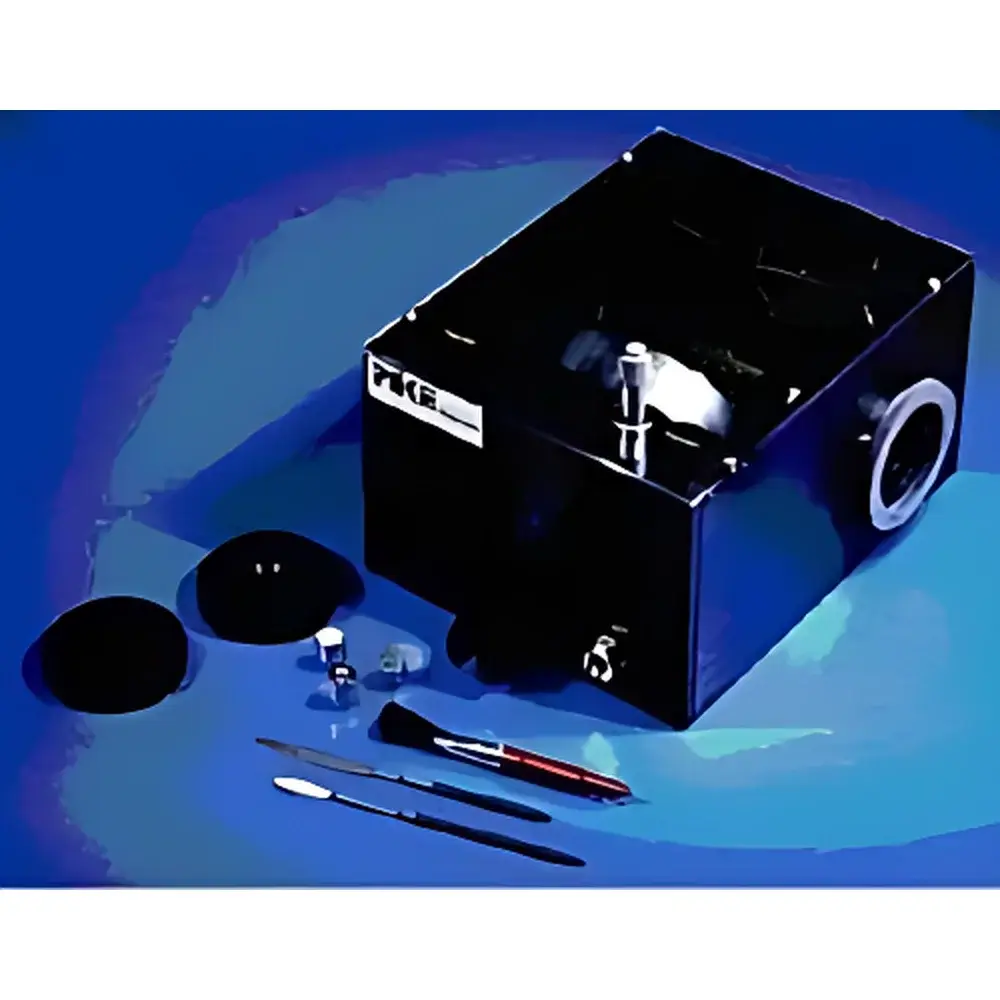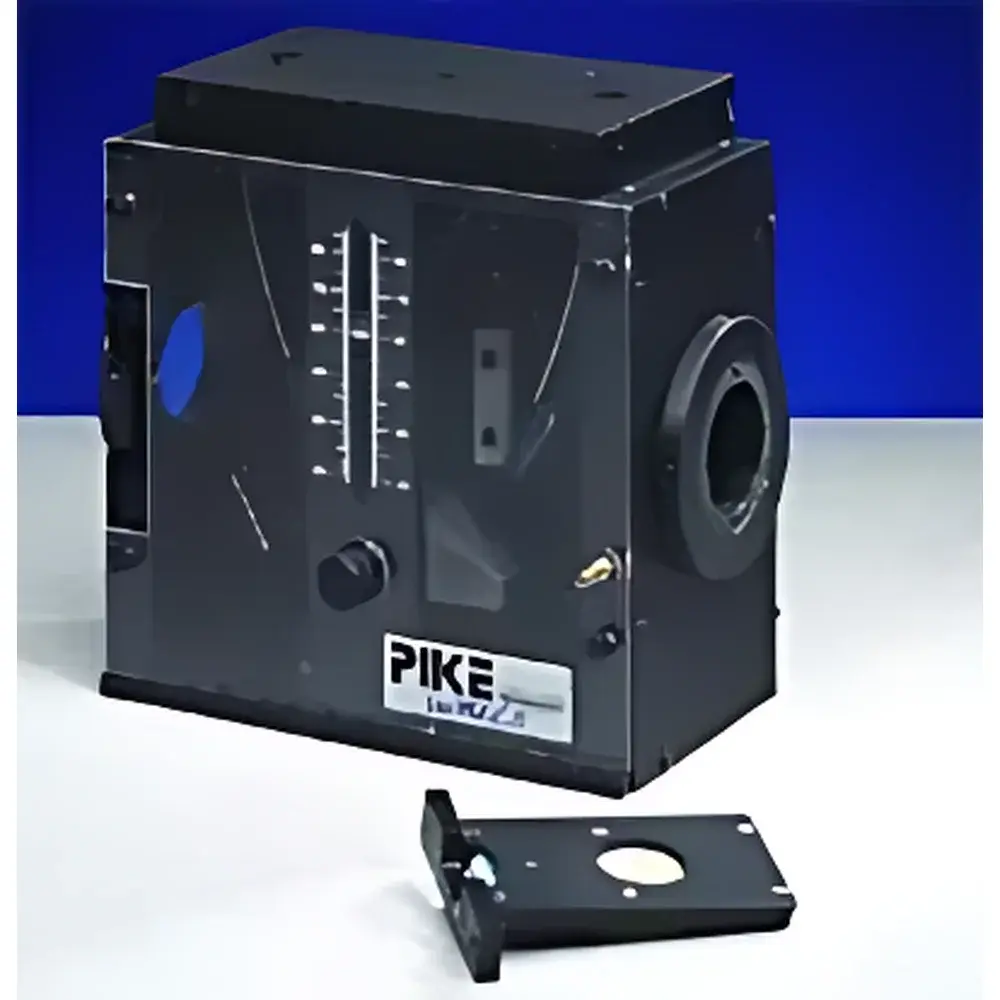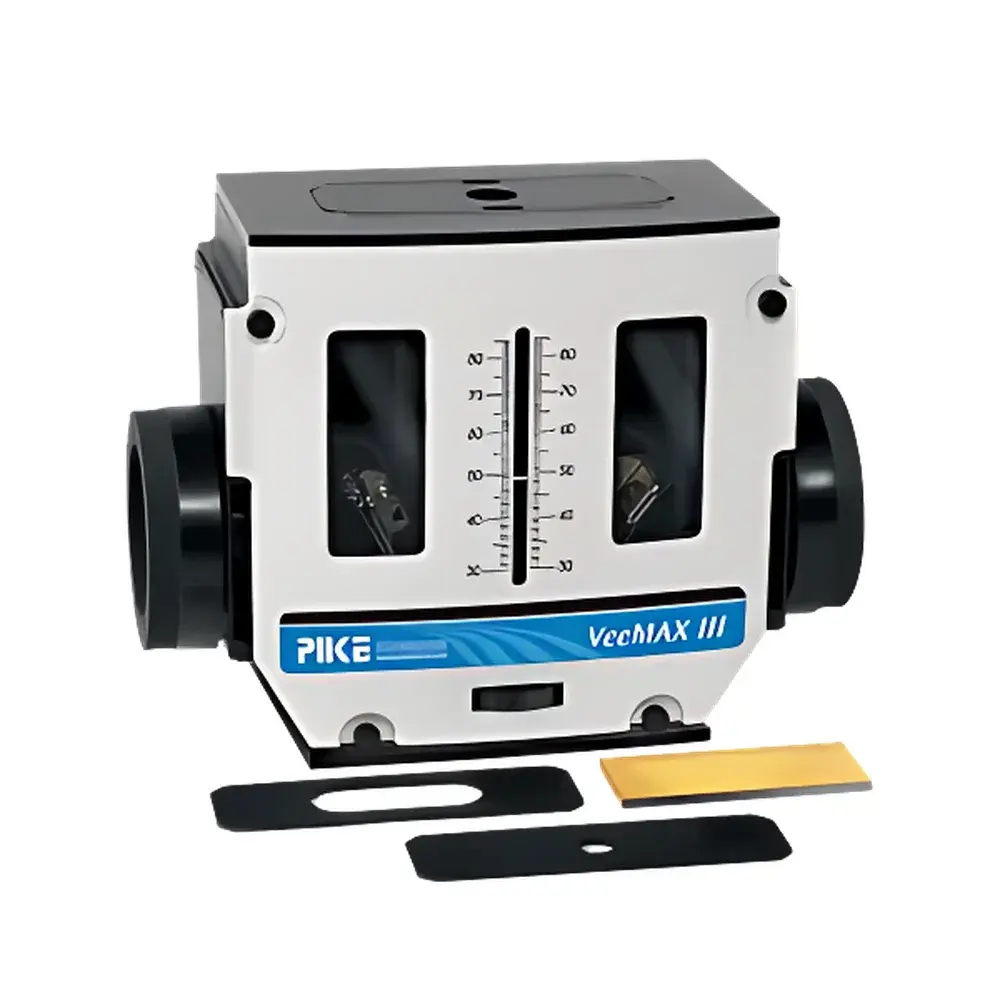
Pike VeeMax III Variable-Angle Mirror Reflection Accessory

| Brand | Pike |
|---|---|
| Origin | USA |
| Model | VeeMax III |
| Angle Range | 30°–80° |
| Compatible Modes | Specular Reflection, Attenuated Total Reflection (ATR) |
| Polarizer Mounting | Integrated slot for linear polarizers |
| Electrochemical Compatibility | Designed for integration with IR-compatible electrochemical cells |
Ask about pricing, availability and specifications.
Overview
The Pike VeeMax III Variable-Angle Mirror Reflection Accessory is an engineered optical interface module designed for Fourier Transform Infrared (FTIR) spectrometers to enable precise, angle-resolved surface interrogation of thin films, monolayers, and interfacial systems. Based on the principle of specular (mirror) reflection spectroscopy, the accessory allows controlled variation of the incident beam angle—ranging continuously from 30° to 80° relative to the sample normal—to optimize signal-to-noise ratio, enhance surface sensitivity, and resolve orientation-dependent vibrational modes. Its mechanical architecture supports both conventional mirror reflection measurements and configurable adaptation to attenuated total reflection (ATR) geometry when paired with appropriate internal reflection elements (IREs), extending its utility across interfacial chemistry, Langmuir–Blodgett film characterization, and in situ electrochemical IR studies.
Key Features
- Precision-machined goniometric stage enabling reproducible angle selection from 30° to 80° in 0.1° increments, with locking mechanism for long-term measurement stability.
- Dual-mode optical path design: native support for specular reflection; optional ATR configuration via removable baseplate and IRE alignment fixtures.
- Integrated linear polarizer mounting slot positioned at the beam entrance, facilitating polarization-modulated IR reflection–absorption spectroscopy (PM-IRRAS) without realignment.
- Modular coupling interface compatible with standard FTIR spectrometer sample compartments (e.g., Thermo Nicolet iS50, Bruker Vertex 80v, PerkinElmer Frontier), including kinematic mounting and beam-height matching.
- Electrochemical cell integration capability: provisioned ports and clearance for commercially available IR-transparent electrochemical flow cells or stationary thin-layer cells (e.g., Harrick-type or custom quartz/PKZT configurations).
- Optical components fabricated from high-purity aluminum-coated mirrors and CaF₂ windows (optional ZnSe or BaF₂ variants available), ensuring broadband IR transmission (4000–400 cm⁻¹) and low scatter.
Sample Compatibility & Compliance
The VeeMax III accommodates substrates up to 25 mm in diameter—including silicon wafers, gold-coated glass slides, germanium crystals, and conductive ITO-coated surfaces—enabling analysis of self-assembled monolayers (SAMs), polymer thin films, lipid bilayers, and catalytic coatings. It supports ambient, purged, and controlled-humidity environments when used inside standard desiccated or gas-purged FTIR chambers. The accessory conforms to ISO 17025 general requirements for competence of testing and calibration laboratories, and its mechanical repeatability (±0.05° angular deviation over 100 cycles) meets ASTM E1421–22 guidelines for infrared reflectance instrumentation verification. When deployed in regulated environments (e.g., pharmaceutical process analytical technology or battery R&D), the system supports GLP-compliant documentation through traceable angle settings logged via host spectrometer software.
Software & Data Management
Angle-specific acquisition is fully integrated into major FTIR control platforms—including OMNIC (Thermo), OPUS (Bruker), and Spectrum (PerkinElmer)—allowing automated angle sweeps, background referencing per angle, and real-time normalization. Raw interferograms are stored with embedded metadata (angle, date, operator ID, spectrometer configuration), satisfying FDA 21 CFR Part 11 audit trail requirements when used with validated instrument software versions. Post-processing supports Kramers–Kronig transformation for complex refractive index extraction and Fresnel-based modeling of layer thickness and dielectric function using third-party tools such as GRASS or RefFit.
Applications
- In situ monitoring of redox-induced conformational changes in electroactive monolayers during cyclic voltammetry-coupled FTIR experiments.
- Quantitative determination of molecular tilt angles in alkylthiol SAMs on Au(111) via intensity ratio analysis of CH₂ symmetric/asymmetric stretches at multiple incidence angles.
- Characterization of interfacial water structure at catalyst–electrolyte boundaries under operando conditions using PM-IRRAS mode.
- Thickness profiling of spin-coated polymer films (1–100 nm) through interference fringe analysis in angle-dependent reflectance spectra.
- Validation of coating uniformity and interfacial adhesion in multilayer optical filters and anti-reflective stacks.
FAQ
What is the minimum detectable film thickness achievable with the VeeMax III in specular reflection mode?
For well-ordered, strongly absorbing monolayers (e.g., C–H or C=O vibrations), detection limits approach sub-monolayer coverage (~0.1 nm equivalent thickness) when combined with high-brightness IR sources and liquid-nitrogen-cooled MCT detectors.
Can the VeeMax III be used with synchrotron IR beamlines?
Yes—the accessory’s compact footprint (<120 mm × 95 mm base), low thermal mass, and absence of motorized components make it suitable for vacuum-compatible or ultra-high-stability beamline endstations, provided beam height and divergence match standard FTIR alignment specifications.
Is firmware or driver update required to enable angle sweep functionality?
No—angle control is purely mechanical; automation relies on the host spectrometer’s stage-control API. No proprietary firmware is embedded in the accessory itself.
Does Pike provide application support for electrochemical IR experimental design?
Yes—Pike Technologies offers documented protocols, reference spectra libraries, and remote consultation for integrating the VeeMax III with potentiostats and IR-transparent electrochemical cells, aligned with ASTM G102 and IUPAC recommendations for interfacial electrochemistry.