
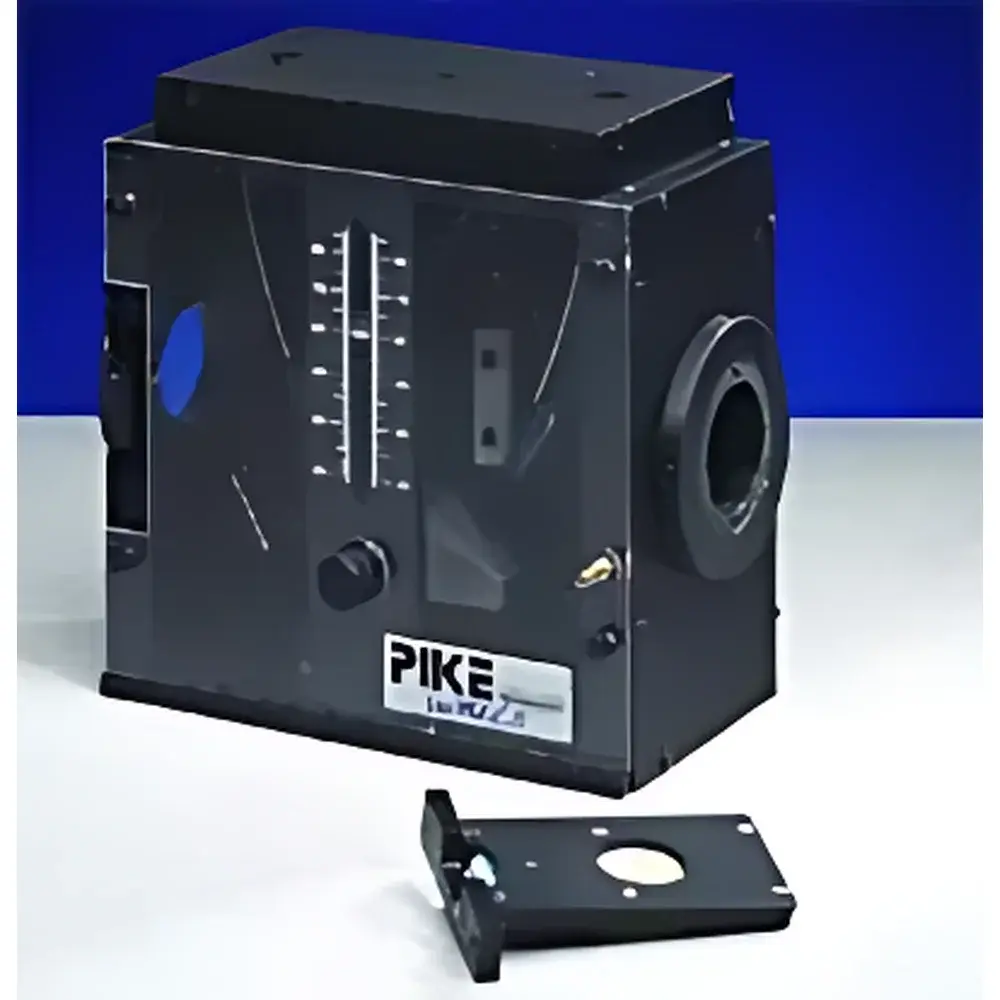
PIKE VeeMAX™ Variable-Angle Mirror Reflection Accessory for FTIR Spectrometers
| Brand | PIKE |
|---|---|
| Origin | USA |
| Model | 16x-xxx |
| Angle Range | 30°–80° (continuously adjustable) |
| Mounting | Pin-locating base compatible with Varian, Shimadzu, Bruker, Thermo Fisher, and PerkinElmer FTIR spectrometers |
| Configuration | External sample stage for large-format specimens |
| Optional Upgrade | Motorized angle control with PC interface for automated angular scans |
| Compliance | Designed to meet ISO 17025-aligned measurement practices for reflectance spectroscopy |
Overview
The PIKE VeeMAX™ Variable-Angle Mirror Reflection Accessory is an engineered optical interface designed for Fourier Transform Infrared (FTIR) spectrometers to perform quantitative specular reflectance measurements across a precisely controlled angular range of 30° to 80°. Based on the principle of angle-resolved specular reflection—where incident and reflected beams lie in the same plane and obey the law of reflection—the accessory enables systematic investigation of thin-film interference, surface oxide thickness (e.g., SiO₂ on silicon wafers), interfacial molecular orientation, and depth-profiling of stratified materials. Its external sample platform architecture decouples measurement geometry from the spectrometer’s internal optics, supporting non-destructive analysis of oversized or irregularly shaped specimens—including 200 mm (8-inch) semiconductor wafers—without requiring sample sectioning or vacuum transfer.
Key Features
- Continuously adjustable incidence angle from 30° to 80°, calibrated via precision-machined angular scale and secured by dual-pin locking mechanism for repeatable positioning.
- Modular pin-locating base ensures mechanical compatibility and optical alignment reproducibility across major FTIR platforms: Thermo Nicolet iS series, Bruker Tensor and Vertex systems, Shimadzu IRTracer, PerkinElmer Spectrum Two/Three, and legacy Varian Excalibur instruments.
- External sample stage accommodates specimens up to 250 mm × 250 mm with ±0.5 mm planarity tolerance; includes height-adjustable sample holder with kinematic mounting for tilt-free alignment.
- Optimized gold-coated mirror optics deliver >98% reflectance across the mid-IR range (4000–400 cm⁻¹), minimizing spectral distortion and enabling high signal-to-noise ratio (SNR) even at low-reflectivity angles.
- Optional motorized angle drive system integrates with standard FTIR control software (e.g., OMNIC, OPUS, Spectrum) via USB or RS-232, supporting programmable angular sweeps (e.g., 0.1° increments) and synchronized data acquisition for Brewster angle mapping or Kramers–Kronig analysis.
Sample Compatibility & Compliance
The VeeMAX™ accessory supports solid, rigid, and optically flat samples including single-crystal wafers (Si, Ge, GaAs), coated glass substrates, polymer films, and metallized surfaces. It is routinely employed in semiconductor process control (per SEMI standards), thin-film metrology (ASTM E1311, ISO 9277), and surface chemistry validation (ISO 18344). When operated under documented procedures—including baseline correction using reference gold mirrors and angle-specific background collection—the system supports GLP-compliant data generation. Full audit trails for angle settings, date/time stamps, and instrument configuration are retained when used with 21 CFR Part 11–enabled software environments.
Software & Data Management
Angle metadata is embedded directly into the interferogram header (via Bruker OPUS .0 format or Thermo .spa container), ensuring traceability during post-processing. The accessory is fully supported in commercial FTIR processing suites for calculation of absolute reflectance spectra, complex refractive index extraction (using Fresnel equations), and multilayer modeling (e.g., Cauchy dispersion fitting). Raw angular scan datasets can be exported as CSV or MATLAB-compatible matrices for advanced statistical analysis or machine learning–based film-thickness classification.
Applications
- Quantitative determination of native SiO₂ layer thickness on silicon wafers (30–80 Å resolution via interference fringe analysis at 30°–50°).
- Characterization of self-assembled monolayers (SAMs) and Langmuir–Blodgett films through polarized angle-dependent intensity ratios (p- vs s-polarization).
- Non-contact evaluation of anti-reflective coatings, ITO layers, and dielectric stacks in photovoltaic R&D.
- In-line quality assurance of hard-coated optical components (e.g., AR/HR coatings on laser optics) without disassembly.
- Corrosion product identification on metallic substrates via angle-enhanced surface sensitivity (evanescent field contribution increases near critical angle).
FAQ
Is the VeeMAX™ compatible with benchtop FTIR systems lacking external beam ports?
No. This accessory requires access to the spectrometer’s external sample compartment or purged beam path. Systems without a dedicated external port (e.g., some compact or fiber-coupled models) are not supported.
Can the 30°–80° range be extended to grazing incidence (e.g., 85°–89°)?
Not with the standard VeeMAX™ configuration. PIKE offers a separate Grazing Angle Reflection Accessory (GARA) for angles ≥85°, optimized for ultra-shallow penetration depth and surface-selective detection.
Does the motorized upgrade include calibration certification?
Yes. Each motorized unit ships with NIST-traceable angular calibration report covering full 30°–80° range at 5° intervals, valid for 12 months under standard laboratory conditions.
What maintenance is required for long-term angular accuracy?
Annual verification of pin-base alignment and optical axis collimation is recommended. No routine lubrication or recalibration is needed under ISO 14644 Class 7 cleanroom-equivalent handling conditions.




