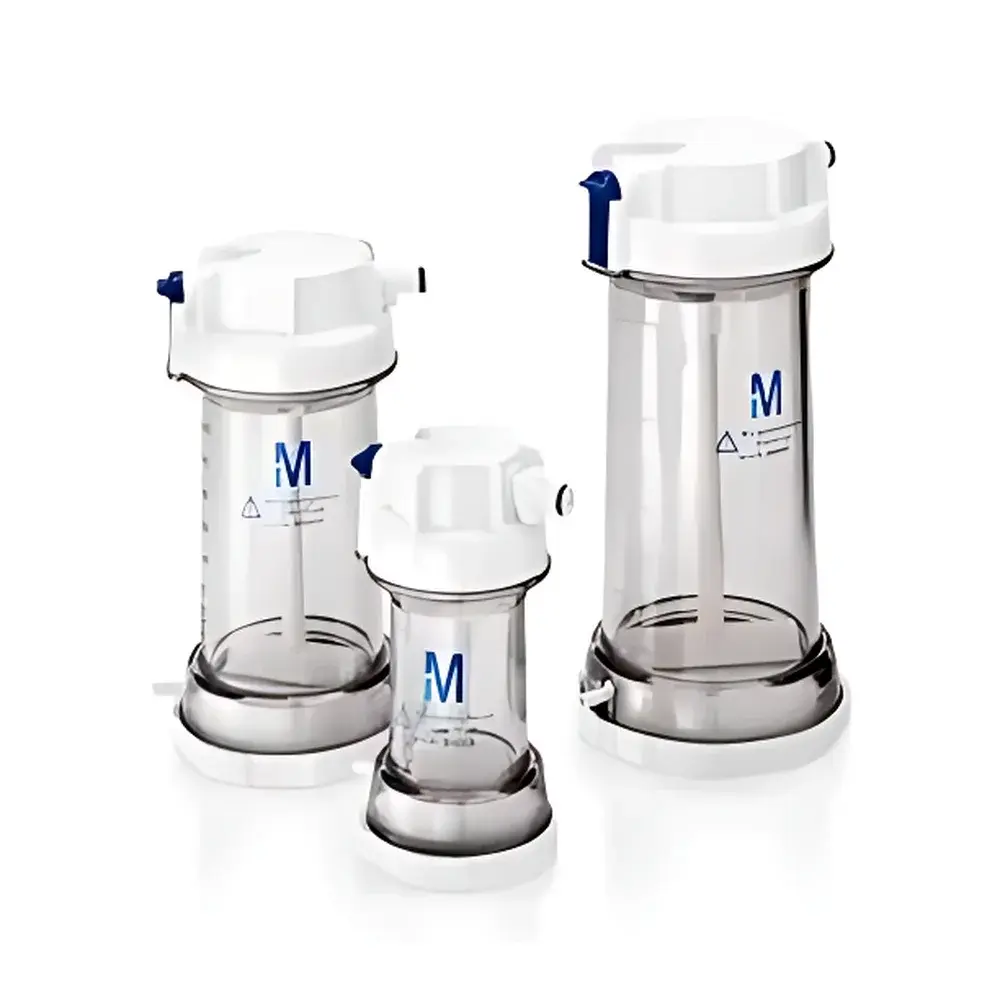
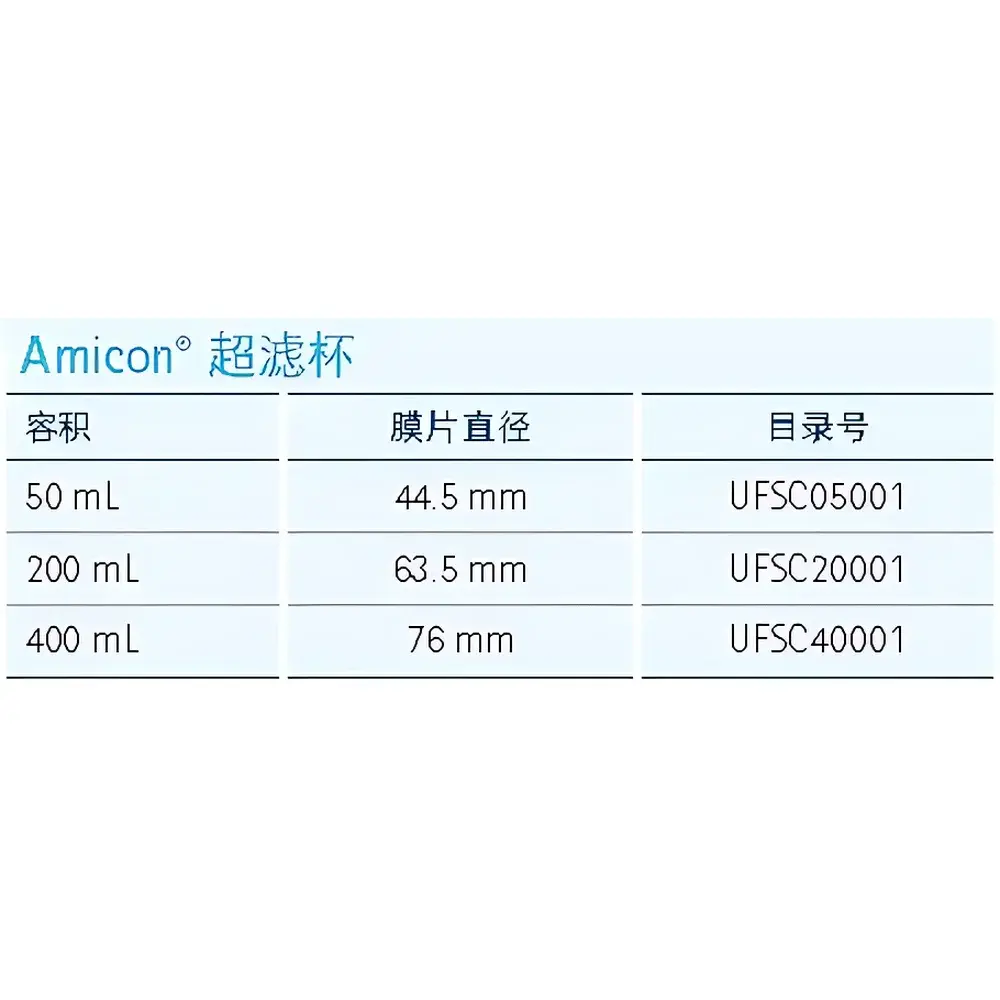
Merck Millipore® Amicon® Stirred Ultrafiltration Cell

| Brand | Merck Millipore |
|---|---|
| Type | Stirred Cell |
| Model | Amicon® Ultrafiltration Cell (11 mL capacity) |
| Max Operating Pressure | 100 psi (6.9 bar) |
| Effective Membrane Area | 4.2 cm² |
| Sample Volume Range | 0.5–11 mL |
| Material | Anodized Aluminum Body, PTFE Seals, Stainless Steel Stir Bar |
| Compatibility | Sterilizable (Autoclavable at 121°C), Solvent-Resistant Options Available |
| Compliance | Meets ASTM D4187 and ISO 15713 for membrane performance evaluation |
Ask about pricing, availability and specifications.
Overview
The Merck Millipore® Amicon® Stirred Ultrafiltration Cell is an engineered laboratory-scale ultrafiltration system designed for precise, reproducible measurement of membrane flux, rejection coefficients, and fouling behavior under controlled hydrodynamic conditions. Based on the classic stirred-cell principle—where a rotating magnetic stir bar generates uniform shear across the membrane surface to minimize concentration polarization—the Amicon® cell enables quantitative assessment of membrane performance in research and development workflows. Since its commercial introduction in 1965, this device has become a globally recognized reference platform for evaluating ultrafiltration (UF) and microfiltration (MF) membranes across academic, industrial, and regulatory environments. Its design adheres to fundamental principles of crossflow filtration kinetics, supporting standardized test protocols required for method validation in water treatment, pharmaceutical process development, and biomaterial characterization.
Key Features
- Robust anodized aluminum housing with integrated pressure-locking mechanism—eliminates reliance on external safety frames while ensuring secure assembly verification via tactile and visual alignment cues.
- Patented internal pressure relief valve and threaded sealing interface prevent over-pressurization and eliminate common leakage pathways observed in legacy stirred cells.
- Ergonomic inlet/outlet port geometry with push-fit fluidic connections enables rapid, tool-free tubing attachment and disconnection without torque-induced seal distortion.
- Optimized stir bar geometry minimizes localized membrane abrasion and promotes laminar shear distribution—extending membrane lifetime and improving inter-run reproducibility.
- Full autoclavability (121°C, 20 min) and optional solvent-resistant configurations (e.g., PEEK body variants) support stringent GMP-compliant cleaning validation and multi-solvent compatibility testing.
- Standardized 4.2 cm² effective filtration area and 11 mL maximum sample volume align with ASTM D4187 guidelines for comparative UF membrane benchmarking.
Sample Compatibility & Compliance
The Amicon® Stirred Ultrafiltration Cell accommodates a broad range of membrane formats—including regenerated cellulose (RC), polyethersulfone (PES), nylon, and track-etched polycarbonate—available in molecular weight cutoffs from 1 kDa to 10 µm. It supports aqueous, organic, and mixed-solvent systems when configured with chemically resistant seals and hardware. The system complies with ISO 15713 for membrane permeability testing and provides traceable operational parameters required for GLP and FDA 21 CFR Part 11–aligned data integrity frameworks. Documentation packages include calibration certificates, material biocompatibility reports (USP Class VI), and full traceability to Merck’s global manufacturing standards.
Software & Data Management
While the Amicon® Stirred Cell operates as a standalone manual or semi-automated unit, it integrates seamlessly with third-party pressure transducers, flow meters, and fraction collectors via standardized 1/8″ NPT and Luer ports. When paired with validated acquisition software (e.g., LabChart, DIAdem, or custom Python-based DAQ scripts), users can log real-time transmembrane pressure (TMP), temperature, filtrate volume, and time-stamped event markers. Audit trails, electronic signatures, and metadata tagging are supported through compliant instrument control platforms—ensuring adherence to ALCOA+ principles for data reliability in regulated environments.
Applications
- Membrane development labs: Screening novel polymeric and ceramic membranes for water desalination pretreatment, wastewater reuse, and forward osmosis integration.
- Pharmaceutical R&D: Assessing protein retention, aggregate formation, and buffer exchange efficiency during downstream purification process optimization.
- Food & beverage QA/QC: Validating microfiltration barrier performance against microbial contaminants (e.g., E. coli, spores) and colloidal stability under shear stress.
- Academic environmental engineering: Quantifying fouling resistance, cake layer formation, and cleaning-in-place (CIP) efficacy using synthetic and real wastewater matrices.
- Regulatory submission support: Generating standardized flux-rejection datasets referenced in EPA Method 1623.2, USP , and EMA Guideline on Quality of Water for Pharmaceutical Use.
FAQ
What is the maximum recommended operating pressure for the standard Amicon® Stirred Cell?
The standard anodized aluminum Amicon® Stirred Cell is rated for continuous operation up to 100 psi (6.9 bar) at 25°C. Exceeding this limit may compromise seal integrity and stir bar stability.
Can the cell be sterilized using autoclaving?
Yes—the complete assembly (excluding optional PEEK components) is fully autoclavable at 121°C for 20 minutes. All elastomeric seals meet USP Class VI biocompatibility requirements.
Which membrane formats are compatible with the 4.2 cm² cell base?
Disc membranes with 25 mm diameter and flat-sheet formats cut to 25 mm × 25 mm are mechanically supported. Merck supplies certified RC, PES, and nylon membranes with MWCOs ranging from 1 kDa to 10 µm.
Is there a version suitable for aggressive organic solvents?
Yes—Merck offers solvent-resistant variants with PEEK bodies and fluoropolymer seals, rated for use with acetone, THF, DMF, and chlorinated hydrocarbons under equivalent pressure and temperature constraints.
How does the stir bar design reduce membrane damage compared to conventional models?
The low-profile, rounded-tip stir bar rotates within a precisely machined recessed channel, minimizing vertical lift and edge contact with the membrane surface—reducing mechanical fatigue by >40% in accelerated lifetime testing.