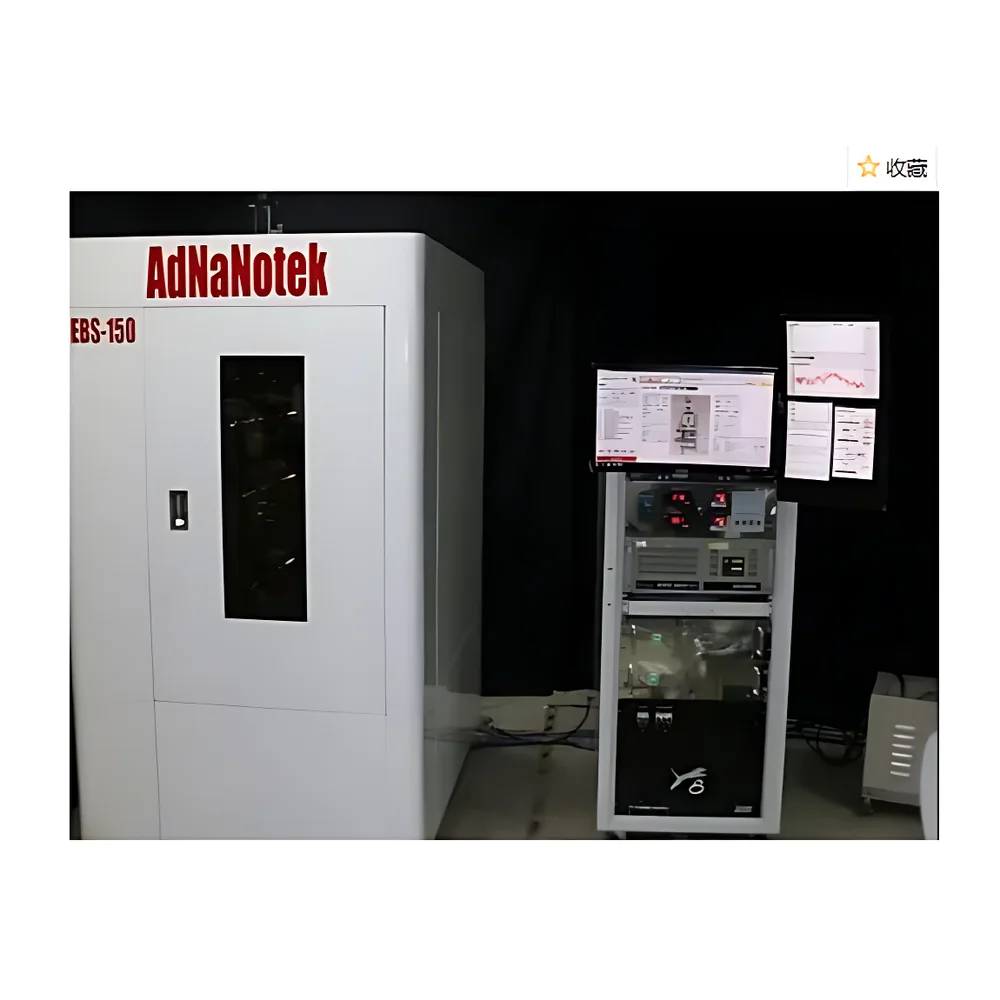
AdNaNotek EBS-150 Electron Beam Evaporation System

| Origin | USA |
|---|---|
| Manufacturer Type | Authorized Distributor |
| Origin Category | Imported |
| Model | EBS-150 |
| Price Range | USD 420,000 – 560,000 (FOB) |
| Minimum Feature Size | Not Applicable (Deposition Tool, Not Lithography Tool) |
| Electron Beam Spot Size | Configurable per source specification |
| Accelerating Voltage Range | 5–10 kV (standard configuration) |
Ask about pricing, availability and specifications.
Overview
The AdNaNotek EBS-150 is a high-vacuum electron beam evaporation system engineered for precision physical vapor deposition (PVD) of refractory metals, dielectrics, oxides, and compound semiconductors. Unlike resistive thermal evaporation or sputtering, the EBS-150 utilizes focused electron beam energy—delivered via thermionic emission from a tungsten or lanthanum hexaboride (LaB₆) cathode—to directly heat source material in a water-cooled copper crucible. This enables localized, high-power-density heating (>10⁶ W/cm²), permitting evaporation of materials with melting points exceeding 3,000 °C (e.g., Ta, W, SiO₂, Al₂O₃). The system operates under ultra-high vacuum (UHV) conditions down to 1×10⁻⁷ Torr, minimizing gas-phase scattering and oxidation, thereby ensuring stoichiometric transfer, low contamination, and high-purity thin-film growth. While often mischaracterized as an “electron beam lithography system” due to shared vacuum infrastructure, the EBS-150 is strictly a *deposition* platform—not a direct-write patterning tool—and is widely deployed in R&D and pilot-line fabrication for optical coatings, superconducting circuits, MEMS metallization, and lift-off processes.
Key Features
- UHV-compatible chamber constructed from electropolished 316L stainless steel with internal RF shielding to suppress stray electron-induced charging and secondary electron emission.
- Base pressure ≤1×10⁻⁷ Torr achieved via dual-stage pumping: primary turbomolecular pump (≥1,200 L/s N₂) + optional cryogenic pump (20 K cold head) for hydrocarbon-free environment.
- 6×3 planetary substrate stage with independent rotation (0–30 rpm) and revolution (0–10 rpm), enabling uniform film thickness distribution across up to six 4-inch wafers or equivalent substrates.
- Multi-crucible e-beam source configuration: single or dual electron guns (options include ULVAC, Telemark, or custom-configured LaB₆ sources); each gun supports up to six independently addressable crucibles (total capacity: 6–12 materials).
- Programmable quartz crystal microbalance (QCM) thickness monitor with dual-sensor redundancy to minimize process interruption from sensor drift or failure.
- Integrated infrared heating assembly (quartz-halogen lamps) with PID-controlled temperature regulation: selectable setpoints at 300 °C, 500 °C, or 800 °C; optional low-temperature mode maintains substrate <80 °C—critical for photoresist integrity during lift-off processing.
- Optional ion-assisted deposition (IAD) module (Ar⁺ or O₂⁺, 0–1,500 eV) for densification, stress control, and enhanced adhesion of oxide and nitride films.
- Modular architecture supports integration with load-lock chambers, inert-atmosphere glovebox interfaces (O₂/H₂O <0.1 ppm), and hybrid PVD platforms (e.g., co-deposition with magnetron sputtering or resistive thermal sources).
Sample Compatibility & Compliance
The EBS-150 accommodates substrates ranging from 10 mm × 10 mm coupons to full 150 mm (6-inch) wafers, with customizable fixture options including flat holders, tilted mounts (±15° adjustable), and patterned shadow masks. All wetted components comply with ASTM F86 (standard practice for surface preparation and marking of metallic surgical implants) and ISO 10993-1 (biocompatibility evaluation framework), supporting applications in biomedical thin-film device development. Vacuum system design adheres to ISO 27427 (vacuum technology — terminology and definitions) and incorporates bake-out capability (up to 150 °C) to meet stringent outgassing requirements for UHV-grade optical coating production. Full audit trail logging—including pressure traces, beam current/voltage profiles, deposition rate curves, and QCM calibration history—is maintained in accordance with FDA 21 CFR Part 11 and GLP/GMP documentation standards when paired with FBBeam software.
Software & Data Management
FBBeam is the native process control suite for the EBS-150, providing deterministic automation of multi-layer deposition sequences, interlayer dwell times, and real-time feedback loops. The software implements hierarchical recipe management (user-, group-, and administrator-level permissions), parameter versioning, and timestamped event logging with SHA-256 hash integrity verification. All deposition runs generate machine-readable .csv and .xml metadata files compliant with ISA-88/ISA-95 batch record structures. Optional OPC UA server integration enables seamless data exchange with MES (Manufacturing Execution Systems) and LIMS platforms. Remote diagnostics and firmware updates are supported over TLS 1.3-secured Ethernet connections, with configurable firewall rules and role-based access control (RBAC).
Applications
The EBS-150 serves advanced thin-film applications requiring high-purity, low-defect-density layers: anti-reflective and high-reflectance optical stacks (e.g., TiO₂/SiO₂ Bragg mirrors for telecom lasers); superconducting NbN and NbTiN films for kinetic inductance detectors (KIDs); transparent conductive oxides (ITO, AZO) on flexible substrates; seed layers for electroplated Cu interconnects; and sacrificial metal stacks (Al/Cr) for high-resolution lift-off lithography. Its compatibility with reactive evaporation (O₂ or N₂ partial pressure control) further extends utility to stoichiometric metal oxide and nitride synthesis—validated in peer-reviewed studies on Ta₂O₅-based memristors and HfO₂ gate dielectrics.
FAQ
Is the EBS-150 capable of electron beam lithography?
No. The EBS-150 is a physical vapor deposition system only. It does not include beam blanking, vector scanning, or pattern generation hardware required for direct-write lithography.
What vacuum level is required before initiating e-beam evaporation?
A stable base pressure ≤5×10⁻⁷ Torr is recommended prior to beam activation to ensure minimal residual gas incorporation and optimal film stoichiometry.
Can the system deposit alloys with precise compositional control?
Yes—via co-evaporation using dual e-beam sources with synchronized rate modulation, or sequential layer-by-layer deposition with in-situ QCM monitoring and closed-loop feedback.
Does the system support automated recipe transfer between instruments?
Yes. FBBeam uses standardized XML-based recipe templates compatible across AdNaNotek’s EBS-series platforms, enabling reproducible process migration from lab-scale to pilot-line tools.
Is ion-assisted deposition (IAD) included by default?
IAD is an optional add-on module. Standard configurations include mechanical shuttering, QCM monitoring, and planetary rotation; IAD requires additional power supply, beam optics, and differential pumping stages.