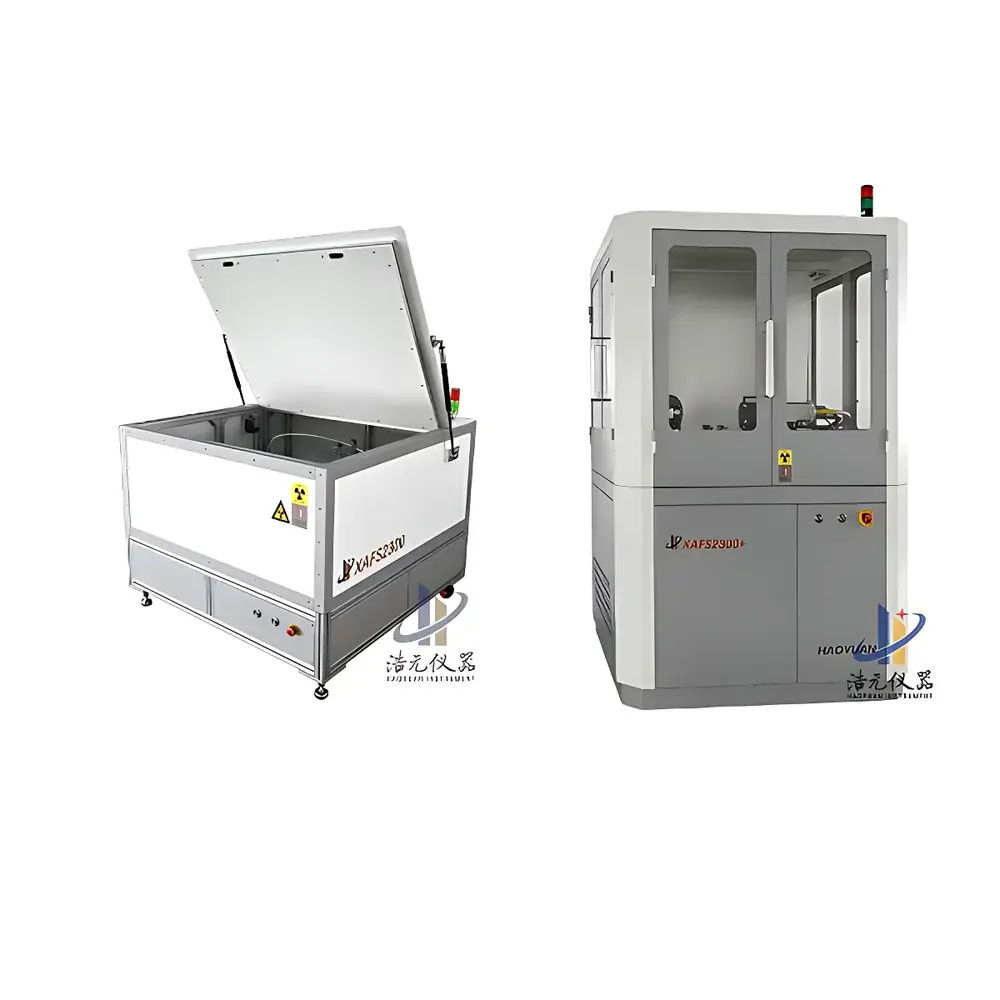
Haoyuan DX2900H Desktop 2D Grazing-Incidence X-ray Diffractometer (2D-GIWAXS)

| Brand | Haoyuan |
|---|---|
| Origin | Liaoning, China |
| Manufacturer Type | Authorized Distributor |
| Product Category | Domestic |
| Model | DX2900H |
| Price Range | USD 140,000 – 280,000 |
| Instrument Type | Powder & Thin-Film X-ray Diffractometer |
| X-ray Source Power | 50 W |
| Anode Material | Cu or Mo |
| Beam Collimation | Multicapillary Optics (0.25° divergence) |
| Focal Spot Size | 0.5 mm |
| Photon Flux | >1×10⁸ ph/s |
| Goniometer Axes | 2-axis thin-film stage (ω: −10° to +10°, resolution 0.002° |
| Z | 0–15 mm, resolution 0.002 mm) |
| Detector | Dectris Pilatus100K (487 × 195 pixels, pixel size 172 µm) |
| Optional Upgrades | 3–5-axis film stage, Pilatus200K/Eiger500K/Eiger1M detectors, transmission stage, in-situ heating stage, solvent vapor chamber, inert-atmosphere glovebox-integrated stage |
Ask about pricing, availability and specifications.
Overview
The Haoyuan DX2900H Desktop 2D Grazing-Incidence X-ray Diffractometer (2D-GIWAXS) is a compact, laboratory-scale instrument engineered for high-resolution structural characterization of thin films, nanolaminates, and surface-adsorbed phases. Unlike conventional Bragg–Brentano powder diffractometers, this system implements grazing-incidence geometry—where the incident X-ray beam strikes the sample surface at angles below the critical angle (typically 0.1°–2.0°)—to enhance surface sensitivity and suppress substrate scattering. The configuration enables quantitative analysis of crystallite orientation, out-of-plane and in-plane lattice parameters, domain size, and strain in polycrystalline or semi-crystalline thin films (e.g., perovskites, conjugated polymers, metal oxides, and 2D layered materials). It serves as a practical alternative to synchrotron-based 2D-GIWAXS when beamtime access is constrained by scheduling, travel restrictions, or operational continuity requirements.
Key Features
- Integrated microfocus X-ray source: Dual-anode (Cu/Mo) tube with 50 W power rating (50 kV / 1 mA), optimized for lab-scale intensity and thermal stability.
- High-brightness multicapillary optics: Delivers collimated beam with ≤0.25° divergence and sub-millimeter focal spot (0.5 mm), achieving photon flux >1×10⁸ ph/s at sample position—comparable to early-generation bending-magnet beamlines.
- Dedicated 2-axis thin-film goniometer: Precision ω-axis (−10° to +10°, 0.002° step resolution) and vertical Z-axis (0–15 mm, 0.002 mm resolution) enable accurate incidence angle control and height alignment for reproducible GI geometry.
- Large-area 2D hybrid pixel detector: Dectris Pilatus100K (487 × 195 active pixels, 172 µm pixel pitch) provides single-photon counting, zero readout noise, and high dynamic range—essential for capturing anisotropic diffraction rings, streaks, and Debye–Scherrer arcs without saturation.
- Modular sample environment support: Interchangeable stages include transmission holder, inert-atmosphere glovebox-integrated stage (pre-assembled under N₂/Ar), and in-situ solvent vapor chamber compatible with common organic solvents (e.g., chlorobenzene, DMF, toluene).
- Scalable architecture: Optional upgrades include 3–5-axis thin-film stages (with φ, χ, and translation degrees of freedom), higher-resolution detectors (Pilatus200K, Eiger500K, Eiger1M), and motorized in-situ heating stages (up to 300 °C).
Sample Compatibility & Compliance
The DX2900H accommodates rigid and flexible substrates (Si wafers, ITO/glass, PET, PI) with thicknesses up to 2 mm and lateral dimensions ≤50 × 50 mm. Film thickness range spans 1 nm to ~500 nm—ideal for organic photovoltaics, ferroelectric heterostructures, and self-assembled monolayers. All mechanical and electrical subsystems comply with IEC 61010-1:2010 (Safety Requirements for Electrical Equipment for Measurement, Control, and Laboratory Use). Radiation shielding meets national Class II X-ray equipment standards (GBZ 138–2002), with interlocked safety enclosure and real-time dose monitoring. Data acquisition and processing workflows support audit-trail generation aligned with GLP principles; raw 2D detector frames are stored in HDF5 format with embedded metadata (exposure time, incidence angle, sample ID, timestamp), facilitating traceability per ISO/IEC 17025:2017 Clause 7.5.2.
Software & Data Management
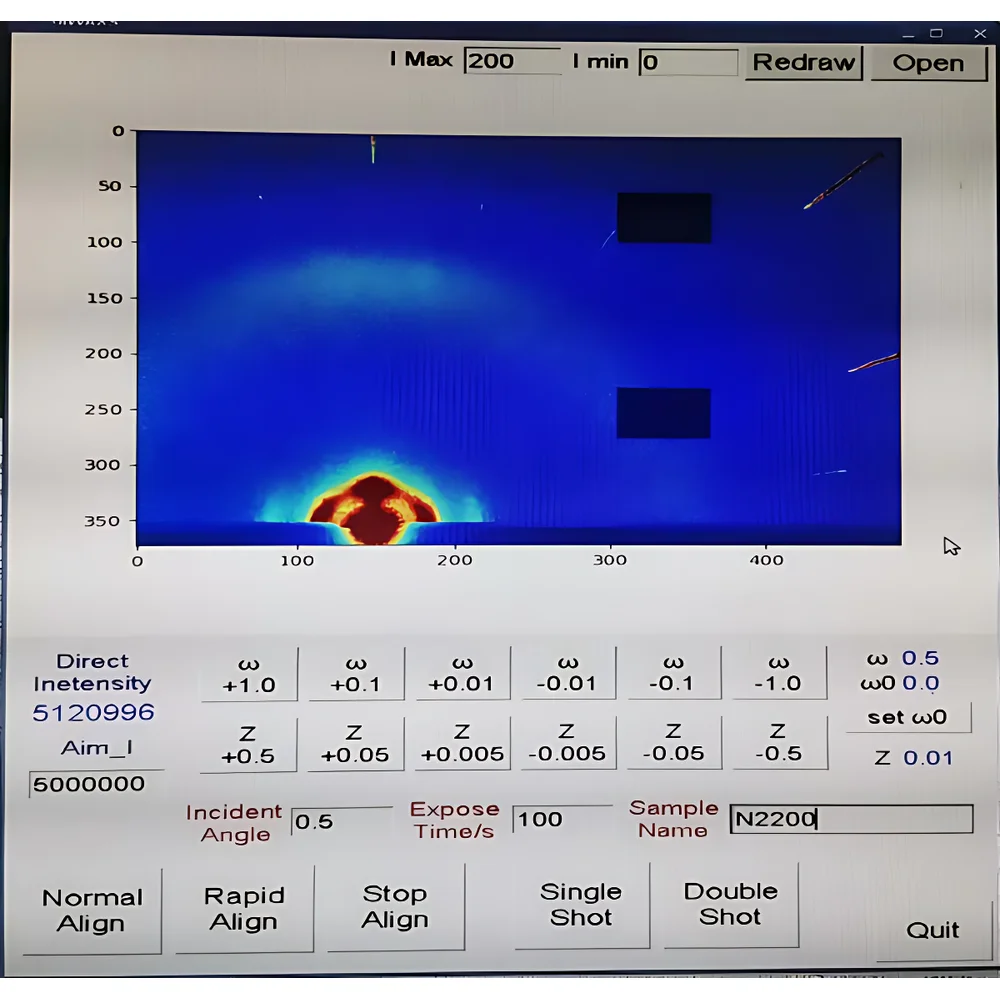
Liyin’s proprietary acquisition and analysis suite—LiyinGIWAXS v3.x—provides synchronized hardware control, real-time 2D image preview, and batch-mode angular integration (azimuthal and radial). The software supports standard file export (CIF, .xy, .chi, .tiff) and integrates with open-source tools including pyFAI, GSAS-II, and Fit2D via API hooks. Calibration routines include direct beam positioning, detector tilt correction, and pixel-to-q conversion using certified NIST SRM 660c (LaB₆). All user actions—including parameter changes, data reduction steps, and report generation—are logged with timestamps and operator IDs, satisfying documentation requirements for internal QA/QC and external regulatory review (e.g., FDA 21 CFR Part 11 compliant configurations available upon request).
Applications
- Crystallinity and phase evolution in solution-processed perovskite thin films (e.g., MAPbI₃, FAPbBr₃) during spin-coating and thermal annealing.
- Out-of-plane vs. in-plane orientation mapping in conjugated polymer systems (e.g., PBTTT, P3HT) for charge transport anisotropy assessment.
- In-situ solvent-vapor-induced structural reorganization in block copolymer thin films.
- Strain quantification at heterointerfaces in epitaxial oxide multilayers (e.g., SrTiO₃/LaAlO₃).
- Time-resolved GIWAXS during electrochemical cycling of battery electrode coatings (LiCoO₂, NMC).
FAQ
Is this system capable of performing both θ–2θ scans and true 2D-GIWAXS measurements?
Yes. The goniometer supports fixed-angle GI geometry for 2D pattern acquisition, as well as sequential θ–2θ scanning with detector arm synchronization for conventional powder diffraction mode.
What is the minimum detectable film thickness for crystalline signal above amorphous background?
Under optimal conditions (Cu Kα, 0.2° incidence, 30 min exposure), crystalline signals from films ≥2 nm thick (e.g., oriented P3HT domains) are reliably resolved using azimuthally integrated intensity profiles.
Can the system be integrated into a nitrogen-filled glovebox?
Yes—the inert-atmosphere stage is pre-aligned and sealed within a custom glovebox port interface; full detector and source housing remain external, with X-ray beam guided through beryllium windows.
Does the software support automatic peak indexing and space-group determination?
Basic indexing (using DICVOL or TREOR algorithms) is included; full structure solution requires coupling with GSAS-II or TOPAS via exported .chi files.
What maintenance intervals are recommended for the X-ray tube and detector?
The microfocus tube is rated for ≥5,000 h mean time between failures; annual calibration of goniometer encoders and detector geometry is advised. Dectris detectors require no routine maintenance beyond firmware updates and periodic vacuum checks.