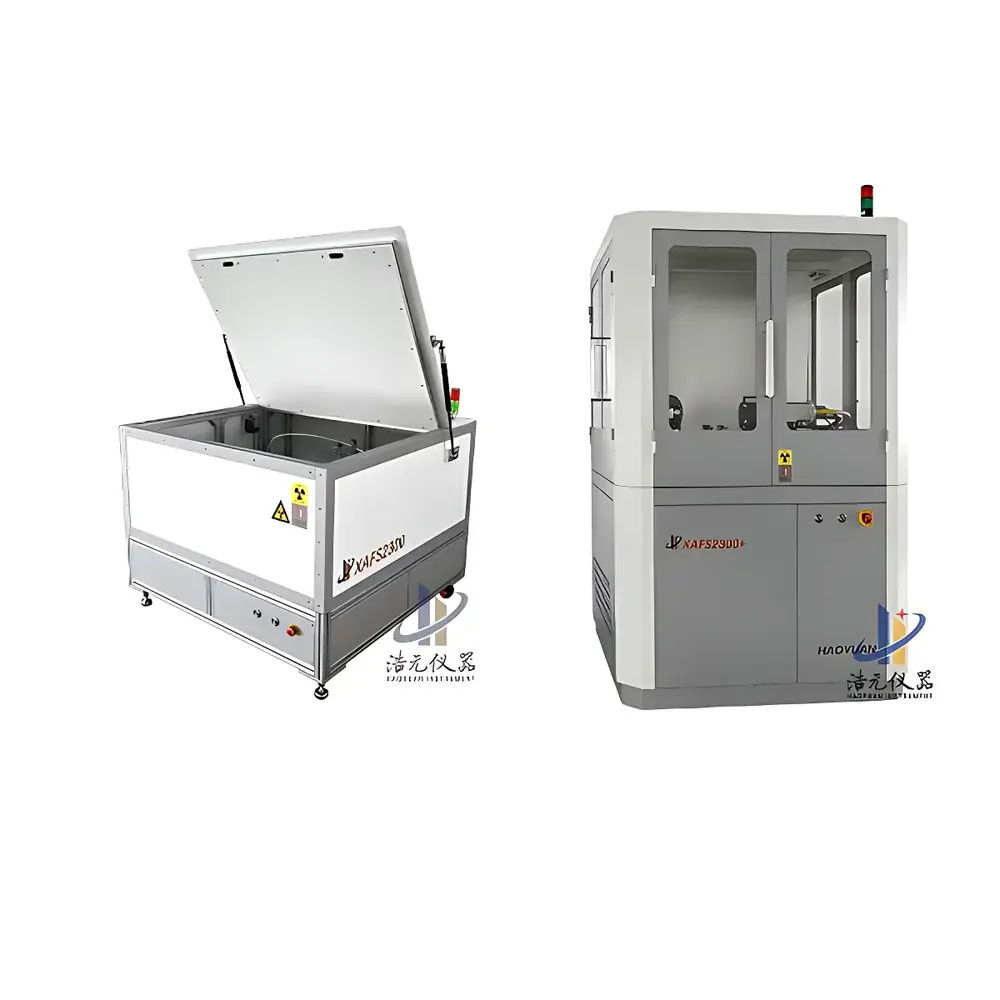
Shenketai DX-2700BH Multi-Functional X-ray Diffractometer

| Brand | Haoyuan |
|---|---|
| Origin | Jilin, China |
| Manufacturer Type | Authorized Distributor |
| Product Category | Domestic |
| Model | DX-2700BH |
| Instrument Type | High-Resolution X-ray Diffractometer |
| Configuration | Floor-Standing |
| X-ray Generator Power | 3 kW |
| Angular Accuracy | ±0.001° |
| Angular Resolution | 0.03° |
Ask about pricing, availability and specifications.
Overview
The Shenketai DX-2700BH Multi-Functional X-ray Diffractometer is a floor-standing, θ–θ geometry-based Bragg–Brentano diffractometer engineered for high-precision crystallographic characterization across academic, industrial, and regulatory laboratory environments. Utilizing Cu Kα radiation (λ = 1.5418 Å) generated by a sealed metal-ceramic X-ray tube, the system delivers stable, high-intensity output at up to 3 kW—enabling rapid data acquisition with enhanced signal-to-noise ratio. Its core measurement principle relies on constructive interference of monochromatic X-rays scattered from periodic atomic planes, governed by Bragg’s law (nλ = 2d sinθ). Designed for structural elucidation rather than elemental analysis, the DX-2700BH supports both routine phase identification and advanced quantitative and structural refinement workflows—including Rietveld full-pattern fitting, crystallite size and microstrain determination, lattice parameter optimization, and residual stress evaluation in polycrystalline materials.
Key Features
- High-accuracy goniometric system with angular reproducibility better than ±0.001° and resolution of 0.03° (FWHM), ensuring reliable peak position assignment and precise d-spacing calculation.
- Robust θ–θ optical configuration that simplifies sample mounting, minimizes absorption artifacts, and facilitates seamless integration of optional accessories such as high-temperature stages, low-temperature cryostats, and thin-film reflectivity modules.
- Dual-detector compatibility: supports both sealed proportional counters (maintenance-free operation) and silicon drift detectors (SDDs), the latter delivering >3× faster acquisition rates and superior energy discrimination for Kα₁/Kα₂ separation and fluorescence suppression.
- Modular, plug-and-play accessory architecture: all major add-ons—including micro-beam collimators, grazing-incidence attachments, texture goniometers, and stress analyzers—are auto-recognized by the control software; no manual optical realignment required after installation.
- Thermally stabilized X-ray generator with active cooling and feedback-controlled filament regulation, ensuring long-term intensity stability (<0.5% RSD over 8 h) essential for time-resolved or sequential scanning applications.
Sample Compatibility & Compliance
The DX-2700BH accommodates diverse physical forms without requiring destructive preparation: powder specimens (standard 13 mm or 25 mm holders), bulk solids (metals, ceramics, geological sections), thin films (including multilayer stacks and epitaxial layers), and micro-region samples via motorized XYZ stage with optional laser alignment. It complies with international safety standards IEC 61000-6-3 (EMC) and IEC 61000-6-4, and its operational protocols align with ISO 17873:2016 (XRD-based phase quantification), ASTM E975 (residual stress measurement), and USP (pharmaceutical polymorph screening). Data audit trails, user access controls, and electronic signature support are implemented in accordance with FDA 21 CFR Part 11 requirements when paired with validated software configurations.
Software & Data Management
The instrument is operated via a dedicated Windows-based platform supporting automated method sequencing, real-time background subtraction, and batch processing of multi-sample datasets. Core analytical functions include: peak search and profile fitting (Pseudo-Voigt, Pearson VII), Kα₁/Kα₂ stripping, pattern indexing (TREOR, DICVOL), crystallite size estimation (Scherrer, Williamson–Hall), macro/micro-stress modeling (Stokes–Wilson, Warren–Averbach), and Rietveld refinement using integrated ICDD PDF-4+ and ICSD crystallographic databases. All raw and processed data are stored in vendor-neutral formats (e.g., .raw, .xy, .cif, .csv), enabling traceable export for third-party validation tools (GSAS-II, TOPAS, FullProf). Audit logs record operator ID, timestamp, parameter changes, and result exports—fully compliant with GLP/GMP documentation practices.
Applications
- Phase identification and quantification in cementitious systems, pharmaceutical excipients, clay minerals, and environmental particulates (e.g., asbestos fiber detection per ISO 22262).
- Thin-film metrology: thickness, roughness, density, and interfacial diffusion profiling via X-ray reflectivity (XRR) and grazing-incidence XRD (GIXRD).
- Texture and pole-figure analysis in rolled metals, additive-manufactured alloys, and sintered ceramics using specialized Eulerian goniometry.
- In-situ structural evolution studies under non-ambient conditions—e.g., thermal expansion coefficients derived from variable-temperature XRD (VT-XRD) between –180 °C and +1600 °C.
- Nanomaterial characterization: crystallite size distribution, lattice strain mapping, and defect density estimation in quantum dots, MOFs, and battery electrode materials.
FAQ
What X-ray tube options are supported on the DX-2700BH?
The system is configured with a sealed metal-ceramic Cu anode tube (standard); optional Mo, Co, Cr, and Fe tubes are available for specific wavelength-dependent applications.
Is the software compliant with 21 CFR Part 11 for regulated laboratories?
Yes—when deployed with password-protected user roles, electronic signatures, and immutable audit trails enabled, the software meets baseline Part 11 requirements for electronic records and signatures.
Can the DX-2700BH perform residual stress analysis on welded components?
Yes—using the sin²ψ method with a dedicated stress attachment and calibrated sample positioning, it supports ASTM E915-compliant macro-stress measurements on ferrous and non-ferrous alloys.
Does the system support automated qualitative/quantitative analysis against ICDD databases?
Yes—integrated search-match algorithms use ICDD PDF-4+ (2023 release) and allow custom library creation; quantitative analysis employs reference intensity ratio (RIR) and full-pattern Rietveld methods.
What maintenance intervals are recommended for the X-ray generator and detector?
The sealed tube requires no scheduled replacement under normal operation (rated lifetime >5,000 h); the SDD operates without cryogenic cooling and has no consumables—only annual calibration verification is advised.