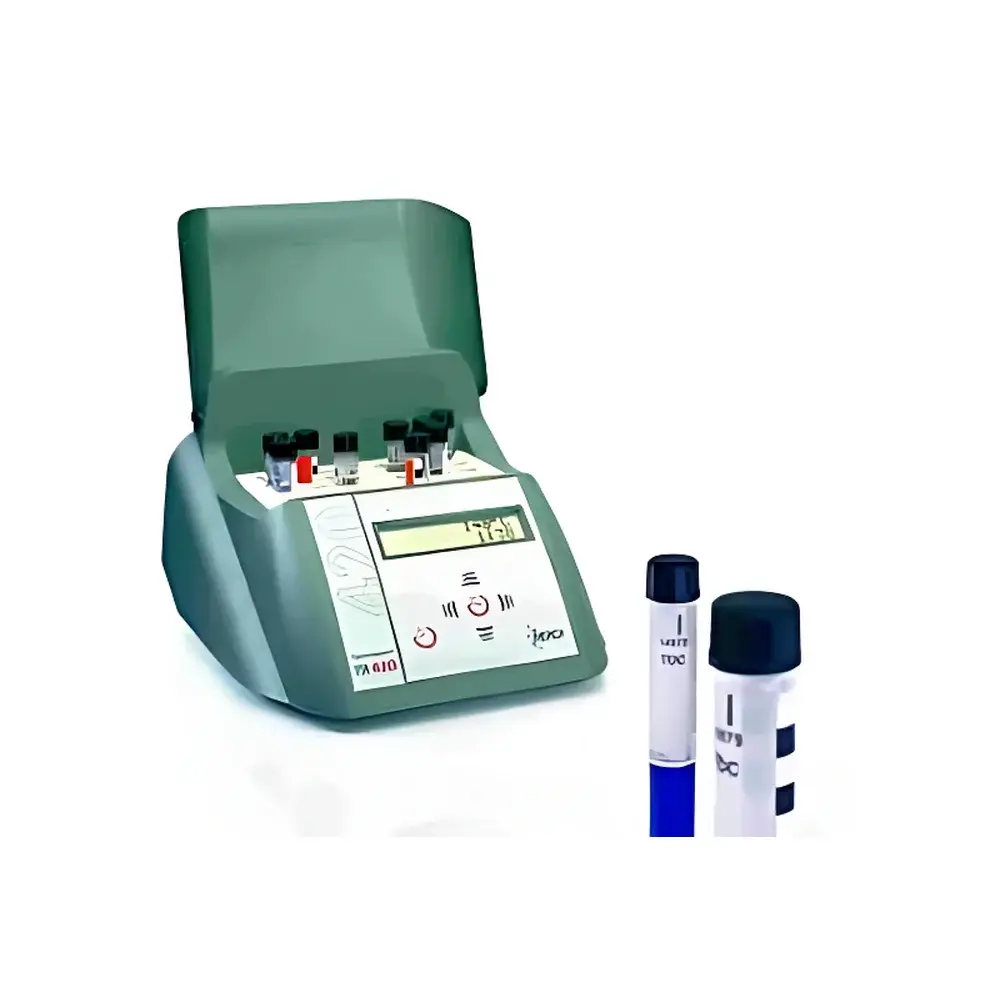
Merck Millipore Spectroquant® Thermoreactor TR320 / TR420 / TR620 Heating Block Digestion System

| Brand | Merck Millipore |
|---|---|
| Origin | Germany |
| Model | TR320 / TR420 / TR620 |
| Display | LCD with real-time temperature & timer |
| Capacity | TR320: 12 × 16 mm tubes |
| TR420/TR620 | 24 × 16 mm tubes (TR620: dual independent 12-position blocks) |
| Temperature Range | TR320: 100–148 °C |
| TR420/TR620 | RT–170 °C |
| Temperature Accuracy | ±1.0 °C |
| Inter-zone Uniformity | ±1.5 °C vs setpoint |
| Built-in Programs | 7 preconfigured (e.g., 148 °C/20 min for COD, 120 °C/60 min for TOC, 100 °C/60 min for Ag/AOX) |
| Custom Programs | TR420/TR620 support up to 8 user-defined protocols (0–180 min, 1 °C resolution) |
| Power Supply | 115–230 V~, 50/60 Hz |
| Dimensions (H×W×D) | 180 × 256 × 307 mm |
| Weight | TR320: 2.85 kg |
| TR420/TR620 | 3.6 kg |
| Optional Accessories | External Pt100 temperature probe, PC interface cable for AQA documentation |
Ask about pricing, availability and specifications.
Overview
The Merck Millipore Spectroquant® Thermoreactor TR Series is a precision-engineered heating block digestion system designed for reproducible, standardized sample preparation in regulatory-compliant water quality analysis. Based on the principle of controlled thermal oxidation in acidic media, these instruments facilitate complete matrix decomposition for subsequent spectrophotometric quantification of key environmental parameters—including Chemical Oxygen Demand (COD), Total Organic Carbon (TOC), Adsorbable Organic Halogens (AOX), Total Nitrogen (TN), Total Phosphorus (TP), and metals such as Cr, Cu, Ni, Pb, Cd, Fe, Zn, and Ag. Each model—TR320 (standard), TR420 (advanced programmable), and TR620 (dual-zone independent control)—is engineered to meet ISO 6060 (COD), EPA Method 410.4 (COD), ISO 8245 (TOC), ISO 11908 (AOX), and EN 15972 (total metal digestion) requirements. The system operates without pressurization, relying on precise conductive heating uniformity across all tube positions to ensure inter-sample comparability and method traceability under GLP and ISO/IEC 17025 laboratory frameworks.
Key Features
- High-precision thermal control with ±1.0 °C accuracy and ≤±1.5 °C inter-hole uniformity—critical for compliance with US EPA, ISO, and ASTM digestion protocols.
- TR320: 12-position fixed-program unit ideal for routine COD and TP testing; TR420: 24-position fully programmable unit supporting custom ramp-hold profiles up to 170 °C and 180 min.
- TR620: Dual independent 12-position heating blocks enable simultaneous execution of two distinct digestion protocols (e.g., COD at 148 °C/20 min and TOC at 120 °C/60 min) within a single instrument footprint.
- LCD interface with real-time temperature and countdown timer; automatic start/stop functionality minimizes operator intervention and improves repeatability.
- Integrated safety features include insulated heating cover, overtemperature cut-off, and stable thermal architecture eliminating hot-spot formation.
- Optional Pt100 temperature probe enables external validation of block temperature—essential for analytical quality assurance (AQA) and internal audit documentation per ISO/IEC 17025 Clause 7.7.
Sample Compatibility & Compliance
The TR Series accommodates standard 16 mm round-bottom digestion tubes used across Spectroquant® test kits (e.g., 1.14687.0001 Crack Set 10 for total metals, 1.14963.0001 Crack Set 20 for TN). All models support digestion of wastewater, surface water, drinking water, and industrial effluents per regulatory workflows. Predefined programs align directly with internationally recognized methods: 148 °C/20 min for rapid COD (EPA 410.4), 120 °C/60 min for TOC (ISO 8245), 100 °C/60 min for silver and AOX (ISO 9562), and 120 °C/30 min for total metal extractions (ISO 17294-2). The system’s thermal stability ensures consistent acid reflux conditions required for complete oxidation without tube rupture or reagent volatilization—meeting the robustness criteria defined in ICH Q2(R2) for analytical procedure validation.
Software & Data Management
While the TR Series operates as a standalone hardware platform, TR420 and TR620 support optional PC connectivity via RS232 or USB interface for AQA data logging. When paired with the temperature probe, users can export time-stamped temperature profiles for each run—enabling full traceability in regulated environments governed by FDA 21 CFR Part 11 and EU Annex 11. These records support audit-ready documentation for GLP/GMP laboratories performing environmental monitoring under ISO 14001 or ISO 50001 frameworks. No proprietary software installation is required; exported CSV files integrate seamlessly into LIMS or electronic lab notebooks (ELN).
Applications
The TR Series serves as the foundational digestion module in accredited environmental testing labs conducting statutory reporting for municipal wastewater treatment plants, industrial discharge monitoring, and potable water safety verification. Typical use cases include: COD determination in influent/effluent streams per ISO 6060; TN quantification in eutrophication studies using alkaline persulfate digestion; TP analysis in lake sediment porewater; and total recoverable metal screening in soil leachates per EPA Method 3050B. Its modular design also supports research applications requiring parallel optimization of digestion conditions—for example, evaluating oxidation efficiency across pH and temperature gradients during method development.
FAQ
What standards does the TR Series comply with?
The TR320, TR420, and TR620 are validated against ISO 6060 (COD), ISO 8245 (TOC), ISO 11908 (AOX), EN 15972 (metals), and US EPA Methods 410.4 and 3050B. Calibration and performance verification follow ISO/IEC 17025 Clause 6.4 requirements.
Can I validate temperature uniformity across all tube positions?
Yes—using the optional Pt100 probe, users can measure actual temperature at any position during operation and generate AQA reports for internal audits or accreditation assessments.
Is the TR620 suitable for high-throughput labs?
Absolutely—the dual-zone architecture allows concurrent processing of two analyte classes (e.g., COD + TN), effectively doubling throughput without compromising protocol integrity or requiring additional bench space.
Do Spectroquant® digestion reagents require special storage or handling?
Crack Set reagents are supplied in sealed, stabilized formats compliant with UN transport regulations (Class 8 corrosive); storage at 15–25 °C in dry, ventilated areas is recommended per SDS documentation.
How often should temperature calibration be performed?
Per ISO/IEC 17025, periodic verification (e.g., quarterly) using NIST-traceable reference thermometers is advised; daily checks with the optional probe fulfill intermediate verification requirements.