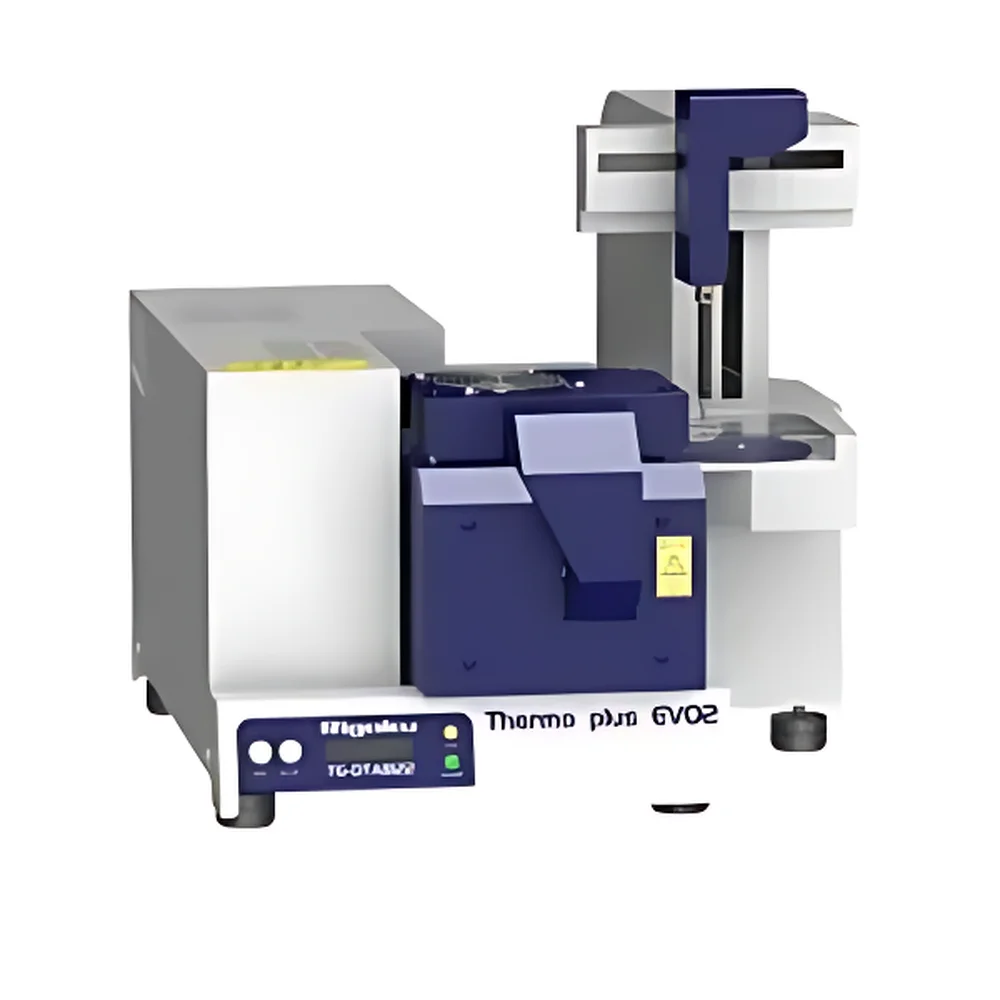
Rigaku Thermo Plus EVO2 STA8122 Simultaneous Thermal Analyzer (TG-DTA)

| Brand | Rigaku |
|---|---|
| Origin | Japan |
| Model | Thermo Plus EVO2 STA8122 |
| Sample Capacity | Up to 1,000 °C operating temperature |
Ask about pricing, availability and specifications.
Overview
The Rigaku Thermo Plus EVO2 STA8122 is a high-precision simultaneous thermal analyzer engineered for concurrent thermogravimetric (TG) and differential thermal analysis (DTA) measurements under controlled atmospheric conditions. Based on horizontal differential triple-coil sensor architecture — a patented design — the instrument delivers exceptional baseline stability and microgram-level mass resolution by actively compensating for mechanical, thermal, and electromagnetic drift sources. Its core measurement principle relies on dual symmetric sample/reference positioning within a precisely balanced horizontal furnace assembly, enabling real-time detection of minute weight changes (Δm) and thermal events (ΔT) across a continuous temperature range up to 1,000 °C. Unlike vertical or single-beam configurations, the EVO2’s horizontal differential geometry ensures superior reproducibility in both dynamic and isothermal regimes, particularly critical for quantitative decomposition kinetics, phase transition studies, and catalytic stability assessment.
Key Features
- Patented horizontal differential triple-coil TG-DTA sensor system for ultra-low drift and high signal-to-noise ratio
- Integrated high-resolution digital microscope with real-time video capture synchronized to thermal data acquisition
- Interactive spectral-image correlation: click any point on the TG/DTA curve to retrieve corresponding live or archived sample image
- Digital zoom, on-screen length measurement, and multi-image tiling for morphological trend analysis during heating
- Modular furnace platform supporting rapid interchange among five specialized configurations: standard resistive, high-temperature (1,200 °C), infrared rapid-heating, steam-compatible isothermal, and atmosphere-resistant quartz-tube variants
- Optional autosampler with programmable sample exchange and purge gas sequencing for unattended multi-sample analysis
- Dynamic TG mode compliant with CRC (Constant Rate of Cooling), DRC (Dynamic Rate Control), and SIA (Stepwise Isothermal Analysis) protocols per ASTM E1131 and ISO 11358
Sample Compatibility & Compliance
The STA8122 accommodates solid powders, granules, thin films, fibers, and small metallic specimens (max. 1 g nominal loading) in standard alumina or platinum crucibles. Optional crucible materials include graphite, silicon carbide, and gold-plated alloys for aggressive atmospheres. The system supports inert (N₂, Ar), oxidizing (air, O₂), reducing (H₂/N₂ mixtures), and saturated steam environments — validated per ISO 11357-3 and ASTM E2009 for polymer degradation, ceramic sintering, and battery cathode stability testing. Data integrity complies with GLP and GMP requirements via full audit trail logging, user access controls, and electronic signature support aligned with FDA 21 CFR Part 11 when configured with Rigaku’s certified software suite.
Software & Data Management
Thermo Plus EVO2 operates exclusively with Rigaku’s proprietary ThermoPlus EVO2 Analysis Software — a Windows-based platform offering synchronized thermal curve visualization, image annotation, kinetic modeling (e.g., Kissinger, Ozawa-Flynn-Wall), and automated peak deconvolution. All acquired images and metadata are embedded directly into project files (.tpx), ensuring traceability from raw pixel data to final report. Export formats include CSV, PDF, PNG, and XML-compliant output for LIMS integration. Batch processing, custom report templates, and password-protected method libraries support laboratory-wide standardization and regulatory documentation workflows.
Applications
The STA8122 serves as a foundational tool in advanced materials R&D, pharmaceutical development, and quality control laboratories. Typical use cases include: quantification of moisture/volatile content and filler loading in composites; thermal stability profiling of Li-ion battery electrode materials under CO₂-free N₂; oxidation onset determination in aerospace-grade alloys; dehydration kinetics of metal-organic frameworks (MOFs); and polymorphic transition mapping in active pharmaceutical ingredients (APIs). Its steam-compatible furnace module enables direct investigation of hydrothermal aging effects on catalysts and zeolites — a capability rarely found in benchtop STA platforms.
FAQ
What is the maximum operating temperature of the standard furnace configuration?
The base furnace supports measurements up to 1,000 °C. Optional high-temperature furnace modules extend this limit to 1,200 °C.
Does the system support quantitative kinetic analysis?
Yes — built-in models for activation energy calculation (Kissinger, Ozawa, Friedman) and reaction order fitting are included, with validation against NIST SRM 742a and 1976b reference materials.
Can the microscope be used under reactive gas atmospheres?
Yes — the optical path is fully isolated from the sample chamber; viewing occurs through a sealed quartz viewport compatible with all supported gas environments.
Is the autosampler compatible with all furnace types?
The autosampler is mechanically integrated with the standard and high-temperature furnaces; IR and steam modules require manual sample loading due to their distinct thermal architectures.
How is baseline stability maintained during long-duration isothermal holds?
Drift compensation is achieved through continuous feedback from the triple-coil sensor array, combined with active furnace temperature homogenization and dual-stage vibration isolation — typical 24-hour isothermal drift is < ±5 µg.