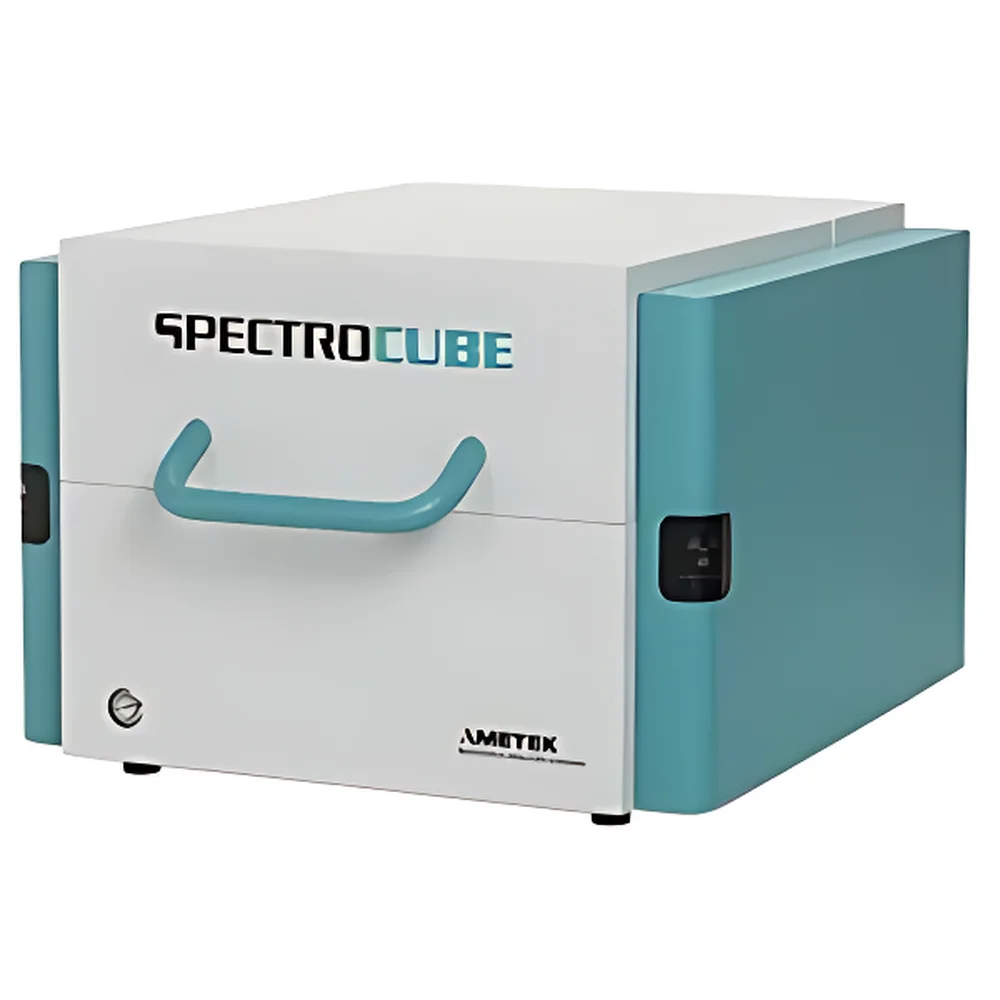
SPECTRO SPECTROCUBE Wavelength Dispersive X-Ray Fluorescence Spectrometer for Petrochemical Applications

| Brand | SPECTRO |
|---|---|
| Origin | Germany |
| Instrument Type | Floor-standing |
| Configuration | Hybrid Scanning + Multi-channel |
| Element Range | Na (11) to U (92) |
| Analytical Resolution | ≤10 eV (Mn Kα) |
| Angular Reproducibility | <0.0005° (2θ) |
| Beryllium Window Thickness | 75 µm standard |
| X-ray Tube Power | 4 kW (Rh anode, water-cooled) |
| Detector Linearity | 10⁵ cps dynamic range (proportional counter + scintillation detector hybrid system) |
| Scan Speed | 0.5–5° 2θ/min (programmable) |
Ask about pricing, availability and specifications.
Overview
The SPECTRO SPECTROCUBE is a high-performance wavelength dispersive X-ray fluorescence (WDXRF) spectrometer engineered specifically for demanding petrochemical and lubricant analysis applications. Unlike energy-dispersive (EDXRF) systems, the SPECTROCUBE employs Bragg diffraction through precisely calibrated analyzing crystals (e.g., LiF(200), PET, TAP) to resolve characteristic X-ray lines with superior spectral resolution and peak-to-background ratios. This physical separation mechanism enables accurate quantification of trace and major elements — including Ni, V, Fe, Ca, Zn, P, S, Cl, and Si — in complex hydrocarbon matrices such as crude oil, base oils, finished lubricants, fuel oils, and used engine oils. Its robust floor-standing architecture integrates a high-stability goniometer, vacuum-purged optical path, and dual-detector configuration (gas-flow proportional counter + NaI(Tl) scintillation detector), ensuring long-term measurement reproducibility (<0.5% RSD for 10 ppm V in oil matrix over 8-hour operation) under routine laboratory conditions.
Key Features
- Hybrid optical design combining sequential scanning and fixed multi-channel detection for simultaneous monitoring of critical elements (e.g., S, Ca, Zn, P) while scanning others (e.g., Ni, V, Fe) — optimizing throughput without compromising accuracy.
- 4 kW Rh-anode X-ray tube with active water cooling and automatic power regulation, delivering stable excitation across low-Z (Na, Mg, Al) and high-Z (Pb, U) elements.
- 75 µm ultra-thin beryllium window on the X-ray tube and detector assemblies, maximizing transmission efficiency for soft X-rays (e.g., S Kα at 2.307 keV, Cl Kα at 2.622 keV).
- High-precision θ–2θ goniometer with laser-interferometric position feedback and angular reproducibility better than ±0.0005° (2θ), essential for maintaining peak alignment during extended calibration intervals.
- Integrated sample handling system supporting liquid cells (13 mm diameter, 2 mL volume), solid discs (up to 40 mm Ø), and sealed film holders — all compatible with ASTM D6443, D7751, and ISO 8217 protocols.
- Automated atmosphere control: selectable He purge (for light elements), vacuum, or air mode — configurable per analytical sequence.
Sample Compatibility & Compliance
The SPECTROCUBE accommodates a full spectrum of petrochemical samples: homogenized used engine oils, centrifuged fuel blends, acid-digested catalyst residues, and filtered crude fractions. All liquid analyses follow standardized preparation per ASTM D6443 (determination of wear metals in used lubricating oils) and ASTM D7751 (elemental analysis of diesel fuel by WDXRF). Solid samples — including refinery catalysts and corrosion scale deposits — are analyzed using pressed pellets or fused beads per ISO 20053. The instrument’s hardware and firmware architecture support full audit trail functionality, electronic signatures, and data integrity controls aligned with FDA 21 CFR Part 11 and EU Annex 11 requirements. Routine performance verification adheres to ISO/IEC 17025:2017 calibration management principles.
Software & Data Management
SPECTRO’s WinFTM® 4.0 software provides method-driven operation with embedded petrochemical application packages (e.g., “Lube Oil Full Spectrum”, “Crude Metal Profiling”, “Fuel Sulfur Screening”). Quantitative analysis uses fundamental parameter (FP) algorithms with matrix correction libraries optimized for hydrocarbon density, viscosity, and additive package variability. All raw intensity data, background subtraction parameters, crystal selection logic, and calibration coefficients are stored immutably in a relational SQL database. Export options include ASTM E1358-compliant .csv, LIMS-ready XML, and PDF analytical reports with embedded metadata (operator ID, timestamp, instrument serial, environmental logs). Remote diagnostics and firmware updates are supported via encrypted TLS 1.2 communication.
Applications
- Quantification of catalytic metals (Ni, V, Fe, Na) in crude oil feedstocks per ASTM D5708 — critical for hydrotreater protection and FCC unit life-cycle planning.
- Routine sulfur monitoring in diesel and jet fuel per ASTM D2622 and D7039, with detection limits of 0.8 ppm (3σ) in 100 s acquisition.
- Wear metal trend analysis in turbine and hydraulic oils (Cu, Cr, Al, Pb, Sn) to support predictive maintenance programs compliant with ISO 4406 and ASTM D7687.
- Phosphorus and zinc determination in ZDDP-containing engine oils — validated against reference materials NIST SRM 2720a and 2721.
- Chloride and silicon contamination screening in process streams to prevent corrosion and fouling in distillation columns and heat exchangers.
FAQ
What sample preparation is required for used oil analysis?
Liquid samples require minimal preparation: homogenization via ultrasonication (5 min), filtration through 0.45 µm membrane filters, and transfer into disposable polypropylene cups with Mylar film windows.
Does the SPECTROCUBE comply with regulatory reporting standards for refinery QA/QC?
Yes — its certified calibration curves, documented uncertainty budgets, and traceable reference materials (e.g., SPECTRO Certified Oil Standards) meet ISO/IEC 17025 and API RP 2550 requirements for accredited testing laboratories.
Can the instrument analyze solid catalysts directly?
Yes, provided samples are ground to <75 µm and pressed into 40 mm pellets with cellulose binder; optional fusion bead preparation is available for silicate-rich matrices.
Is remote method validation supported?
WinFTM® 4.0 includes built-in method transfer tools enabling cross-instrument validation between SPECTROCUBE units using identical crystal/detector configurations and shared CRM libraries.
What maintenance intervals are recommended for routine operation?
Daily: vacuum gauge check and sample chamber purge verification. Quarterly: X-ray tube filament calibration and goniometer backlash compensation. Annually: full optical alignment verification and detector gain stabilization.