
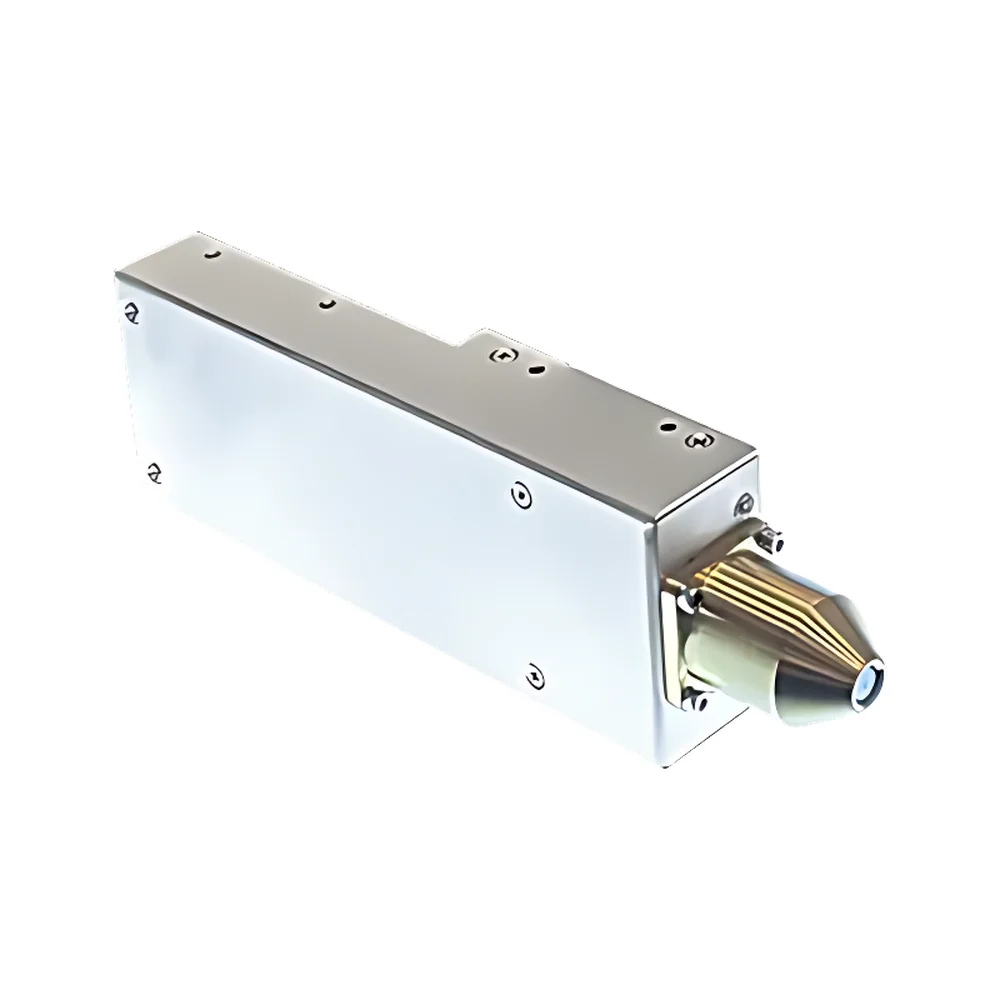
SUNJE SXF-5010-S Portable Energy Dispersive X-Ray Fluorescence (EDXRF) Spectrometer

| Brand | SUNJE |
|---|---|
| Origin | South Korea |
| Model | SXF-5010-S |
| X-ray Tube | Metal-ceramic body with grounded anode |
| Target Material | Silver (Ag) |
| Window | Beryllium (Be), 127 µm thickness |
| External Cone Angle | 60° (with Ø3 mm collimator) |
| Focal Spot Size | <1 mm |
| Tube Voltage Range | 0–50 kV |
| Tube Current Range | 0–200 µA |
| Input Voltage | 9–12 VDC |
| Operating Temperature | −10°C to +50°C |
| Storage Temperature | −40°C to +85°C |
| Control & Monitoring Signals | 0–4 VDC for voltage/current control and monitoring (0–4 V = 0–100%) |
| Enable Signal | +5 VDC = ON, <1 VDC = OFF |
Ask about pricing, availability and specifications.
Overview
The SUNJE SXF-5010-S is a compact, battery-operable portable Energy Dispersive X-Ray Fluorescence (EDXRF) spectrometer engineered for rapid, non-destructive elemental analysis in field-deployed and laboratory-adjacent environments. Based on the fundamental principle of X-ray fluorescence—where primary X-rays excite inner-shell electrons in sample atoms, resulting in characteristic secondary (fluorescent) X-ray emission—the SXF-5010-S delivers qualitative and semi-quantitative elemental composition data from Na (Z=11) to U (Z=92). Its integrated metal-ceramic X-ray tube with a silver anode target and ultra-thin beryllium window (127 µm) ensures high photon transmission efficiency in the low-energy range (<3 keV), critical for light element sensitivity. The 60° external cone geometry coupled with a Ø3 mm collimator enables precise micro-spot excitation, minimizing matrix effects and improving spatial resolution for heterogeneous or layered samples.
Key Features
- Lightweight, handheld form factor with integrated rechargeable battery support—designed for extended operation (>4 hours typical) without external power sources.
- High-stability metal-ceramic X-ray tube featuring grounded anode architecture, delivering consistent output over thermal and operational cycles.
- Optimized excitation geometry: 60° take-off angle and fixed Ø3 mm collimation ensure reproducible beam-sample interaction and reduce scattering artifacts.
- Wide operating voltage and current ranges (0–50 kV / 0–200 µA) allow flexible excitation conditions tailored to specific elemental groups (e.g., low-kV for Mg–Cl; high-kV for transition metals and heavy elements).
- Industrial-grade environmental tolerance: functional across −10°C to +50°C ambient temperatures and storable from −40°C to +85°C—suitable for outdoor geological surveys, scrap metal sorting, and construction material verification.
- Analog I/O interface compliant with OEM integration standards: four independent 0–4 VDC channels for real-time tube voltage/current control and monitoring, plus TTL-compatible enable/disable signaling.
Sample Compatibility & Compliance
The SXF-5010-S accommodates solid, powdered, and coated substrates—including alloys, soils, ores, ceramics, polymers, and painted surfaces—without requiring vacuum or helium purge. Its open-beam configuration supports direct analysis of irregularly shaped objects up to 150 mm × 150 mm footprint. While not certified for regulatory compliance out-of-the-box, the instrument’s hardware design aligns with foundational requirements of ISO 21043 (XRF instrumentation performance evaluation) and ASTM E1621 (standard guide for XRF elemental analysis). When paired with validated calibration standards and documented measurement protocols, it supports GLP-aligned workflows and preliminary screening per EPA Method 6200 (field portable XRF for metals in soils/sediments). Note: Beryllium window handling complies with IEC 61000-4-2 ESD immunity class 2 and requires adherence to local occupational safety regulations regarding X-ray shielding and operator training.
Software & Data Management
The SXF-5010-S communicates via USB-C or RS-232 to companion Windows-based acquisition software, which provides real-time spectrum visualization, peak deconvolution using fundamental parameter (FP) algorithms, and customizable library matching. All spectral data—including raw counts, processed net intensities, and acquisition metadata (voltage, current, live time, ambient temperature)—are stored in vendor-neutral .CSV and .EDX formats. Audit trail functionality records user actions, parameter changes, and calibration events—supporting traceability in QA/QC environments. While native software does not implement FDA 21 CFR Part 11 electronic signature controls, the platform allows export to LIMS-integrated systems where full ALCOA+ (Attributable, Legible, Contemporaneous, Original, Accurate, Complete, Consistent, Enduring, Available) data governance can be enforced externally.
Applications
- Rapid alloy grade identification (e.g., stainless steels, aluminum series, titanium alloys) in scrap yards and fabrication facilities.
- In-field soil and sediment screening for regulated metals (Pb, As, Cd, Cr, Hg) under environmental remediation programs.
- RoHS and WEEE compliance verification of electronic components and plastic housings.
- Geological prospecting and mining exploration—elemental mapping of drill core chips and outcrop surfaces.
- Forensic material comparison, including paint layer analysis and glass fragment characterization.
- Quality assurance of incoming raw materials (e.g., catalysts, pigments, battery cathode precursors) prior to batch processing.
FAQ
Is the SXF-5010-S suitable for light element analysis below sodium (Na)?
No. Due to inherent absorption in the Be window and detector dead layer, reliable detection is limited to elements from Na (Z=11) upward. Oxygen, nitrogen, and carbon are not measurable.
Does the instrument require annual recalibration by the manufacturer?
While no mandatory factory recalibration is specified, users must perform routine performance verification using certified reference materials (CRMs) at least daily or per shift when used in regulated contexts. Calibration stability checks against multi-element CRMs (e.g., NIST SRM 2711a) are recommended before critical measurements.
Can the SXF-5010-S operate inside a glovebox or inert atmosphere?
Yes—its sealed X-ray tube housing and passive cooling design permit safe operation in argon- or nitrogen-purged enclosures, provided electrical feedthroughs and viewport materials (e.g., beryllium or polyimide windows) maintain X-ray transmission integrity.
What safety certifications does the device hold?
The SXF-5010-S conforms to IEC 61010-1 (safety requirements for electrical equipment) and IEC 62471 (photobiological safety), with Class 1 laser product classification for its optional alignment LED. It carries KC Mark certification for South Korean market compliance and meets CE essential requirements for electromagnetic compatibility (EMC Directive 2014/30/EU).

