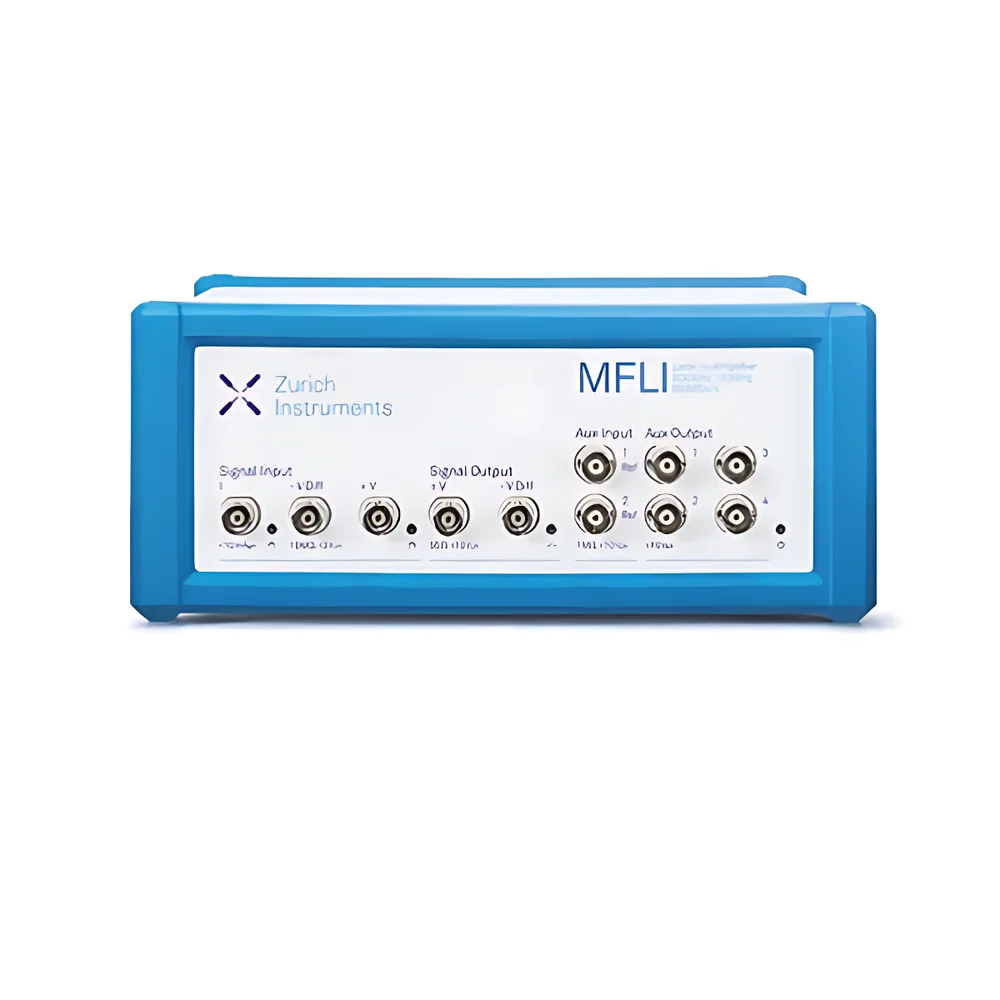
Zurich Instruments MFLI 500 kHz Low-Noise Digital Lock-in Amplifier

| Brand | Zurich Instruments |
|---|---|
| Origin | Switzerland |
| Model | MFLI |
| Frequency Range | DC to 500 kHz (upgradable to 5 MHz) |
| Input Voltage Noise | 2.5 nV/√Hz @ 1 kHz |
| Minimum Time Constant | 336 ns |
| Filter Order | 1–8 |
| Dynamic Range | 120 dB |
| Connectivity | USB, LAN, Wi-Fi |
| Power Supply | AC or 12 V DC |
| API Support | MATLAB, LabVIEW, Python, C, .NET, VISA, SCPI |
Ask about pricing, availability and specifications.
Overview
The Zurich Instruments MFLI 500 kHz Low-Noise Digital Lock-in Amplifier is a precision measurement instrument engineered for high-sensitivity detection of weak periodic signals buried in noise—particularly in low-frequency and mid-frequency domains (DC to 500 kHz, field-upgradeable to 5 MHz). Based on digital lock-in detection principles, the MFLI employs a fully digitized signal path from input stage through real-time FPGA-based demodulation, eliminating analog drift and enabling exceptional long-term stability and reproducibility. Its ultra-low input voltage noise floor of 2.5 nV/√Hz at 1 kHz, combined with a 120 dB dynamic range and sub-microsecond time constants down to 336 ns, makes it suitable for demanding applications in quantum transport, scanning probe microscopy, impedance spectroscopy, and low-temperature physics where signal integrity and phase coherence are critical.
Key Features
- FPGA-accelerated real-time digital signal processing with deterministic latency and no analog filter drift
- Integrated LabOne software platform providing unified access to oscilloscope, spectrum analyzer, sweeper, parametric plotter, and data logger tools
- Web-based user interface accessible via any modern browser—no client installation required
- Dual-domain operation: simultaneous analog and digital signal generation (bias outputs) with programmable amplitude, offset, and waveform shape
- Flexible power options: operable from standard AC mains or 12 V DC battery supply for portable or cryogenic lab environments
- Multi-interface connectivity: native support for USB 2.0, 1 GbE LAN, and optional Wi-Fi module for remote monitoring and control
- Comprehensive API ecosystem supporting MATLAB, Python, LabVIEW, C, and .NET with full command logging and script replay capability
Sample Compatibility & Compliance
The MFLI interfaces seamlessly with a wide range of transducers and sensors—including photodiodes, Hall probes, SQUIDs, piezoresistive cantilevers, and electrochemical cells—without requiring external preamplification in most configurations. Its differential voltage inputs (±10 V full scale) and optional current input module (via MF-IA) support direct connection to low-output devices while maintaining optimal signal-to-noise ratio. The instrument complies with IEC 61000-4 electromagnetic compatibility standards and meets CE/FCC regulatory requirements for laboratory instrumentation. While not certified for medical or industrial safety-critical use, its architecture supports GLP/GMP-aligned workflows through LabOne’s audit-trail-enabled experiment logging, timestamped data export (HDF5, CSV), and user-access controls.
Software & Data Management
LabOne serves as the embedded operating system and application environment, running on the MFLI’s onboard Linux-based processor. It includes an integrated web server enabling concurrent multi-user access, real-time data streaming, and synchronized multi-instrument control. All measurements are stored in self-describing HDF5 files containing metadata (instrument settings, timestamps, calibration parameters), ensuring traceability and interoperability with third-party analysis platforms. The LabOne API provides synchronous and asynchronous communication modes, supports SCPI command syntax for legacy integration, and enables automated test sequences compliant with ASTM E2923 (standard guide for lock-in amplifier use in materials characterization) and ISO/IEC 17025 documentation requirements.
Applications
- Quantum device characterization: gate-dependent conductance mapping, Coulomb blockade analysis, and RF reflectometry of superconducting qubits
- Scanning probe microscopy: dual-channel phase-resolved topography and dissipation imaging (e.g., Kelvin probe force microscopy)
- Electrochemical impedance spectroscopy (EIS): multi-frequency acquisition across 1 mΩ–1 TΩ range using MF-IA option
- Optomechanical sensing: laser interferometry with active feedback stabilization via MF-PID controller
- Modulated spectroscopy: AM/FM demodulation of absorption or fluorescence signals using MF-MOD
- Fundamental physics experiments: precision measurement of thermal noise, Johnson–Nyquist voltage fluctuations, and shot noise spectra
FAQ
Can the MFLI operate without a PC connected?
Yes—the MFLI contains an embedded Linux system and web server; all core functionality is accessible via any network-connected device with a browser.
Is firmware upgrade supported in the field?
Yes—Zurich Instruments provides regular firmware updates via LabOne’s built-in updater, including new features, bug fixes, and performance enhancements.
What is the maximum sampling rate for raw data acquisition?
With the MF-DIG option enabled, the MFLI supports continuous digitization at up to 125 MSa/s with 2.5 Msample memory depth per channel.
Does the MFLI support external reference synchronization?
Yes—it accepts TTL, sine, or differential LVDS reference signals and can lock to external clocks with jitter below 10 ps RMS.
How is calibration traceability maintained?
Factory calibration is performed against NIST-traceable standards; users may perform verification routines using internal reference signals and export calibration reports with unique serial-numbered metadata.