
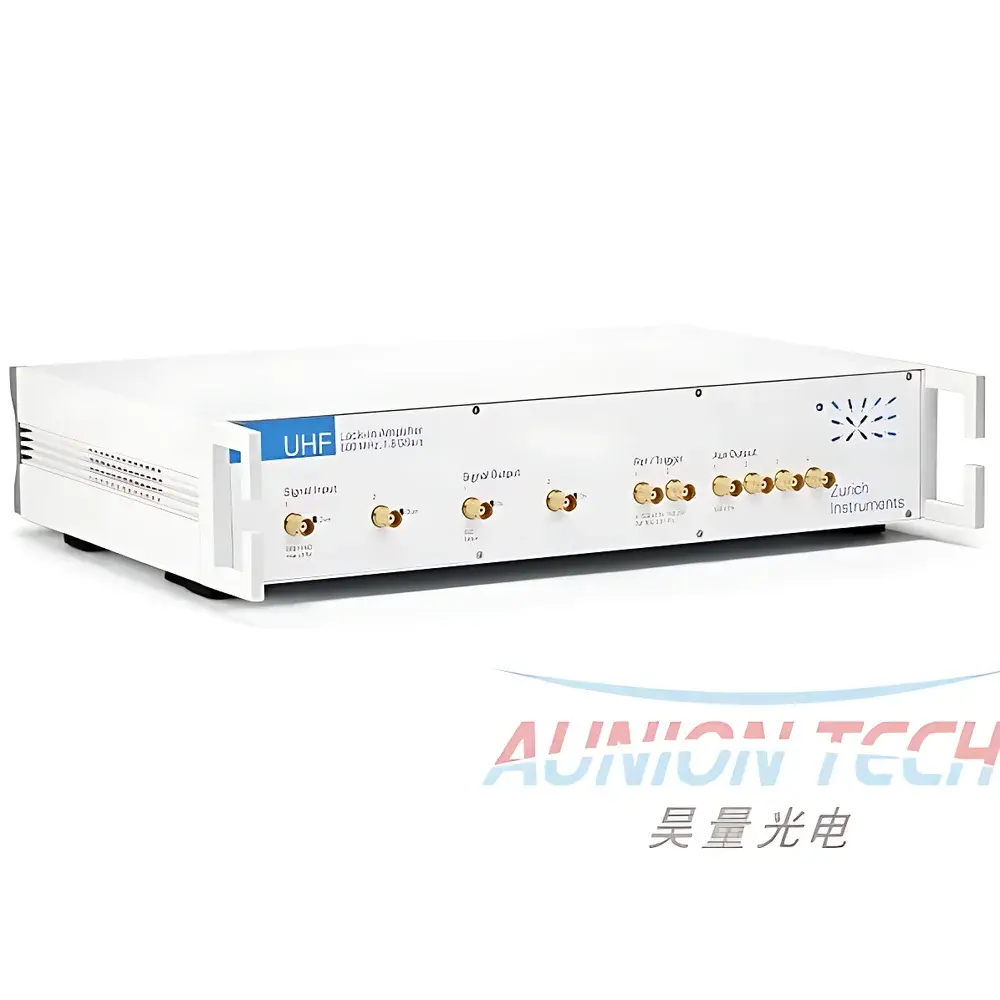
Zurich Instruments UHF-AWG 600 MHz Arbitrary Waveform Generator
| Brand | Zurich Instruments |
|---|---|
| Origin | Switzerland |
| Model | UHF-AWG |
| Output Channels | 2 |
| DAC Resolution | 14 bit |
| Max Sample Rate | 1.8 GSa/s |
| Waveform Memory | 128 MSa per channel |
| Output Frequency Range | DC – 600 MHz |
| Output Amplitude | ±150 mV / ±1.5 V (DC-coupled, 50 Ω) |
| Phase Noise | −120 dBc/Hz @ 10 MHz (100 Hz offset), −130 dBc/Hz @ 10 MHz (1 kHz offset) |
| Sequencer Instructions | 1024 core + dynamic expansion |
| Feedback Latency | <1 µs |
| Trigger Delay | <150 ns |
| Trigger Jitter | 2.2–4.4 ns |
| Built-in Oscillators | 2 (expandable to 8 with UHF-MF option) |
| Modulation Modes | Direct output & AM mode with internal oscillator reference |
| Digital Outputs | 32-bit parallel, 2 markers per channel, 4 AUX outputs |
| Input Triggers | Lock-in, scope, counter, external, internal |
| Optional Modules | UHF-DIG (digitizer), UHF-MF (multi-frequency), UHF-RUB (rubidium clock), UHF-CNT (pulse counter) |
Overview
The Zurich Instruments UHF-AWG 600 MHz Arbitrary Waveform Generator is a high-performance, integrated signal generation and acquisition instrument engineered for demanding quantum and ultrafast measurement applications. Unlike conventional arbitrary waveform generators, the UHF-AWG combines dual-channel 600 MHz analog output with synchronized high-bandwidth input paths, real-time signal processing, and deterministic low-latency feedback—enabling closed-loop control essential for quantum error correction, cQED, trapped-ion experiments, and NMR spectroscopy. Its architecture is based on a field-programmable gate array (FPGA)-driven sequencer that executes compiled waveform instructions with sub-microsecond determinism. The instrument operates on the principle of digital synthesis followed by high-fidelity 14-bit, 1.8 GSa/s DAC conversion, supporting both direct baseband output and coherent amplitude-modulated (AM) waveforms using internally referenced oscillators. This dual-path capability ensures phase coherence across all generated signals—a critical requirement in heterodyne detection, pulsed ESR, and microwave quantum control.
Key Features
- Dual 600 MHz analog output channels with 14-bit resolution and 1.8 GSa/s sample rate, enabling precise reproduction of complex microwave and RF transients.
- 128 MSa waveform memory per channel, scalable via LabOne’s waveform compression and envelope-based AM mode to reduce storage overhead for long-duration, phase-coherent pulse sequences.
- Integrated FPGA sequencer with 1024-core instruction memory and dynamic expansion—supporting conditional branching, real-time parameter updates, and hardware-triggered state transitions.
- Sub-1 µs feedback latency between input detection and AWG reconfiguration, facilitating active stabilization and adaptive pulse shaping in quantum feedback protocols.
- Two independent, low-phase-noise oscillators (−120 dBc/Hz @ 100 Hz offset; −130 dBc/Hz @ 1 kHz offset) serving as shared references for both generation and demodulation paths.
- Hardware-synchronized digital I/O: 32-bit parallel digital output, two marker signals per analog channel, and four auxiliary analog outputs for system-level coordination.
- Trigger engine with <150 ns output delay and jitter of 2.2–4.4 ns, ensuring temporal fidelity in multi-instrument synchronization scenarios such as pump-probe or time-of-flight measurements.
Sample Compatibility & Compliance
The UHF-AWG is designed for laboratory environments requiring traceable timing integrity and electromagnetic compatibility in sensitive quantum measurement setups. It complies with CE, FCC Class A, and RoHS directives. Its low-phase-noise architecture meets the spectral purity requirements of ISO/IEC 17025-accredited calibration laboratories performing RF metrology. When configured with the UHF-RUB rubidium frequency standard option, the instrument supports long-term stability (<5 × 10⁻¹² aging per month) suitable for GLP-compliant NMR validation protocols. All firmware and LabOne software operations adhere to principles aligned with FDA 21 CFR Part 11 for audit-trail-enabled electronic records in regulated R&D settings.
Software & Data Management
LabOne—the unified software platform for Zurich Instruments—is fully integrated with the UHF-AWG. It provides a browser-based interface for waveform design (via Python API or graphical sequence editor), real-time visualization of generated and acquired signals, and hierarchical data export in HDF5 format. The built-in compiler translates high-level pulse descriptions into optimized FPGA instructions without manual assembly programming. All configuration states, waveform binaries, and measurement metadata are automatically timestamped and stored with SHA-256 checksums. LabOne supports role-based access control, encrypted remote sessions over TLS 1.3, and optional integration with enterprise LIMS systems via RESTful API. Version-controlled experiment scripts ensure reproducibility across instrument deployments and multi-site collaborations.
Applications
- Quantum Computing & Control: Microwave pulse shaping for superconducting qubit gates, real-time feedback in quantum error correction loops, and parametric amplification bias sequencing.
- Trapped-Ion & Quantum Dot Systems: Arbitrary voltage waveform generation for dynamic electrode control, Doppler cooling pulse trains, and spin-echo timing sequences.
- NMR & ESR Spectroscopy: Coherent excitation pulses, shaped adiabatic inversion, and multi-tone excitation with precise inter-pulse phase relationships.
- Lidar & Radar Signal Simulation: Generation of chirped FMCW waveforms, pulse compression codes, and jamming-resistant modulation schemes at RF carrier frequencies up to 600 MHz.
- Ultrafast Photonics: Synchronization of optical modulators, cavity dumping triggers, and pump-probe delay scanning with picosecond-level jitter control.
FAQ
What is the maximum sustained update rate for dynamic waveform parameters during playback?
The sequencer supports real-time parameter updates at rates up to 100 kS/s per channel via the LabOne API, constrained only by PCIe bandwidth and host CPU scheduling—not by FPGA logic latency.
Can the UHF-AWG operate independently without a host PC connection?
No. The instrument requires continuous LabOne session management for waveform compilation, sequencer initialization, and data streaming; however, once loaded, the FPGA executes sequences autonomously until reconfigured.
Is the 600 MHz output bandwidth DC-coupled across the full range?
Yes—both analog outputs are DC-coupled with 50 Ω termination, supporting true baseband waveforms from 0 Hz to 600 MHz without harmonic distortion or group delay artifacts.
How does the UHF-MF option affect oscillator flexibility?
UHF-MF adds six additional oscillators (for eight total), each independently configurable in frequency, phase, and amplitude—enabling simultaneous multi-tone excitation, parallel lock-in detection, and orthogonal signal synthesis.
Does the UHF-RUB rubidium clock option require factory installation?
Yes. UHF-RUB is a hardware module installed at the time of manufacture and cannot be retrofitted in the field due to precision RF shielding and thermal anchoring requirements.




