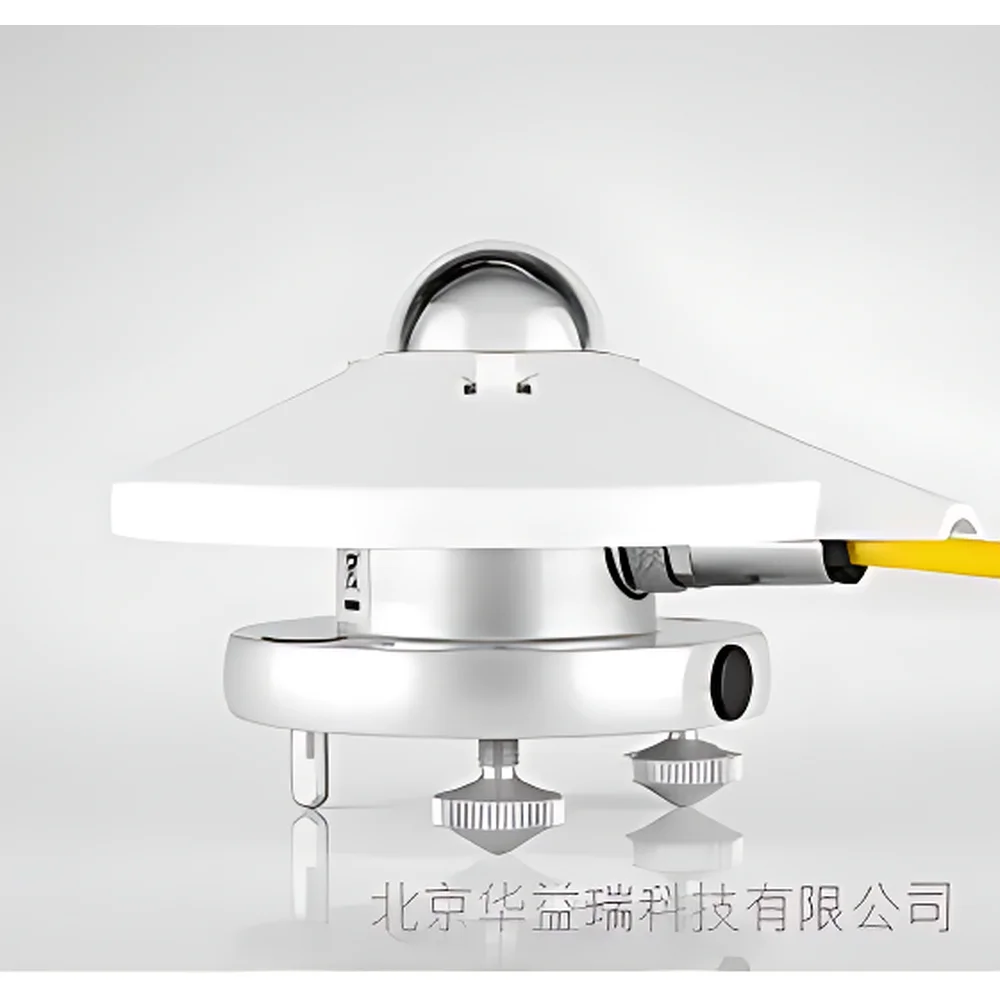
Kipp & Zonen CS301 Shortwave Silicon Pyranometer

| Brand | Kipp & Zonen |
|---|---|
| Origin | Netherlands |
| Model | CS301 |
| Spectral Range | 360–1120 nm |
| Measurement Range | 0–2000 W/m² |
| Calibration Factor | 5 W/m²/mV |
| Cosine Error | ±5% at 75° zenith angle, ±2% at 45° |
| Response Time | <1 ms |
| Long-term Stability | <2% per year |
| Operating Temperature | −40 °C to +70 °C |
| IP Rating | IP67 |
| Sensitivity | 0.2 mV/(W/m²) |
| Dimensions | Ø24 mm × H25 mm |
| Weight | 65 g (with 2-m cable) |
Ask about pricing, availability and specifications.
Overview
The Kipp & Zonen CS301 Shortwave Silicon Pyranometer is a precision-calibrated, solid-state radiometric sensor engineered for continuous, unattended measurement of global shortwave solar irradiance (GHI) in meteorological, agricultural, hydrological, and solar energy monitoring applications. Unlike thermopile-based pyranometers, the CS301 employs a high-stability silicon photovoltaic detector mounted beneath a hemispherical, cosine-corrected optical dome—enabling spectral response optimized for terrestrial solar radiation between 360 nm and 1120 nm. This range captures over 95% of the extraterrestrial shortwave irradiance reaching Earth’s surface under clear-sky conditions, including the dominant photosynthetically active radiation (PAR) band (400–700 nm) and near-infrared portion critical for energy balance modeling. The sensor is factory-calibrated against Kipp & Zonen’s traceable CM21 thermopile reference standard under ISO 9060:2018 Class C (formerly Secondary Standard) conditions, ensuring metrological consistency across field-deployed networks. Its compact form factor, low power demand (<10 µA standby), and direct compatibility with Campbell Scientific dataloggers eliminate the need for external signal conditioning—reducing system complexity and measurement uncertainty.
Key Features
- Silicon photodiode detector with integrated cosine correction optics, delivering rapid response (<1 ms) and high linearity across 0–2000 W/m² irradiance levels
- Hemispherical fused quartz dome prevents water pooling and minimizes soiling; optically bonded to eliminate internal condensation via hermetic potting
- IP67-rated marine-grade 316L stainless-steel connector enables field-replaceable cabling and facilitates recalibration without sensor dismounting
- Robust mechanical design: Santoprene®-jacketed 2-meter shielded cable, operating temperature range from −40 °C to +70 °C, and 0–100% RH tolerance
- Traceable calibration certificate supplied with each unit, referencing Kipp & Zonen’s primary thermopile standard compliant with WMO and BSRN requirements
- Low thermal offset (<0.04 ± 0.04 %/°C) and annual drift <2%, supporting multi-year climate-grade data series without frequent recalibration
Sample Compatibility & Compliance
The CS301 is designed for outdoor deployment on fixed masts, solar tracker arms, or automated weather stations. Its spectral response aligns with ASTM G173-03 and ISO 9060:2018 definitions of “shortwave” irradiance, making it suitable for validation of satellite-derived solar resource datasets and model input in PV performance simulation (e.g., PVsyst, SAM). While not classified as an ISO 9060:2018 Class A or B instrument due to its silicon-based detector architecture, the CS301 meets the functional requirements for Class C (formerly “Secondary Standard”) use in non-critical solar monitoring networks where cost, size, and power efficiency are prioritized over absolute thermopile-level accuracy. It complies with IEC 61724-1:2021 for photovoltaic system monitoring and supports GLP-compliant data logging when paired with Campbell Scientific CR1000X or CR6 dataloggers configured with audit-trail-enabled firmware.
Software & Data Management
The CS301 outputs a millivolt-level analog signal (0–200 mV full scale at 2000 W/m²), directly readable by Campbell Scientific’s analog input channels without external amplification. Datalogger programs can apply the factory-provided calibration factor (5 W/m²/mV) in real time, enabling immediate conversion to SI units. Raw voltage and processed irradiance values are stored with timestamped metadata—including battery voltage, internal temperature, and diagnostic flags—supporting post-processing traceability. When integrated into a Campbell SCADA environment (e.g., LoggerNet or PC400), data can be exported in CF-1 compliant NetCDF or CSV formats compatible with NOAA’s SURFRAD, NASA’s POWER, and WMO’s GSN archival standards. Firmware updates and configuration changes retain full revision history, satisfying basic FDA 21 CFR Part 11 electronic record integrity requirements for research-grade environmental monitoring.
Applications
- Long-term solar resource assessment for utility-scale photovoltaic plant site selection and yield forecasting
- Surface energy balance studies in eddy covariance flux towers and micrometeorological networks
- Real-time irrigation scheduling support through PAR-integrated evapotranspiration modeling
- Validation of numerical weather prediction (NWP) models and satellite albedo products (e.g., MODIS, Sentinel-3 SLSTR)
- Climate monitoring in remote or low-infrastructure locations where low power consumption and mechanical resilience are essential
- Education and training platforms for atmospheric science curricula requiring hands-on irradiance measurement practice
FAQ
Is the CS301 suitable for scientific-grade solar irradiance measurement?
Yes—when deployed in accordance with WMO Guide to Instruments and Methods of Observation (CIMO Guide, Chapter 7), the CS301 provides Class C–equivalent data quality appropriate for regional climate monitoring, agronomy, and solar energy feasibility studies. For primary reference-grade measurements (e.g., BSRN sites), a thermopile pyranometer such as the CMP21 is recommended.
How often does the CS301 require recalibration?
Kipp & Zonen recommends recalibration every two years under typical field conditions. Annual verification using a portable reference pyranometer is advised for mission-critical deployments.
Can the CS301 be used with non-Campbell dataloggers?
Yes—any datalogger with a high-impedance, differential analog input capable of resolving microvolt-level signals and applying linear scaling can interface with the CS301. Proper shielding and grounding are essential to maintain signal integrity.
Does the CS301 measure diffuse or direct irradiance separately?
No—the CS301 measures global horizontal irradiance (GHI) only. To derive diffuse or direct normal irradiance (DNI), it must be deployed with a shading device (e.g., shadow band or sun tracker-mounted occulting disk) and complementary algorithms.
What maintenance is required for long-term operation?
Bi-weekly visual inspection and gentle cleaning of the dome with deionized water and lint-free cloth; quarterly verification of mounting level and cable integrity; annual check of zero-offset under shaded conditions.