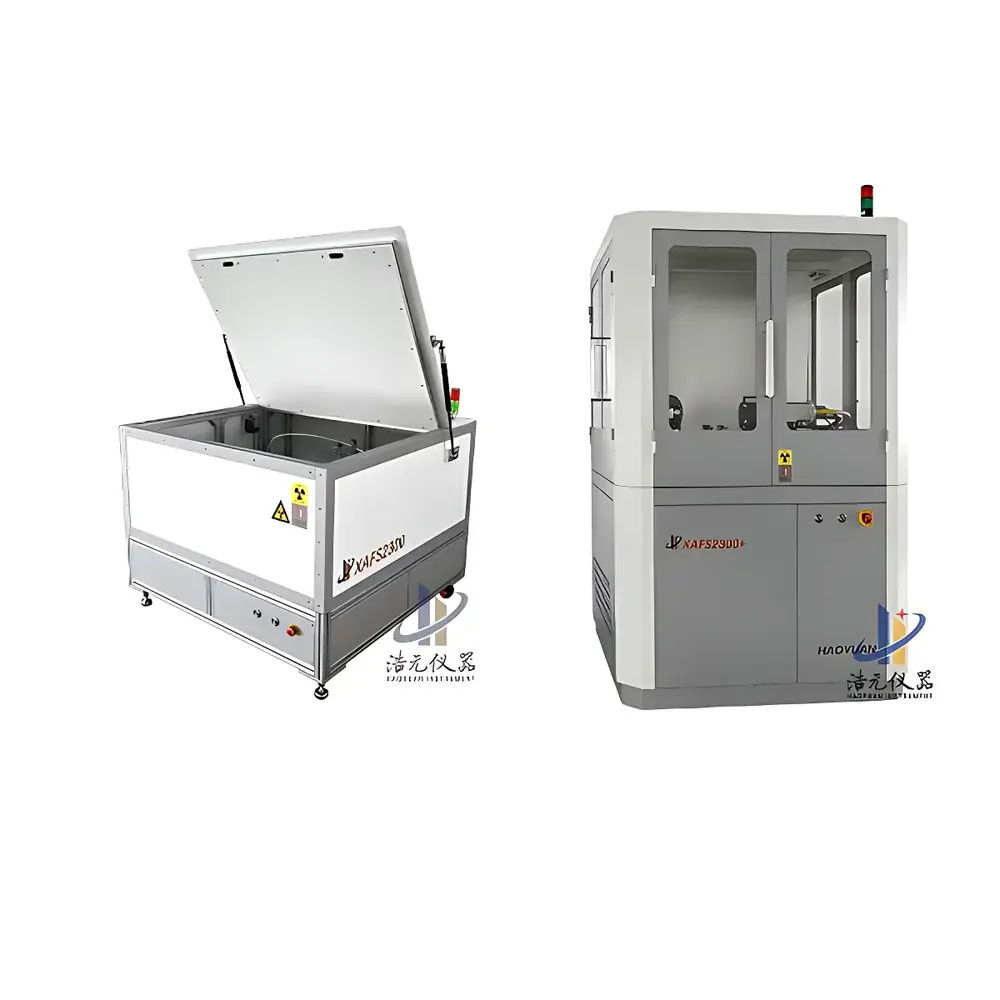
Haoyuan DX2900V Vertical 2D X-ray Diffractometer

| Brand | Haoyuan |
|---|---|
| Origin | Liaoning, China |
| Manufacturer Type | Authorized Distributor |
| Origin Category | Domestic |
| Model | DX2900V |
| Price Range | USD 140,000 – 280,000 |
| Instrument Type | Powder X-ray Diffractometer |
| Angular Resolution | 0.1° |
| X-ray Source | Cu/Mo anode, 50 W (50 kV / 1 mA) |
| Capillary Optics | Multicapillary, divergence ≤ 0.25°, focal spot diameter 0.5 mm, photon flux > 1×10⁸ ph/s |
| Goniometer Axes | Two-axis thin-film stage (ω: −10° to +10°, resolution 0.002° |
| Z | 0–15 mm, resolution 0.002 mm) |
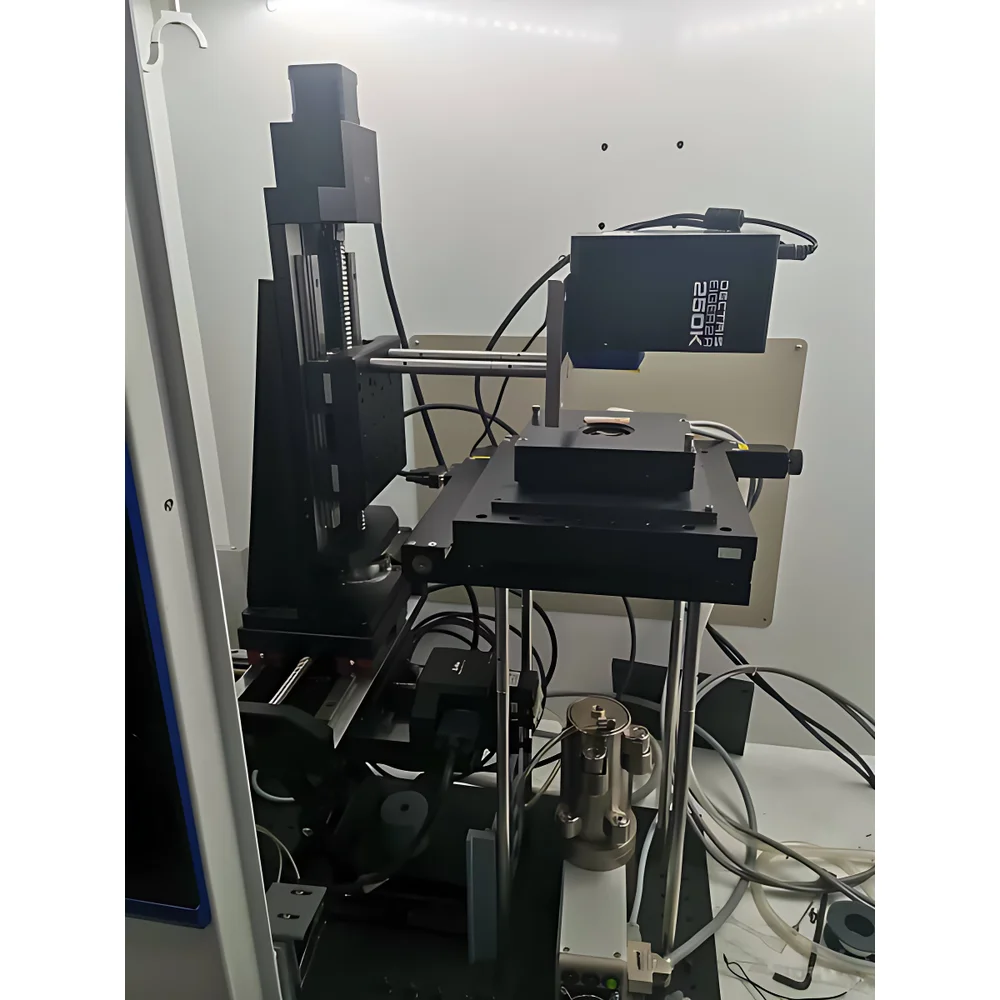
| 2D Detector | Eiger2 R 250K, 512 × 512 pixels, pixel size 75 µm |
| XY Sample Stage | 150 mm × 150 mm travel range |
| Optional Accessories | Transmission stage, in-situ heating stage, inert-atmosphere glovebox-integrated stage, solvent vapor-compatible in-situ atmosphere chamber |
| Upgradability | Thin-film stage extendable to 3–5 axes |
Ask about pricing, availability and specifications.
Overview
The Haoyuan DX2900V Vertical 2D X-ray Diffractometer is a purpose-engineered powder and thin-film XRD platform designed for structural characterization under non-standard sample conditions—including liquids, melts, volatile solvents, and air-sensitive materials. Unlike conventional horizontal θ–2θ Bragg–Brentano diffractometers, the DX2900V adopts a vertical geometry where the sample plane remains horizontal throughout measurement. This configuration enables gravity-stable placement of capillary-loaded liquids, molten polymers, slurries, and gel-phase samples—eliminating flow-induced smearing and orientation artifacts common in tilted-sample geometries. The system operates on standard Cu Kα or Mo Kα radiation (50 kV / 1 mA, 50 W), coupled with a high-brightness multicapillary optic from XOS (USA) that delivers collimated microfocus beam (≤0.25° divergence, 0.5 mm focal spot) with photon flux exceeding 1×10⁸ photons per second. Detection is performed using the Dectris Eiger2 R 250K hybrid pixel array detector (512 × 512 pixels, 75 µm pitch), enabling simultaneous acquisition of Debye–Scherrer rings, azimuthal intensity distributions, and anisotropic scattering patterns without mechanical scanning.
Key Features
- Vertical sample orientation: Horizontal sample plane ensures stable positioning of liquid, melt, and suspension samples—critical for time-resolved studies and in-situ reaction monitoring.
- Modular goniometry: Standard two-axis thin-film stage (ω ±10°, Z 0–15 mm) with sub-arcsecond angular resolution (0.002°) and sub-micron linear precision (0.002 mm); optionally expandable to 3-, 4-, or 5-axis configurations for complex texture and grazing-incidence measurements.
- Large-area XY stage: 150 mm × 150 mm motorized translation stage supports unattended multi-sample workflows, batch screening, and spatially resolved mapping across heterogeneous specimens.
- Integrated safety architecture: Fully interlocked radiation enclosure with real-time X-ray emission sensing, dual-layer lead-acrylic observation window, adjustable LED illumination, and emergency cut-off logic compliant with IEC 61000-6-4 and GB/T 18801-2015 electromagnetic compatibility standards.
- Thermal and environmental flexibility: Compatible with heated stages (up to 800°C), inert-atmosphere glovebox integration (Ar/N₂ purged), and solvent-vapor-tolerant in-situ chambers—enabling operando studies under controlled chemical environments.
Sample Compatibility & Compliance
The DX2900V accommodates diverse physical states and chemistries without compromising data fidelity. Liquid samples are loaded into quartz or borosilicate capillaries (1–3 mm OD) mounted horizontally on the stage; melt-phase polymers and low-viscosity alloys are tested directly on thermally stabilized Si or Al substrates. For air-sensitive battery cathodes, MOFs, or organometallics, the instrument integrates seamlessly with commercial gloveboxes via standardized flange ports (CF-63), maintaining <1 ppm O₂/H₂O during measurement. All optional accessories—including transmission geometry stages, GIXRD slits, and humidity-controlled cells—are mechanically and software-synchronized. System compliance includes adherence to ISO 17025 calibration traceability protocols, ASTM E975-22 for residual stress analysis, and USP for pharmaceutical crystallinity verification. Full audit trail logging and user-access controls support GLP/GMP environments aligned with FDA 21 CFR Part 11 requirements.
Software & Data Management
Liyin’s proprietary LiXRD Suite provides unified control of hardware modules, real-time 2D image processing, and quantitative phase analysis. The software features multithreaded acquisition management, automatic ring centering and calibration (using NIST SRM 660c LaB₆), azimuthal integration with background subtraction, and Rietveld refinement via integrated TOPAS engine (Bruker). Raw .tiff and .h5 detector files are stored with embedded metadata (sample ID, operator, timestamp, beam parameters, stage coordinates). Export formats include CIF, XYE, CSV, and GSAS-II project packages. Remote access, role-based permissions, and electronic signature support ensure regulatory readiness. Data integrity is preserved through SHA-256 hashing of all acquired frames and immutable log entries synchronized to network time protocol (NTP).
Applications
- Crystallinity quantification and polymorph identification in pharmaceutical intermediates and APIs
- In-situ thermal evolution of polymer lamellae (e.g., polyethylene, polybutadiene) under controlled heating ramps
- Phase transformation kinetics in battery electrode slurries during solvent evaporation
- Texture analysis of sputtered thin films (Al₂O₃, TiN, ITO) using pole figure reconstruction
- Reaction monitoring in catalytic systems under solvent vapor pressure (e.g., methanolysis, hydrolysis)
- Residual stress mapping in additively manufactured metal components using sin²ψ methodology
FAQ
Is the DX2900V suitable for quantitative Rietveld analysis?
Yes—the system delivers high signal-to-noise ratio 2D patterns with calibrated intensity response, enabling robust whole-pattern fitting using TOPAS or GSAS-II. Calibration against NIST SRM standards ensures absolute intensity reproducibility across sessions.
Can the detector be upgraded post-purchase?
Yes—hardware and software interfaces support field upgrades to Dectris Eiger500K or Eiger1M detectors without chassis modification or firmware replacement.
Does the system support automated batch processing of multiple samples?
Yes—the 150 mm × 150 mm XY stage, combined with LiXRD Suite’s scriptable workflow engine, enables fully unattended sequential measurement of up to 49 samples (7 × 7 grid) with auto-focus and auto-calibration between positions.
What safety certifications does the enclosure meet?
The radiation shielding meets national Class II X-ray equipment requirements (GBZ 138-2002), with independent verification of leakage dose <0.5 µSv/h at 5 cm distance. Interlock circuitry complies with IEC 61508 SIL2 functional safety standards.
Is remote operation supported for collaborative labs?
Yes—LiXRD Suite includes TLS-encrypted web interface with real-time detector preview, stage teleoperation, and secure file transfer, compatible with institutional single-sign-on (SSO) and LDAP directory services.