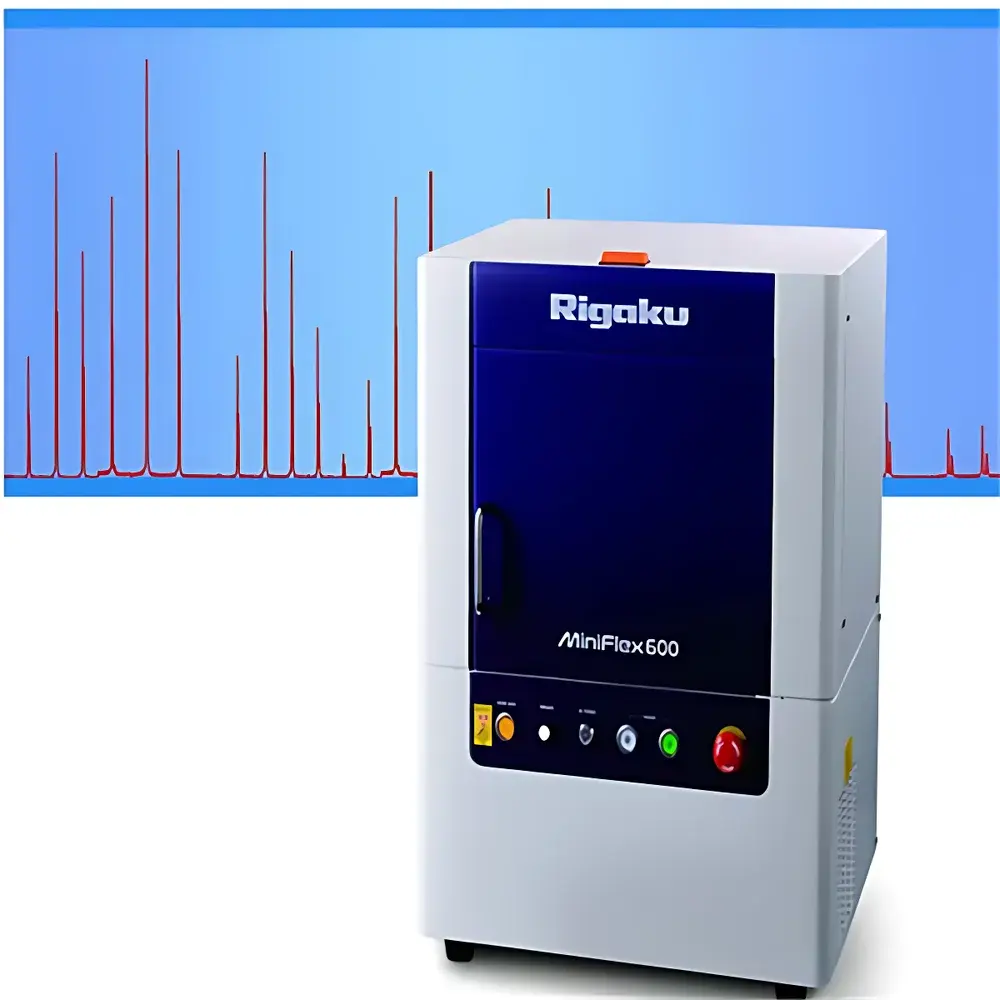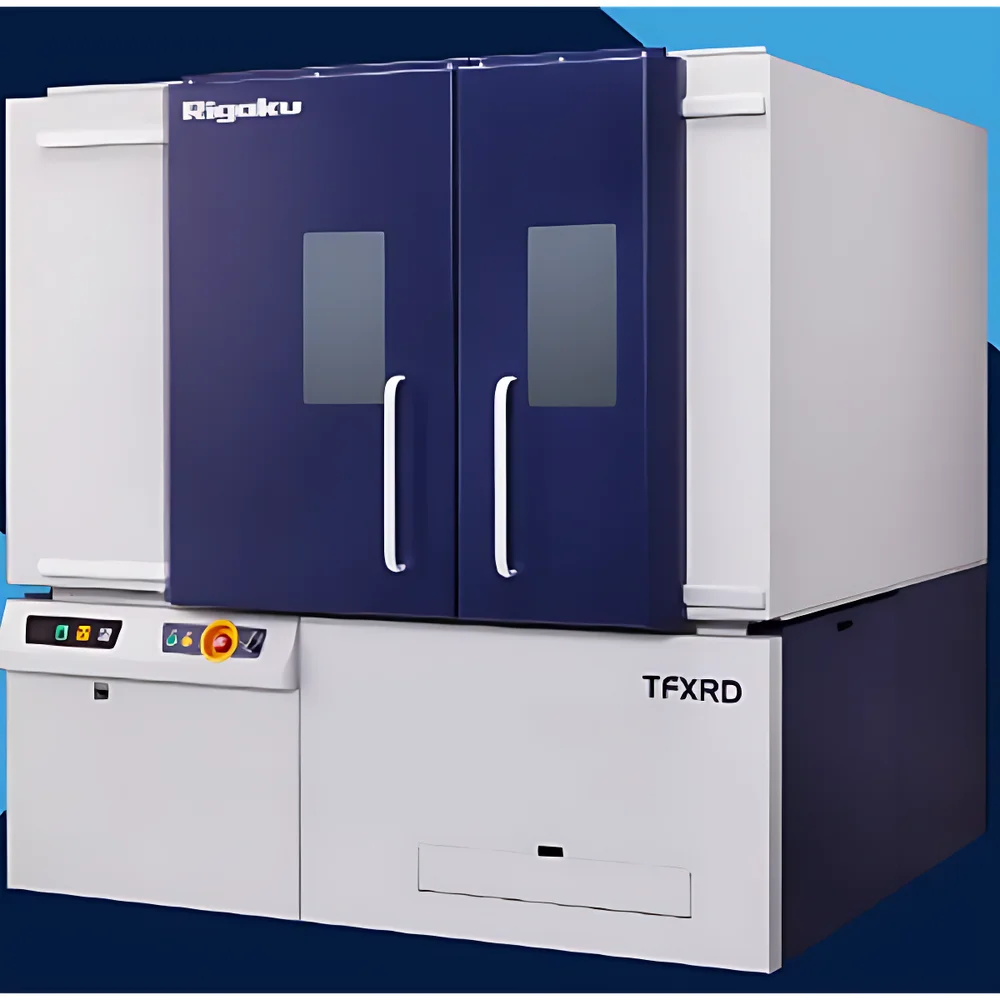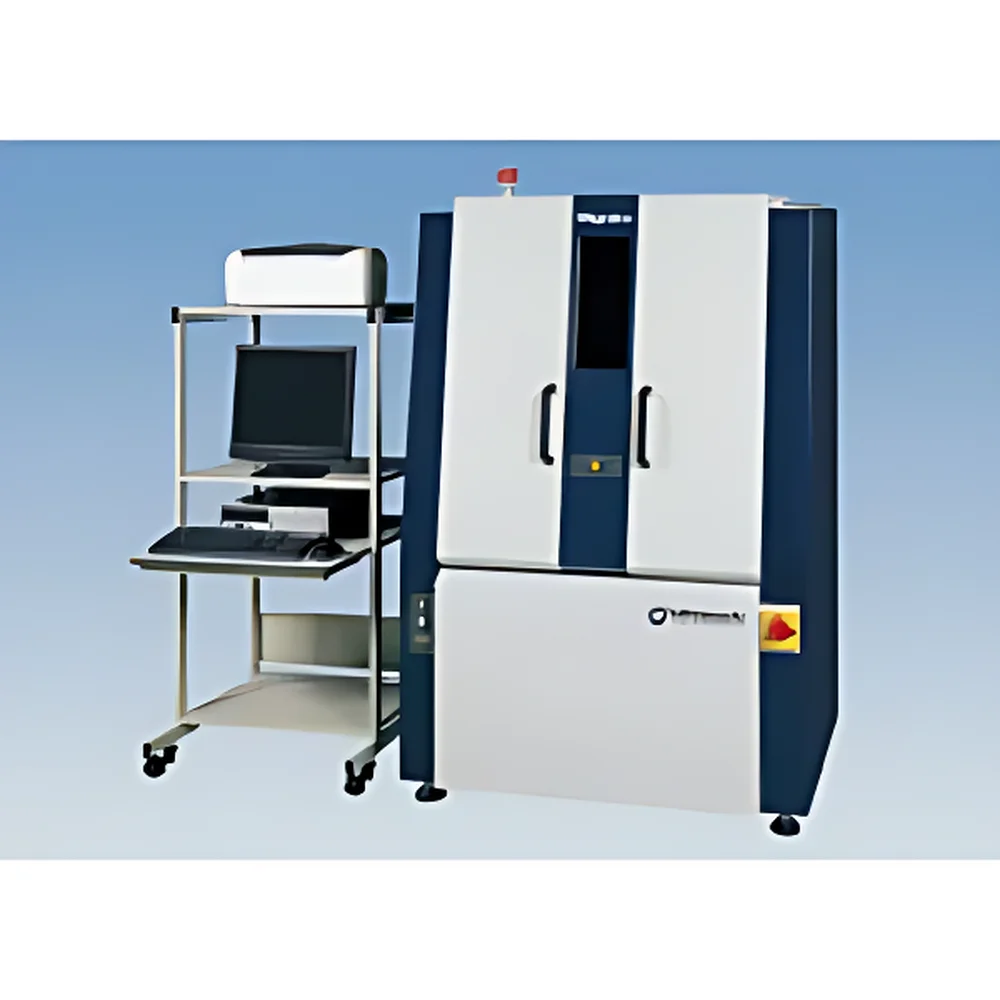
Rigaku Ultima IV Series Hybrid Multi-Function X-ray Diffractometer

| Brand | Rigaku |
|---|---|
| Origin | Japan |
| Model | Ultima IV Series |
| Instrument Type | Powder X-ray Diffractometer |
| X-ray Generator Power | 3 kW |
| Goniometer | Horizontal θ–θ configuration |
| Minimum Angular Step | 0.0001° (1/10,000°) |
| Goniometer Slit | Programmable Variable Aperture |
| Monochromator | High-efficiency Graphite Monochromator |
| Optics | CBO Cross-Beam Optics (patented Rigaku technology) enabling both focused-beam and high-intensity/high-resolution parallel-beam modes with mirror optics |
| Optional Modules | SAXS attachment, Thin-Film Analysis stage, Micro-Beam stage, In-Plane stage (Rigaku-exclusive) |
| Detector | D/teX-Ultra high-speed silicon strip detector |
| Integrated Hybrid System | XRD-DSC simultaneous measurement module |
| Software Suite | PDXL (XRD analysis), NANO-Solver (nanoscale scattering & particle size distribution), GXRR (grazing-incidence X-ray reflectivity) |
Ask about pricing, availability and specifications.
Overview
The Rigaku Ultima IV Series is a hybrid multi-function X-ray diffractometer engineered for precision structural characterization across diverse material classes and experimental configurations. Based on Bragg’s law and constructive interference of monochromatic X-rays scattered by crystalline lattices, the system delivers quantitative phase identification, lattice parameter refinement, microstructural analysis, and nanoscale scattering data — all within a single platform. Its horizontal θ–θ goniometer architecture ensures mechanical stability and long-term angular reproducibility, while the proprietary CBO (Cross-Beam Optics) system enables seamless switching between focused-beam geometry for high sensitivity on small or weakly diffracting samples and parallel-beam optics — enhanced by a high-reflectivity mirror — for superior resolution in thin-film and grazing-incidence applications. Designed and manufactured in Japan, the Ultima IV meets stringent international standards for laboratory-grade XRD instrumentation and serves as a core analytical tool in academic research labs, industrial R&D centers, and quality control environments operating under GLP or ISO/IEC 17025 frameworks.
Key Features
- 3 kW sealed-tube X-ray generator delivering stable, high-flux Cu Kα radiation for rapid data acquisition and improved signal-to-noise ratio
- Horizontal θ–θ goniometer with 0.0001° minimum step resolution, enabling high-precision angular scanning essential for strain mapping and fine peak separation
- Programmable variable divergence and receiving slits for dynamic optimization of intensity vs. resolution trade-offs during acquisition
- Graphite monochromator providing high spectral purity and background suppression, critical for quantitative phase analysis and trace-phase detection
- Rigaku-exclusive CBO optics supporting dual-beam-path operation: focused mode for powder and bulk analysis; parallel-beam + mirror mode for thin-film, GI-XRD, and reflectivity measurements
- Modular design accommodating field-upgradable attachments: SAXS unit for nanoscale particle sizing and pore structure analysis; micro-beam stage (<100 µm spot size) for spatially resolved phase mapping; In-Plane stage for simultaneous out-of-plane and in-plane diffraction — uniquely resolving anisotropic crystallographic orientation in layered or textured materials
- D/teX-Ultra silicon strip detector offering >95% quantum efficiency at Cu Kα, zero dead-time operation, and real-time 2θ acquisition without moving parts
Sample Compatibility & Compliance
The Ultima IV accommodates a broad range of sample geometries and physical states without requiring major hardware reconfiguration: free-flowing powders, pressed pellets, solid blocks, freestanding films, coated substrates, and micro-regions defined via motorized XYZ stages. It supports ASTM E975 (phase analysis of metallic materials), ISO 17892-12 (geotechnical XRD testing), and USP (pharmaceutical polymorph identification). All software modules comply with FDA 21 CFR Part 11 requirements for electronic records and signatures when deployed in regulated environments. Audit trails, user access controls, and secure data archiving are embedded in PDXL and NANO-Solver, facilitating GMP-compliant workflows and regulatory submissions.
Software & Data Management
Data acquisition and analysis are unified through Rigaku’s modular software suite. PDXL provides full Rietveld refinement (using GSAS-II or TOPAS engines), quantitative phase analysis (QPA) via reference intensity ratio (RIR) or internal standard methods, crystallite size and microstrain determination (via Williamson-Hall or Warren-Averbach), and lattice parameter optimization. NANO-Solver performs model-independent SAXS data reduction, Guinier and Porod analysis, and polydisperse sphere fitting for nanoparticle size distributions. GXRR enables precise modeling of electron density profiles from reflectivity curves, extracting layer thickness, interfacial roughness, and interdiffusion parameters in multilayer stacks. All software packages support batch processing, scripting (Python API), and export to industry-standard formats (XYE, CIF, CSV, PDF).
Applications
- Qualitative and quantitative phase identification in metallurgical alloys, ceramics, catalysts, and battery electrode materials
- Crystallinity assessment and crystallite size estimation in polymers, pharmaceuticals, and amorphous–crystalline composites
- Grazing-incidence XRD (GI-XRD) and X-ray reflectivity (XRR) for thin-film thickness, density, and interface quality in semiconductor and optical coatings
- In-Plane diffraction for texture analysis and epitaxial relationship verification in oriented perovskites, MOFs, and 2D materials
- Small-angle X-ray scattering (SAXS) for nanoparticle size distribution, shape anisotropy, and aggregate morphology in colloids and nanocomposites
- Simultaneous XRD-DSC measurements for real-time correlation of structural transitions (e.g., polymorphic conversion, crystallization onset) with thermal events
- Micro-diffraction mapping of phase heterogeneity in weld zones, corrosion products, or heterogeneous catalysts
FAQ
What distinguishes the Ultima IV’s CBO optics from conventional XRD optics?
CBO enables true dual-mode operation — focused-beam for maximum intensity on powders and bulk samples, and parallel-beam + mirror for high-resolution thin-film analysis — without manual realignment or optical swapping.
Can the system perform Rietveld refinement on complex multiphase systems?
Yes. PDXL integrates robust profile fitting algorithms and supports constrained refinements with site occupancy, anisotropic displacement, and preferred orientation corrections.
Is the D/teX-Ultra detector compatible with time-resolved studies?
Yes. Its frameless readout architecture allows continuous acquisition at up to 100 Hz per 0.02° 2θ step, suitable for in situ heating, humidity, or electrochemical cells.
Does the In-Plane stage require additional X-ray optics?
No. It uses dedicated goniometer geometry and beam-defining slits integrated into the CBO path, enabling simultaneous collection of out-of-plane (00l) and in-plane (hk0) reflections.
How is data integrity ensured in regulated laboratories?
All software modules include electronic signature workflows, immutable audit logs, role-based permissions, and encrypted database storage compliant with 21 CFR Part 11 Annex 11 and ISO 13485 requirements.