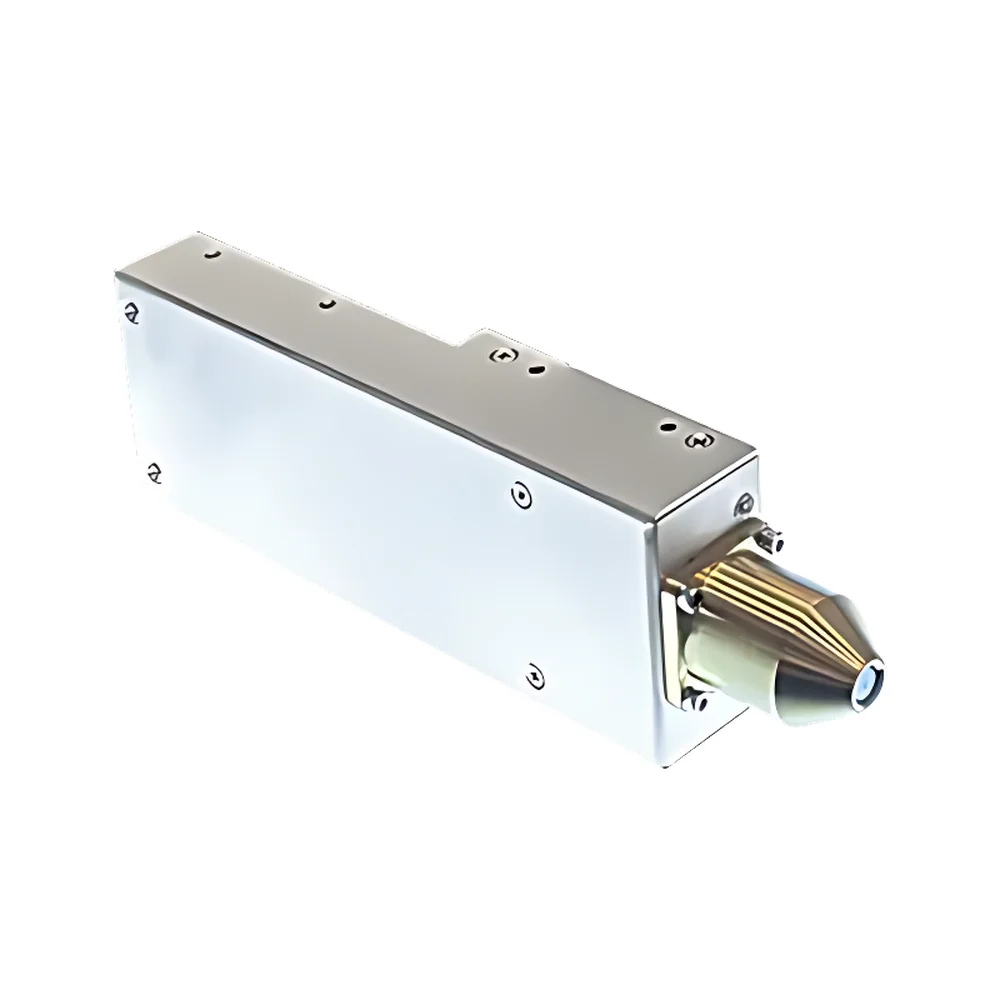
SUNJE SXF-5010-C Portable Energy Dispersive X-Ray Fluorescence Spectrometer

| Brand | SUNJE |
|---|---|
| Origin | South Korea |
| Manufacturer Type | Authorized Distributor |
| Origin Category | Imported Instrument |
| Model | SXF-5010-C |
| X-ray Tube | Metal-ceramic body with grounded anode |
| Target Material | Silver (Ag), transmission-type |
| Window Material | Beryllium (Be), thickness 127 µm |
| Output Cone Angle | 60° (with Ø3 mm collimator) |
| Focal Spot Size | <1 mm |
| Tube Voltage Range | 0–50 kV (negative polarity) |
| Tube Current Range | 0–200 µA |
| Input Power | 9–12 VDC |
| Operating Temperature | −10 °C to +50 °C |
| Storage Temperature | −40 °C to +85 °C |
| Analog I/O Interface | Voltage/Current Control & Monitor (0–4 V = 0–100%), Enable TTL logic (+5 VDC = ON, <1 VDC = OFF) |
Ask about pricing, availability and specifications.
Overview
The SUNJE SXF-5010-C is a handheld, battery-operated energy dispersive X-ray fluorescence (EDXRF) spectrometer engineered for rapid, non-destructive elemental analysis in field and laboratory environments. It operates on the fundamental principle of X-ray fluorescence: primary X-rays from a microfocus Ag-target tube excite atoms in the sample, inducing emission of characteristic secondary X-rays whose energies are uniquely associated with specific elements. The detector—typically a high-resolution silicon drift detector (SDD)—captures these photons and converts them into digital spectra, enabling qualitative identification and semi-quantitative concentration estimation across the Mg–U range. Unlike wavelength-dispersive systems, EDXRF offers real-time spectral acquisition without mechanical scanning, making the SXF-5010-C particularly suited for on-site screening of alloys, soils, coatings, consumer goods, and electronic components. Its compact metal-ceramic X-ray tube architecture, grounded anode design, and precisely collimated 60° output beam ensure stable excitation geometry and minimized bremsstrahlung background—critical for reproducible light-element response and low detection limits in portable configurations.
Key Features
- Compact, ergonomic handheld form factor with integrated trigger and real-time display for point-and-measure operation
- High-stability Ag transmission-target X-ray tube with beryllium window (127 µm), optimized for enhanced sensitivity to elements from sodium (Na) to uranium (U)
- Microfocus source (<1 mm focal spot) coupled with Ø3 mm collimator for precise spatial resolution and reduced matrix interference
- Wide excitation control range: 0–50 kV tube voltage and 0–200 µA tube current, enabling method-specific optimization for diverse sample types
- Robust thermal management supporting continuous operation from −10 °C to +50 °C ambient conditions
- Standard analog I/O interface (0–4 V control/monitor signals + TTL enable) for integration into automated test stations or OEM platforms
- Low-power 9–12 VDC input compatible with external power banks or vehicle power systems, extending operational runtime in remote deployments
Sample Compatibility & Compliance
The SXF-5010-C accommodates solid, powder, and coated samples with minimal or no preparation—ideal for scrap metal sorting, RoHS compliance screening, mining exploration, and environmental soil testing. Its sealed X-ray path and automatic beam shutter comply with IEC 61010-1 (safety requirements for electrical equipment) and IEC 62495 (radiation safety for portable XRF devices). While not certified as a Class I laser product, its X-ray emission is fully contained during operation and meets regulatory thresholds for unrestricted use under local radiation safety guidelines when operated per manufacturer instructions. The instrument supports method development aligned with ASTM E1621 (standard guide for XRF analysis of metals), ISO 21043 (EDXRF for cement and building materials), and EPA Method 6200 (field screening of heavy metals in soils).
Software & Data Management
Data acquisition and analysis are managed via SUNJE’s proprietary PC-based software suite, supporting spectral deconvolution using fundamental parameter (FP) algorithms and empirical calibration models. Raw spectra and processed results—including elemental intensities, net peak areas, and concentration estimates—are stored in vendor-neutral formats (CSV, .spc, .rpt) for traceability and third-party validation. Audit trail functionality logs operator ID, measurement timestamp, instrument settings, and calibration history—supporting GLP and GMP documentation requirements. For regulated environments, optional software modules provide 21 CFR Part 11-compliant user authentication, electronic signatures, and immutable data archiving.
Applications
- Positive material identification (PMI) of stainless steels, nickel alloys, and titanium grades in petrochemical and power generation infrastructure
- Rapid screening of restricted substances (Pb, Cd, Hg, Cr⁶⁺, Br) in electronics and plastics per EU RoHS and China RoHS directives
- In-field geochemical mapping and grade control in exploration drilling and open-pit mining operations
- Lead-in-paint and heavy-metal-in-soil assessment for environmental site investigations and remediation verification
- Quality assurance of plating thickness and composition in electroplating and PCB manufacturing
- Forensic analysis of glass, paint chips, and gunshot residue where portability and non-destructiveness are essential
FAQ
What is the minimum detectable limit (MDL) for lead (Pb) in soil using the SXF-5010-C?
MDL depends on measurement time, matrix composition, and instrument calibration; typical values range from 5–20 mg/kg under 60-second live-time acquisition on dried, homogenized soil samples.
Can the SXF-5010-C analyze light elements such as magnesium or aluminum?
Yes—its Ag-target tube and thin Be window enable reliable detection down to Mg (Z=12); optimal performance requires helium purge or vacuum interface for Na and lighter elements.
Is factory recalibration required annually?
Annual verification against certified reference materials (CRMs) is recommended; full recalibration is performed only if energy drift exceeds ±5 eV or intensity stability falls below 95% RSD over 8 hours.
Does the device support wireless data transfer?
The base configuration includes USB-C connectivity; optional Bluetooth 5.0 or Wi-Fi 6 modules are available for secure OTA firmware updates and remote spectral upload.
How is radiation safety ensured during operation?
The unit features dual interlocks: a mechanical shutter that closes automatically when the trigger is released, and a proximity sensor that disables X-ray emission if the measurement window is unobstructed—ensuring zero unintended exposure.