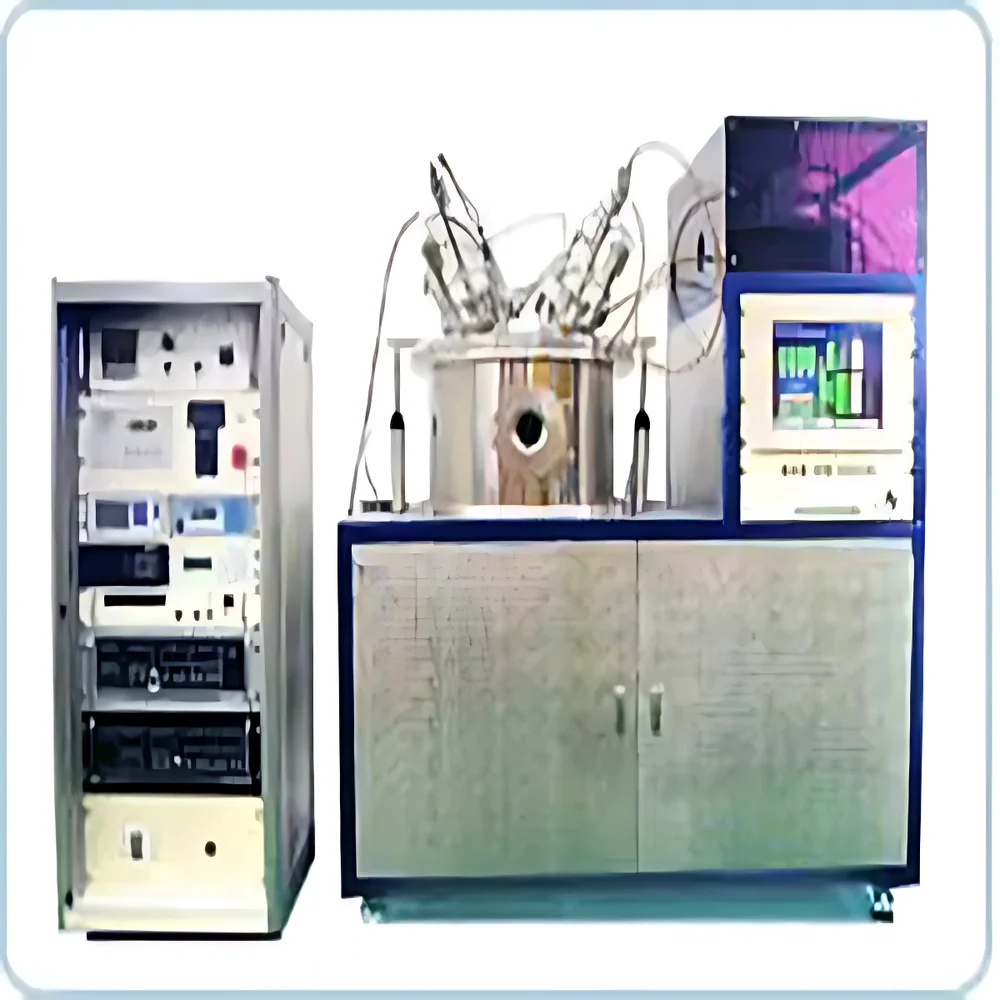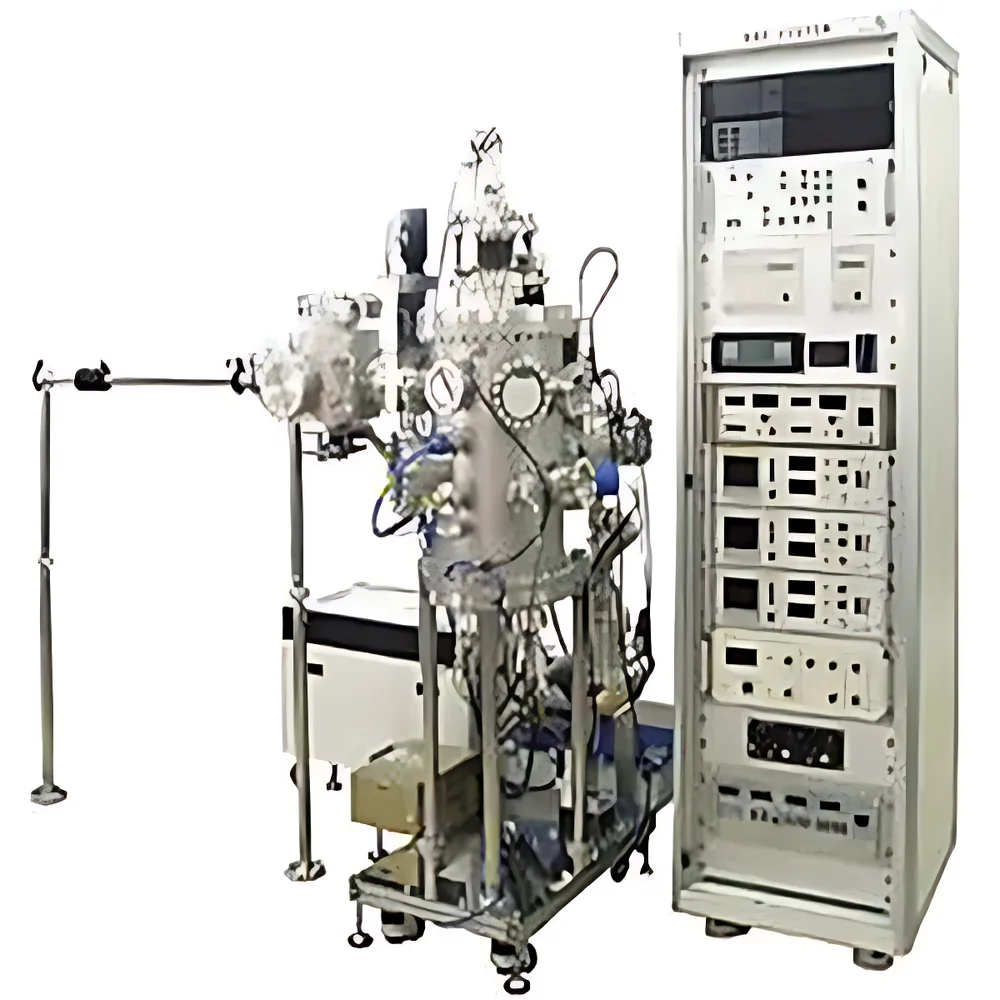
Microphase Model 18 Molecular Beam Epitaxy System

| Brand | Microphase |
|---|---|
| Origin | Japan |
| Model | 18 |
| Vacuum Chamber OD | 355–1,000 mm (substrate up to Ø600 mm) |
| Height | 700–1,000 mm |
| Effusion Cell Max Temp | < 1800 °C |
| Crucible Capacity | up to 200 cm³ |
| Crucible Materials | Al₂O₃, BN, PBN |
| DC Power Supply | 20 A / 100 V |
| RF Plasma Source | 300 W with matching network |
| RHEED Gun | 30 kV / 1 mA, filament current ≤3 A |
| Thickness Monitoring | Quartz Crystal Microbalance (QCM) |
| Beam Flux Measurement | Bayard–Alpert ion gauge |
| Vacuum System | Dry roughing pump + dual-stage turbomolecular pumps + cryopump + ion gauge |
| Control | PLC-based integrated touchscreen HMI |
Ask about pricing, availability and specifications.
Overview
The Microphase Model 18 Molecular Beam Epitaxy (MBE) System is a high-precision, ultra-high vacuum (UHV) thin-film growth platform engineered for the controlled, layer-by-layer fabrication of epitaxial semiconductor heterostructures. Operating on the principle of thermal effusion and directional molecular beam deposition under UHV conditions (typically <1×10⁻¹⁰ mbar base pressure), the system enables atomic-scale control over composition, doping, interface sharpness, and crystallinity—critical for advanced optoelectronic devices, quantum wells, two-dimensional materials, and III–V/II–VI compound semiconductors. Designed and manufactured in Japan, the Model 18 integrates modular effusion cells, RF plasma sources, reflection high-energy electron diffraction (RHEED), and real-time in situ metrology to support research-grade MBE processes compliant with fundamental surface science requirements and industrial process reproducibility standards.
Key Features
- Modular effusion cell configuration with PID-controlled heating up to 1800 °C, compatible with high-melting-point elements (e.g., Ga, As, Sb, Si, Ge) and refractory crucible materials including Al₂O₃, BN, and pyrolytic boron nitride (PBN).
- Dual-stage UHV pumping architecture: dry roughing pump paired with two turbomolecular pumps and a cryogenic pump, achieving ultimate pressures below 1×10⁻¹⁰ mbar—essential for minimizing background contamination and enabling monolayer-resolved growth kinetics.
- Integrated 30 kV RHEED gun with adjustable emission current (≤1 mA) and filament power (≤3 A), providing real-time, non-destructive monitoring of surface reconstruction, growth mode (2D vs. 3D), and layer completion during deposition.
- In situ thickness and rate control via quartz crystal microbalance (QCM) and calibrated Bayard–Alpert ion gauge for absolute beam flux quantification—supporting stoichiometric tuning across multi-element systems.
- RF plasma source (300 W, matched network) with mass flow controllers for reactive gases (N₂, O₂), enabling plasma-assisted MBE (PA-MBE) for nitride and oxide compound growth (e.g., GaN, ZnO) with enhanced dissociation efficiency and reduced substrate thermal budget.
- PLC-driven control system with industrial-grade touchscreen HMI, supporting recipe-based automation, interlock safety logic, and timestamped parameter logging—fully traceable for GLP/GMP-aligned process documentation.
Sample Compatibility & Compliance
The Model 18 accommodates substrates up to Ø600 mm within its cylindrical UHV chamber (OD range: 355–1,000 mm; height: 700–1,000 mm), allowing flexibility for standard wafers (2″–8″), custom templates, and bulk crystals. Substrate heating (resistive or e-beam) and cryogenic cooling (LN₂ or chilled water) are available as optional modules to enable growth across wide temperature ranges (−150 °C to >900 °C). The system meets ISO 14644-1 Class 4 cleanroom compatibility for installation environments and adheres to IEC 61000-6-2/6-4 electromagnetic immunity and emission standards. All vacuum components conform to ASTM F2780 for UHV material outgassing specifications, and control software supports audit trails and electronic signatures per FDA 21 CFR Part 11 when configured with validated firmware.
Software & Data Management
The embedded HMI software provides real-time visualization of vacuum status, cell temperatures, RHEED intensity profiles, QCM frequency shifts, and gas flow rates. Process data—including time-stamped sensor readings, setpoint deviations, and alarm events—are stored in structured CSV/SQLite format with configurable retention policies. Optional API integration (RESTful endpoints over Ethernet) enables bidirectional communication with laboratory information management systems (LIMS) or centralized data lakes. All operational logs include user authentication metadata and are write-protected post-acquisition to satisfy GLP audit requirements. Firmware updates follow a signed-package protocol verified via SHA-256 checksums prior to deployment.
Applications
- Growth of lattice-matched and strained heterostructures for high-electron-mobility transistors (HEMTs), quantum cascade lasers (QCLs), and single-photon emitters.
- Atomic-layer engineering of topological insulators (e.g., Bi₂Se₃, Sb₂Te₃) and van der Waals heterostructures requiring atomically clean interfaces.
- Development of dilute nitride alloys (e.g., GaAsN, InGaAsN) using RF-plasma-assisted nitrogen incorporation.
- In situ studies of surface diffusion, adatom mobility, and island nucleation dynamics via synchronized RHEED oscillation analysis.
- Integration with ex situ characterization workflows (XRD, TEM, XPS) through standardized load-lock transfer protocols minimizing air exposure.
FAQ
What base pressure can the Model 18 achieve with the standard pump configuration?
With the dual turbomolecular pump + cryopump system, the chamber reaches ≤5×10⁻¹¹ mbar after 48-hour bakeout at 150 °C.
Is the system compatible with arsenic or phosphorus effusion cells?
Yes—standard Al₂O₃ and PBN crucibles are chemically inert toward Group V elements; optional differential pumping zones mitigate cross-contamination.
Can RHEED patterns be recorded and analyzed offline?
The system exports raw image sequences (16-bit TIFF) and intensity profiles (CSV); third-party tools (e.g., MATLAB, Python-based RHEED analysis suites) are supported.
Does the control software support remote monitoring via secure network access?
Yes—SSH-enabled terminal access and HTTPS-based dashboard viewing are available with role-based authentication and TLS 1.2 encryption.
What maintenance intervals are recommended for the ion gauge and turbomolecular pumps?
Ion gauge calibration every 6 months; turbopump bearing inspection and oil replacement every 12,000 operating hours or per manufacturer’s service bulletin.