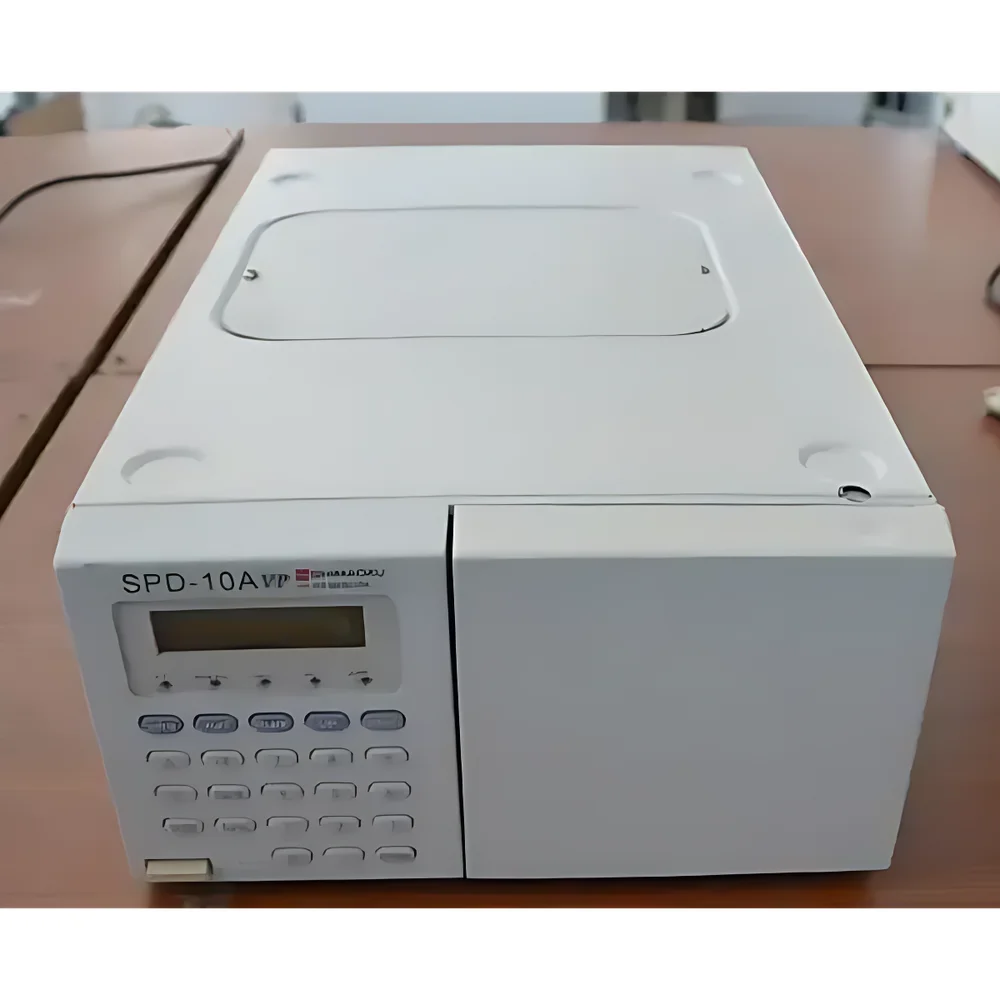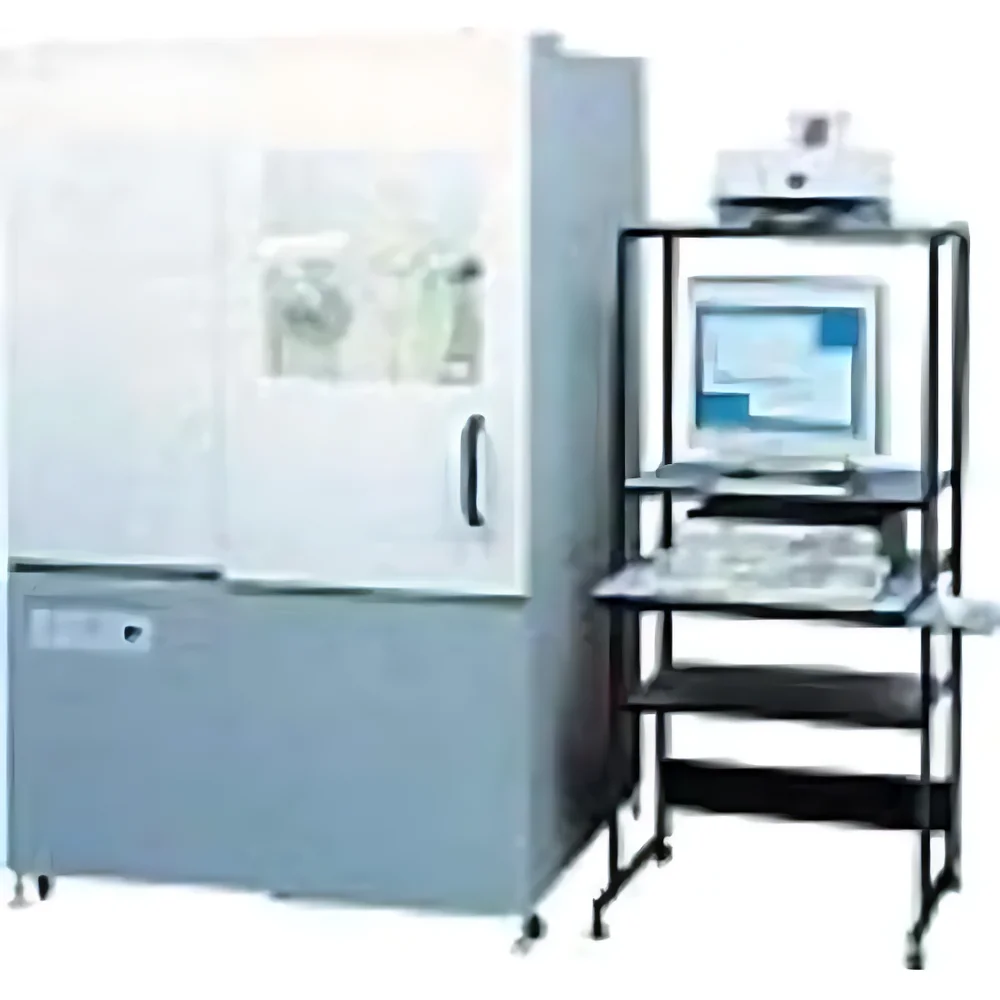
Shimadzu XRD-6100 Powder X-ray Diffractometer

| Brand | Shimadzu |
|---|---|
| Origin | Japan |
| Model | XRD-6100 |
| Instrument Type | Powder X-ray Diffractometer |
| Scan Geometry | θ/2θ |
| Monochromator | Focusing Bent-Crystal Monochromator |
| Typical X-ray Tube Power | 2.2 kW (Cu Kα) |
| X-ray Efficiency | >50% |
| Safety Compliance | IEC 61010-1, IEC 62471 (Radiation Safety Class 1) |
| Configuration | Benchtop, Fixed-Anode Cu Target Tube |
Ask about pricing, availability and specifications.
Overview
The Shimadzu XRD-6100 is a benchtop powder X-ray diffractometer engineered for high-fidelity phase identification, quantitative phase analysis, crystallite size determination, and lattice parameter refinement in academic, industrial, and quality control laboratories. It operates on Bragg’s law (nλ = 2d sinθ) using monochromatic Cu Kα radiation (λ = 1.5418 Å) generated by a sealed-tube X-ray source. The instrument employs a precise θ/2θ goniometer configuration with high-resolution angular positioning (0.0005° minimum step size), ensuring accurate peak position registration and reproducible diffraction pattern acquisition. Its core innovation lies in the proprietary focusing bent-crystal monochromator — a single-element, curved graphite or Ge(111) crystal that delivers >50% monochromatic beam intensity retention, significantly outperforming conventional flat-crystal or multilayer optics in signal-to-noise ratio and peak resolution. This optical architecture enables robust detection of low-abundance phases and subtle peak broadening effects critical for microstructural analysis.
Key Features
- High-efficiency focusing bent-crystal monochromator delivering >50% monochromatic X-ray throughput, enhancing sensitivity and reducing measurement time
- Independent X-ray tube power and filament current control system, enabling optimized thermal management and extending tube lifetime beyond 5,000 operating hours under standard usage
- Integrated radiation safety architecture: fully interlocked cabinet with lead-equivalent shielding, automatic beam shutter, and real-time dose monitoring compliant with IEC 61010-1 and IEC 62471 Class 1 requirements
- Benchtop design with rigid granite base and precision-ground goniometer bearings, minimizing mechanical drift and supporting long-term stability (angular repeatability ≤ ±0.002° over 100 h)
- Modular detector compatibility: supports scintillation counter (SC) and optional solid-state detectors (e.g., silicon strip detectors) for variable count-rate and resolution requirements
Sample Compatibility & Compliance
The XRD-6100 accommodates standard 25 mm and 50 mm diameter powder sample holders, as well as custom-mount accessories for thin films, fibers, and small-volume slurries. Sample stages support manual and motorized height adjustment to maintain optimal focus across diverse sample morphologies. All hardware and firmware comply with ISO 17025 calibration traceability requirements when used with certified reference materials (e.g., NIST SRM 640e, 660c). Data acquisition workflows support GLP/GMP-aligned documentation, including electronic signatures, audit trails, and raw data archiving in vendor-neutral formats (e.g., .raw, .xye, .csv). The system meets essential regulatory expectations for pharmaceutical solid-state characterization per USP , ICH Q5A(R2), and FDA guidance on polymorph screening.
Software & Data Management
Operation is managed via Shimadzu’s proprietary PDXL software suite (v3.10 or later), which provides integrated control, real-time pattern visualization, and automated Rietveld refinement using the GSAS-II engine. The software supports ASTM E1421-compliant peak search algorithms, internal standard quantification (e.g., Si or ZnO spike methods), and crystallite size analysis via Scherrer and Williamson–Hall modeling. Data export adheres to Crystallographic Information File (CIF) standards and supports direct import into third-party platforms including TOPAS, FullProf, and Match!. Audit trail functionality records user actions, parameter changes, and calibration events in accordance with FDA 21 CFR Part 11 requirements for electronic records and signatures.
Applications
- Pharmaceutical development: polymorph screening, hydrate/solvate identification, and stability-indicating assays for active pharmaceutical ingredients (APIs)
- Materials science: phase evolution during thermal treatment, residual stress mapping in sintered ceramics, and cation disorder quantification in battery cathode materials (e.g., NMC, LFP)
- Geology and mining: mineralogical quantification in bulk ores and tailings using reference intensity ratio (RIR) methods
- Quality assurance in cement, catalysts, and pigments: verification of crystalline phase composition against batch specifications per ISO 21379 and ASTM C1365
- Academic research: teaching crystallography fundamentals, validating DFT-predicted structures, and supporting synchrotron beamline experiment planning
FAQ
What X-ray tube options are supported on the XRD-6100?
The system is factory-configured with a fixed-anode Cu-target X-ray tube (2.2 kW nominal power); alternative anodes (Co, Fe, Mo) are not supported due to monochromator optimization for Cu Kα.
Is the XRD-6100 compatible with automated sample changers?
No — the XRD-6100 is a manually loaded benchtop platform; automation requires upgrading to the XRD-7000 series or higher-tier configurations.
Does the instrument support in situ or environmental cell measurements?
Standard configuration does not include environmental stages; however, third-party heating/cooling stages (e.g., Anton Paar HTK 1200N) may be mechanically integrated with custom mounting solutions.
What is the typical maintenance interval for the X-ray tube?
Under recommended operating conditions (≤80% max power, ≥30 min warm-up/cool-down cycles), tube replacement is typically required every 5–7 years, with annual vacuum and cooling system inspection advised.
Can raw diffraction data be exported without proprietary software?
Yes — all scan data are stored in ASCII-based .raw format with header metadata, enabling direct parsing in Python (using PyMca or xrdtools), MATLAB, or Excel without licensing dependencies.