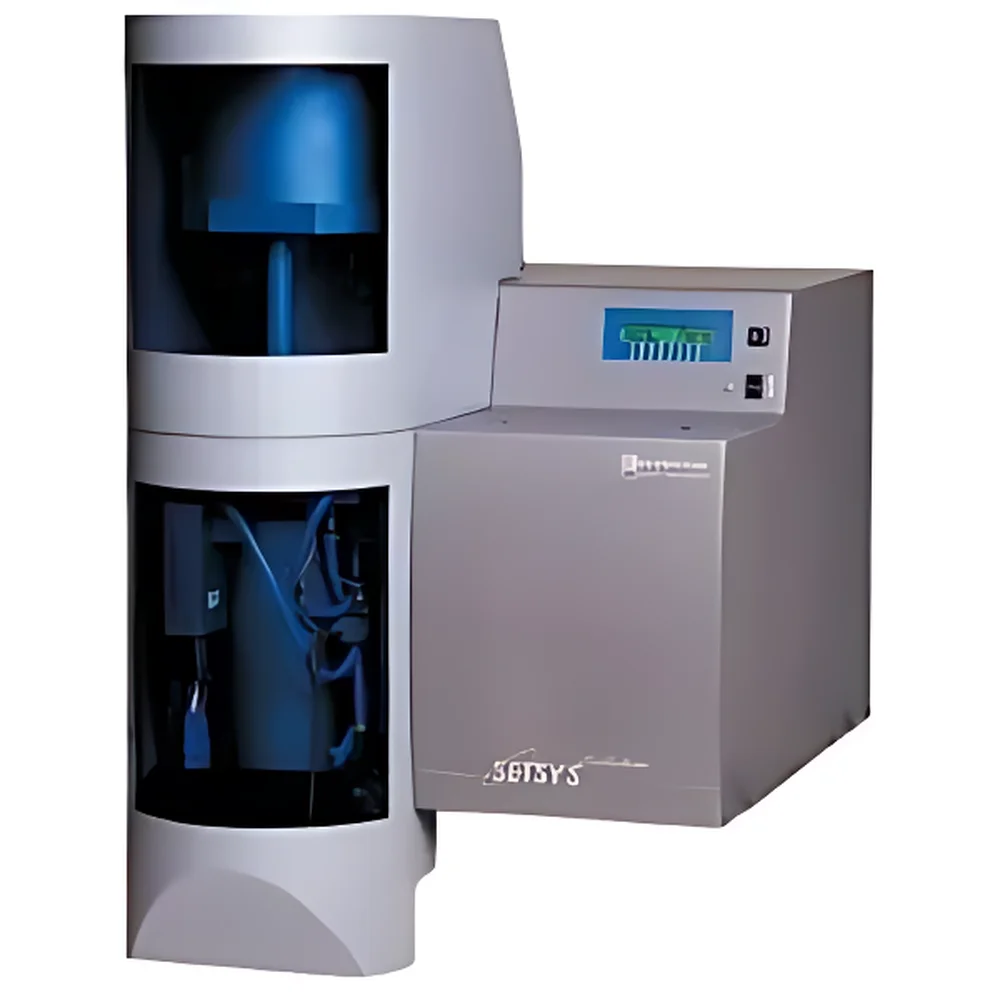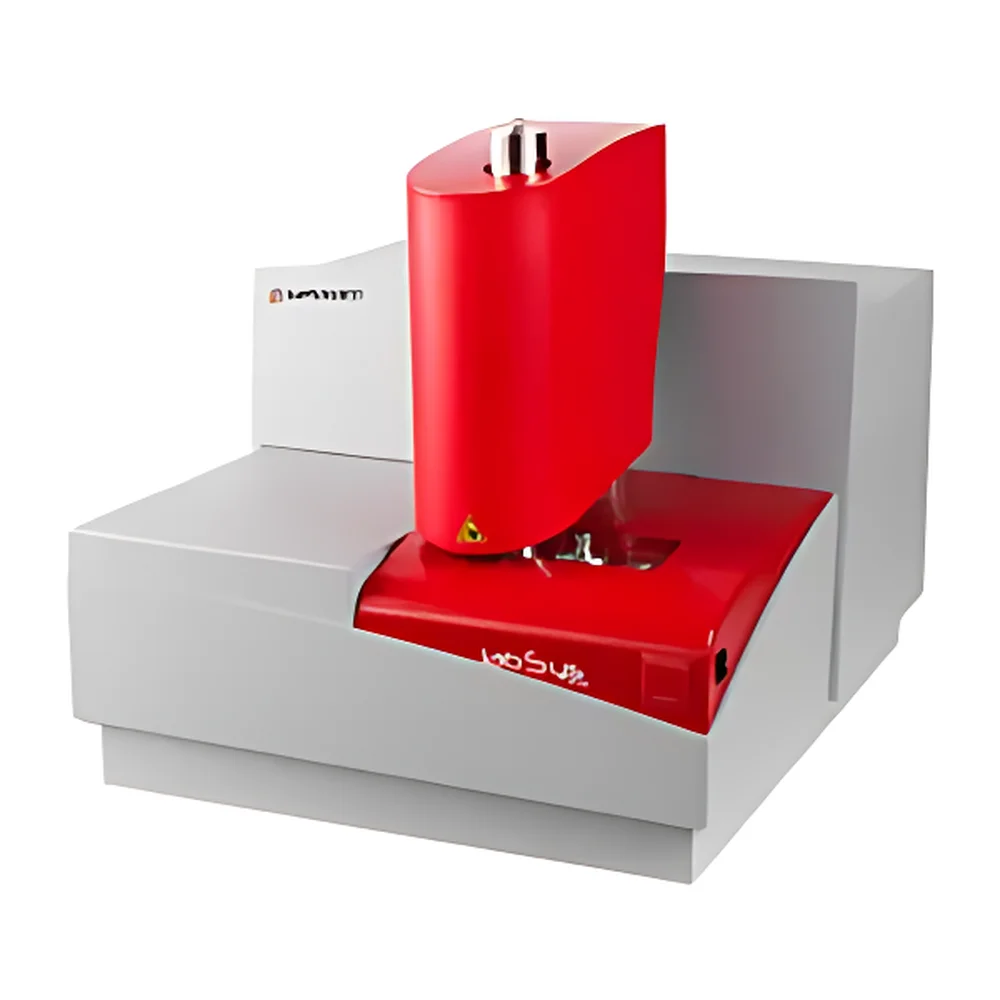
SETARAM VistoMS Fourier Transform Ion Cyclotron Resonance Mass Spectrometer (FTICR-MS) Coupled with Thermal Analyzer

| Brand | SETARAM |
|---|---|
| Origin | France |
| Manufacturer | AlyXan (co-developed with SETARAM) |
| Model | VistoMS |
| Detection Principle | Fourier Transform Ion Cyclotron Resonance Mass Spectrometry |
| Mass Range | up to 300 u |
| Mass Accuracy | ≤ 0.01 u |
| Detection Limit | sub-ppm (parts per million) |
| Ionization Mode | Soft chemical ionization (e.g., H₃O⁺ reagent ions) |
| Vacuum Architecture | Dual-stage differential vacuum system (atmospheric pressure interface → primary vacuum → secondary high vacuum measurement region) |
| Sample Introduction | Direct coupling to thermal analyzer (TGA, DSC, or TGA-MS compatible platforms) |
| Measurement Duration per Scan | ~2 seconds |
| Environmental Control | Humidity-regulated gas atmosphere capability |
| Quantification | Calibration-free relative quantitation across full mass range |
| Compatibility | Real-time evolved gas analysis (EGA) for organic and polymeric materials |
Ask about pricing, availability and specifications.
Overview
The SETARAM VistoMS is a purpose-engineered thermal analysis–mass spectrometry coupling platform integrating a high-field Fourier Transform Ion Cyclotron Resonance Mass Spectrometer (FTICR-MS) with benchtop thermal analyzers—including thermogravimetric analyzers (TGA), differential scanning calorimeters (DSC), and hybrid TGA-DSC systems. Unlike conventional quadrupole or time-of-flight (TOF) MS detectors used in thermal analysis couplings, the VistoMS leverages the intrinsic advantages of FTICR physics: ultra-high mass resolving power (>1,000,000 at m/z 200), sub-ppm mass accuracy (≤0.01 u), and non-destructive soft ionization via proton-transfer reactions using H₃O⁺ as the primary reagent ion. This enables unambiguous determination of elemental composition directly from measured m/z values—without chromatographic separation or prior knowledge of sample chemistry. The system operates under continuous atmospheric-pressure gas effluent transfer from the thermal analyzer, followed by differential pumping through two vacuum stages to maintain optimal ion trapping conditions in the FTICR cell. Measurement duty cycles are optimized for real-time evolved gas analysis (EGA), delivering full-spectrum acquisition every ~2 seconds across a mass range extending to 300 u.
Key Features
- Direct atmospheric-pressure interface between thermal analyzer and FTICR-MS—no cryo-trapping, no modulation, no loss of labile volatiles
- Soft chemical ionization using H₃O⁺ reagent ions preserves molecular integrity; eliminates fragmentation-induced ambiguity in spectral interpretation
- Calibration-free semi-quantitative analysis enabled by uniform ion transmission efficiency across the entire mass range
- Dual-stage vacuum architecture ensures stable ion cyclotron motion and long transient signal decay times (>5 s), essential for high-resolution FT signal acquisition
- Humidity-controlled carrier gas environment support—enables studies under physiologically or industrially relevant moisture conditions
- Real-time, full-spectrum EGA profiling with simultaneous detection of all co-eluting species, including isobaric and isomeric compounds distinguishable by exact mass
Sample Compatibility & Compliance
The VistoMS is validated for evolved gas analysis of thermally labile and complex organic matrices, including polymers, resins, pharmaceutical excipients and APIs, food constituents, tobacco, petroleum fractions, lignocellulosic biomass, synthetic fibers, and municipal organic waste streams. Its ability to resolve isobaric species (e.g., C₂H₄O vs. CH₄N₂, both nominal m/z 44.026) supports compliance with ISO 11358 (polymer thermal degradation), ASTM E2550 (thermal stability by TGA), and USP (analytical method validation for impurity profiling). The system’s audit-trail-capable software architecture aligns with GLP and GMP data integrity requirements per FDA 21 CFR Part 11 when deployed in regulated laboratories.
Software & Data Management
Acquisition and processing are managed via SETARAM’s proprietary Calisto™ software suite, extended with AlyXan’s FTICR-specific modules. Raw transients undergo zero-filling, apodization, and fast Fourier transformation; peak picking employs adaptive thresholding and isotopic pattern matching against theoretical elemental databases (e.g., ChemCalc, SIRIUS-compatible formats). Time-resolved mass chromatograms are synchronized with thermal events (weight loss steps, exothermic peaks) and exported in open formats (mzML, NetCDF) for third-party chemometric tools (e.g., MATLAB, Python-based PyOpenMS). All processing parameters, instrument logs, and user actions are recorded with timestamped metadata for full traceability.
Applications
- Identification and quantification of trace-level degradation markers in polymer thermal aging (e.g., formaldehyde, acetaldehyde, phthalates)
- Reaction mechanism elucidation in catalytic pyrolysis of biomass—tracking intermediate carbonyls, furans, and phenolics with elemental specificity
- Residual solvent mapping in lyophilized pharmaceuticals without derivatization
- Off-gassing profiling of flame-retardant composites under controlled humidity to assess hydrolytic instability
- Thermal desorption fingerprinting of microplastics in environmental sediment samples
- Decomposition pathway analysis of energetic materials under inert and oxidative atmospheres
FAQ
How does VistoMS differ from conventional TGA-MS systems using quadrupole or TOF detectors?
VistoMS replaces low-resolution mass filtering with FTICR detection—delivering >100× higher mass resolution and sub-ppm mass accuracy, enabling definitive elemental formula assignment without reference standards.
Is calibration required for quantitative analysis?
No absolute calibration is needed for relative quantitation; ion response uniformity across m/z 10–300 u allows direct comparison of peak intensities for semi-quantitative evolved gas profiling.
Can VistoMS operate under non-inert atmospheres?
Yes—the system supports humidified N₂, synthetic air, CO₂-rich, or O₂-diluted environments via integrated mass flow controllers and humidity generators.
What is the minimum detectable concentration for volatile organics?
Detection limits are typically in the low parts-per-trillion (pptv) range for targeted analytes under optimized ionization conditions, translating to sub-ppm in evolved gas streams.
Is the FTICR cell compatible with routine maintenance in an industrial lab setting?
The magnet and ICR cell are sealed and permanently aligned; only the ion optics and transfer capillary require periodic cleaning—procedures documented in ISO/IEC 17025-compliant service manuals.