
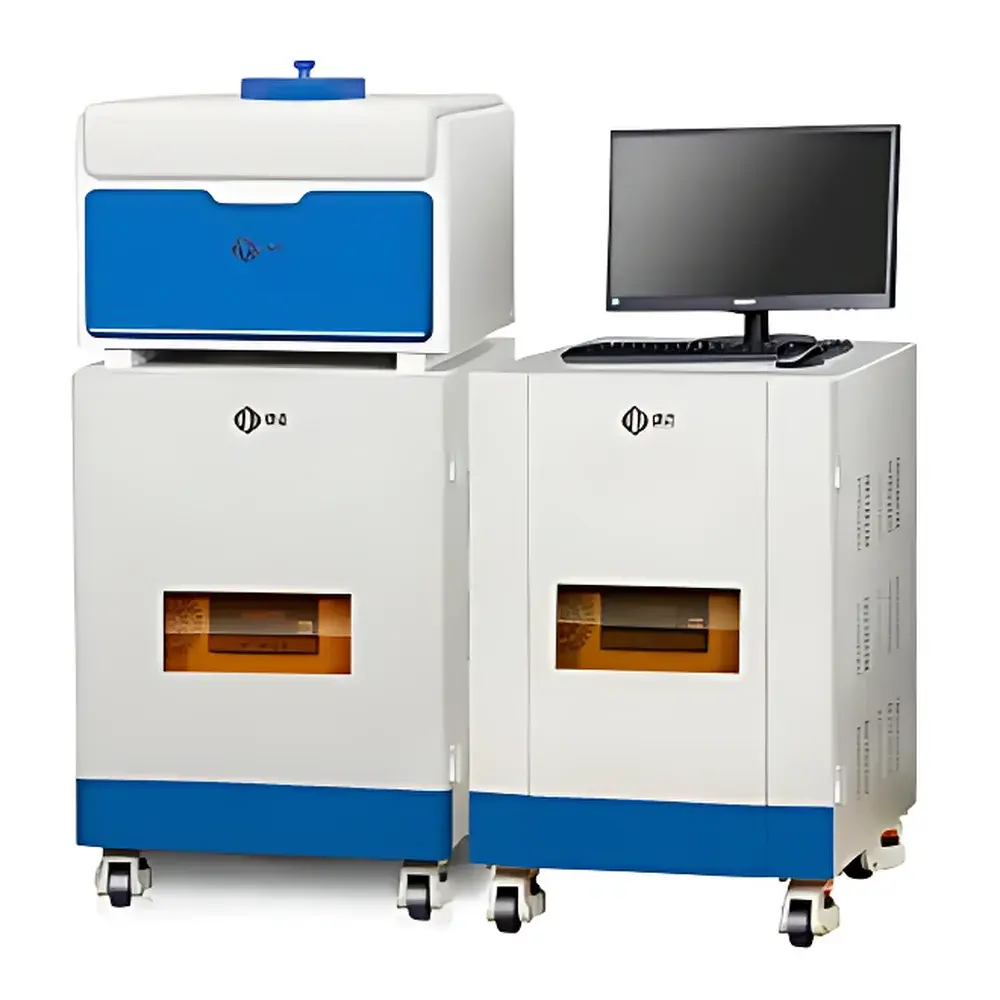
NIUMAG VTMRNMR Variable-Temperature Nuclear Magnetic Resonance Analyzer
| Brand | NIUMAG |
|---|---|
| Origin | Jiangsu, China |
| Magnet Type | Permanent Magnet |
| Magnetic Field Strength | 0.5 ± 0.05 T |
| Standard Temperature Range | Room Temperature to 130 °C |
| Optional Cryo/High-Temp Module | –100 °C to 200 °C |
| Relaxometry Capabilities | T₁ & T₂ Measurement |
| Advanced Acquisition Technology | FLAT (Fast Low-Amplitude Transient) for Short-T₁/Weak-Signal Samples |
| Sample States Supported | Solutions, Gels, Solids, Powders, Particulates |
| Compliance Framework | Designed for GLP/GMP-aligned workflows |
Overview
The NIUMAG VTMRNMR Variable-Temperature Nuclear Magnetic Resonance Analyzer is a benchtop, permanent-magnet-based NMR relaxometer engineered for precise, non-invasive characterization of molecular dynamics and microstructural evolution under controlled thermal conditions. Operating at a stable 0.5 ± 0.05 T field, the system leverages pulsed NMR principles—specifically spin–lattice (T₁) and spin–spin (T₂) relaxation time analysis—to quantify molecular mobility, phase distribution, crosslink density, pore structure, and interfacial interactions across a broad temperature spectrum. Unlike conventional NMR spectrometers requiring cryogenics or superconducting magnets, the VTMRNMR integrates a robust, low-drift permanent magnet with an in-situ temperature-controlled sample chamber, enabling true *in situ*, time-resolved thermal profiling without sample transfer or external calibration drift. Its core application domain spans polymer curing kinetics, rubber vulcanization monitoring, pharmaceutical solid-state stability assessment, food matrix phase transitions (e.g., fat crystallization, starch retrogradation), and battery electrolyte dynamics—all within a compact, laboratory-safe footprint.
Key Features
- Integrated variable-temperature probe with high-precision PID control: standard range from ambient to +130 °C; optional extended module covering –100 °C to +200 °C for cryogenic polymer glass transitions or high-temperature degradation studies.
- FLAT (Fast Low-Amplitude Transient) acquisition technology optimized for short-T₁ species (e.g., rigid polymers, bound water, fluorinated compounds), delivering enhanced signal-to-noise ratio and reproducibility for weak or rapidly relaxing signals.
- Dual-mode operation: quantitative relaxometry (T₁/T₂ distribution analysis via inverse Laplace transform) and optional 2D/3D magnetic resonance imaging (MRI) for spatial mapping of heterogeneity, internal defects, or component segregation.
- Modular hardware design with field-upgradable components—including RF amplifier, gradient set, and temperature controller—ensuring long-term adaptability to evolving analytical needs.
- Self-shielded permanent magnet architecture requiring zero cryogens, no quench risk, and minimal siting infrastructure—ideal for QC labs, pilot plants, and academic core facilities.
Sample Compatibility & Compliance
The VTMRNMR accepts samples in standard 15–25 mm OD NMR tubes, custom-insert holders for irregular solids, and flow-through cells for inline process monitoring. It accommodates viscous liquids, gels, elastomers, granular composites, and heterogeneous mixtures without pretreatment or labeling. All measurements are intrinsically non-destructive and require no ionizing radiation or chemical derivatization. The system complies with ISO/IEC 17025 documentation practices for method validation and supports traceable calibration using reference standards (e.g., doped water, polyethylene). Software architecture incorporates role-based user management, electronic signatures, and full audit trails aligned with FDA 21 CFR Part 11 and EU Annex 11 for regulated environments. Instrument qualification (IQ/OQ/PQ) protocols and SOP templates are provided to facilitate GxP implementation.
Software & Data Management
NIUMAG’s proprietary NMI (Nuclear Magnetic Imaging) software suite provides end-to-end workflow control—from parameter setup and real-time temperature ramping to automated multi-point T₂ decay fitting, diffusion-weighted analysis, and parametric MRI reconstruction. Data export conforms to HDF5 and ASCII formats for third-party statistical modeling (e.g., PCA, PLS regression) in MATLAB, Python, or JMP. Batch processing supports unattended overnight experiments with auto-restart on power recovery. Raw FID data, processed spectra, and metadata are stored in a relational database with versioned backups and configurable retention policies. Remote monitoring via secure HTTPS interface enables centralized fleet management across multi-site operations.
Applications
- Rubber & Elastomer R&D: Quantification of crosslink density, filler dispersion homogeneity, and network evolution during sulfur vulcanization or peroxide curing.
- Pharmaceutical Solid Dosage Forms: Assessment of amorphous content, moisture migration, and excipient–API compatibility under accelerated aging conditions.
- Food Science: Real-time tracking of oil solidification, protein denaturation, and starch gelatinization kinetics across defined thermal ramps.
- Materials Aging Studies: Monitoring microcrack initiation, plasticizer leaching, and oxidative degradation in polymers exposed to thermal cycling.
- Battery Research: Characterizing Li-ion electrolyte viscosity changes, SEI formation dynamics, and electrode wetting behavior at sub-zero temperatures.
- Geoscience & Porous Media: Pore-size distribution analysis in shale cores and cementitious materials under simulated reservoir thermal gradients.
FAQ
What temperature accuracy and stability does the VTMRNMR achieve during ramping?
The system maintains ±0.5 °C temperature accuracy over the full range, with short-term stability better than ±0.1 °C over 30 minutes at steady state.
Can the VTMRNMR be integrated into automated production lines?
Yes—via Ethernet TCP/IP and Modbus RTU interfaces, it supports PLC-triggered measurement sequences and real-time data streaming to MES/SCADA platforms.
Is MRI capability suitable for quantitative porosity mapping?
Absolutely—the optional MRI module delivers voxel-resolved T₂-weighted contrast with spatial resolution down to 50 µm, validated against mercury intrusion porosimetry per ASTM D4404.
How is instrument performance verified post-installation?
NIUMAG provides on-site verification using NIST-traceable relaxation standards and issues a Certificate of Conformance with T₁/T₂ repeatability data (RSD ≤ 1.2% over 10 runs).
Does NIUMAG offer method development support for novel sample types?
Yes—customers receive dedicated application engineering hours, including feasibility testing, pulse sequence optimization, and SOP co-development, backed by a global library of >120 validated protocols.



