
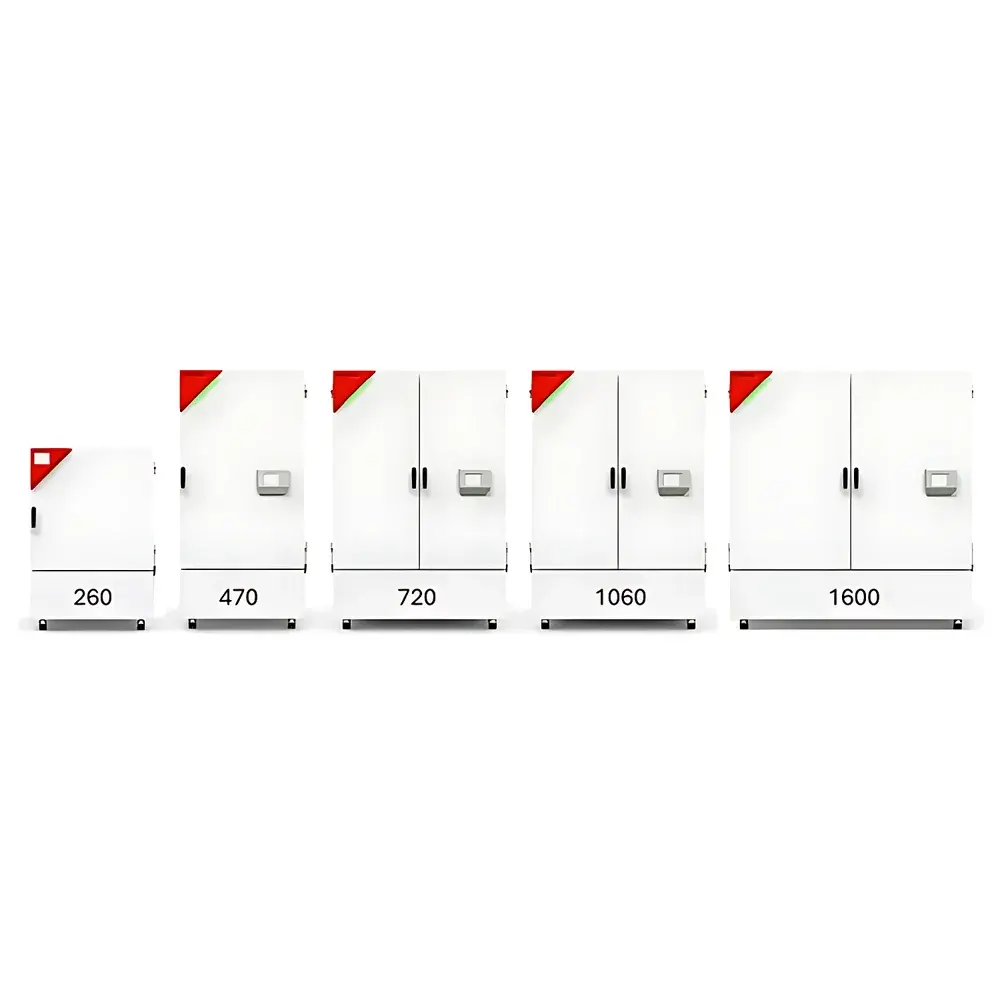
BINDER KB PRO / KBF / KBF PRO Series LED-Enabled Plant Growth Chambers
| Brand | BINDER |
|---|---|
| Origin | Germany |
| Chamber Volumes | 260 L, 470 L, 720 L, 1060 L, 1600 L |
| Temperature Range (KB PRO) | 0 °C to +50 °C (no humidity control) |
| Temperature Range (KBF) | 10 °C to +50 °C, Humidity Range: 10–50 % RH |
| Temperature Range (KBF PRO) | 10 °C to +50 °C, Humidity Range: 10–90 % RH |
| LED System | 16 modular strips, each with independently controllable warm white (3000 K), cool white (6500 K), and deep red (660 nm) channels |
| PAR Irradiance | Up to 1000 µmol·m⁻²·s⁻¹ (simulating full sunlight) |
| Control Interface | Touch-enabled external controller with programmable light recipes, twilight simulation, and fresh-air exchange mode |
| Compliance | Designed per IEC 61000-6-3 (EMC), EN 61010-1 (safety), and compatible with GLP/GMP documentation workflows |
Overview
BINDER’s KB PRO, KBF, and KBF PRO Series LED-Enabled Plant Growth Chambers are precision-engineered environmental simulation systems designed for reproducible, long-term plant phenotyping, seed germination studies, photobiology research, and controlled-environment agriculture (CEA) applications. These chambers integrate BINDER’s proven climate control architecture—featuring high-stability PID temperature regulation, uniform air distribution via rear-mounted centrifugal fans, and double-walled insulated construction—with a fully configurable, spectrally tunable LED illumination system. Unlike conventional growth cabinets relying on fixed-spectrum fluorescent or HID lamps, BINDER’s modular LED platform delivers programmable photosynthetically active radiation (PAR) profiles across 400–700 nm, enabling precise emulation of diurnal cycles, seasonal light quality shifts, and photomorphogenic stimuli. The system operates on a closed-loop control principle: temperature and humidity (where applicable) are regulated in real time via platinum resistance thermometers (Pt100) and capacitive hygrometers, while LED output is synchronized via RS485 communication to maintain temporal and spectral fidelity across experimental replicates.
Key Features
- Modular LED lighting system comprising 16 individually mountable strips—each equipped with three independently addressable LED channels: warm white (3000 K), cool white (6500 K), and narrow-band deep red (660 nm ±5 nm) optimized for phytochrome B activation;
- External touchscreen controller enabling per-channel dimming (0–100%), timed ramping, circadian scheduling, twilight simulation (gradual intensity decay over 30–120 min), and coordinated fresh-air exchange sequences;
- Uniform irradiance distribution: ±5% spatial homogeneity across standard shelf configurations, validated using calibrated quantum sensors (Li-Cor LI-190R);
- Three chamber families differentiated by climatic capability: KB PRO (refrigerated, 0–50 °C, no humidity control), KBF (10–50 °C, 10–50 % RH), and KBF PRO (10–50 °C, 10–90 % RH with condensation-free humidification);
- Chamber volumes scalable from 260 L to 1600 L, supporting single-shelf assays up to multi-tiered cultivation arrays; all models feature stainless steel interior, double-glazed observation windows, and ISO Class 5-compatible interior surface finish;
- Compliance-ready architecture: supports audit trails, user access levels (admin/operator/guest), event logging, and exportable CSV reports—aligned with GLP and GMP documentation requirements under FDA 21 CFR Part 11 when paired with optional BINDER ecoView software.
Sample Compatibility & Compliance
The chambers accommodate a broad range of botanical specimens—from Arabidopsis thaliana seedlings and tissue culture plates to mature tomato or lettuce plants in hydroponic trays. Interior dimensions permit integration of custom irrigation manifolds, CO₂ supplementation lines, and sensor arrays (e.g., leaf temperature IR probes, stomatal conductance meters). All models conform to EN 61010-1:2010 for laboratory equipment safety and IEC 61000-6-3:2019 for electromagnetic compatibility. Humidity-controlled variants (KBF and KBF PRO) meet ISO 17025 calibration traceability standards for relative humidity sensors. Optional validation packages include IQ/OQ documentation templates compliant with ASTM E2500-13 (good practice for equipment qualification) and support for third-party 21 CFR Part 11 compliance audits.
Software & Data Management
BINDER ecoView software (optional) provides centralized remote monitoring, multi-chamber synchronization, and automated light/temperature/humidity protocol deployment. Data is logged at user-defined intervals (1 s to 60 min resolution) and stored locally on an embedded industrial SSD with 10-year retention capacity. Export formats include CSV, PDF summary reports, and XML for LIMS integration. The system supports TLS 1.2-secured cloud upload to BINDER’s myBINDER portal—enabling cross-site collaboration, version-controlled protocol libraries, and role-based data access control. All parameter changes generate timestamped, user-identified audit entries with before/after values—fulfilling ALCOA+ (Attributable, Legible, Contemporaneous, Original, Accurate, Complete, Consistent, Enduring, Available) data integrity criteria.
Applications
- Photomorphogenesis studies requiring selective activation of phytochromes (via 660 nm) and cryptochromes (via 450 nm blue-enhanced cool white);
- Controlled abiotic stress experiments—e.g., drought simulation via stepwise RH reduction coupled with PAR modulation;
- Seed dormancy breaking protocols combining stratification (low-temperature KB PRO cycles) and photostimulation;
- Pharmaceutical-grade medicinal plant cultivation under documented environmental conditions (GACP-aligned workflows);
- Vertical farming R&D, including spectral optimization trials for biomass yield, anthocyanin accumulation, or nitrate reduction;
- Microbiome–plant interaction studies where consistent light quality prevents confounding effects on rhizosphere microbiota composition.
FAQ
Can the LED spectrum be customized beyond the three default channels?
Yes—third-party spectral tuning is supported via Modbus RTU interface; users may integrate external spectroradiometers and feed real-time feedback into custom control loops.
Is UV-A or far-red (730 nm) illumination available?
Not natively, but the modular strip design allows field retrofitting with certified UV-A (365 nm) or far-red (730 nm) LED modules through BINDER’s engineering services group.
How is temperature uniformity maintained under full LED load?
LED drivers are thermally decoupled from the chamber cavity; heat dissipation occurs externally via convection-cooled heatsinks, preventing radiant heating of samples and ensuring <±0.5 °C vertical gradient (measured per DIN 12880).
Does the system support CO₂ enrichment?
Yes—optional CO₂ inlet ports and integrated NDIR sensors are available as factory-installed accessories, with concentration control ranging from 400 ppm to 2000 ppm.
What maintenance is required for long-term PAR stability?
LED luminous flux degradation is <3% per 10,000 operating hours; annual recalibration using a NIST-traceable quantum sensor is recommended to maintain PAR accuracy within ±2%.



