
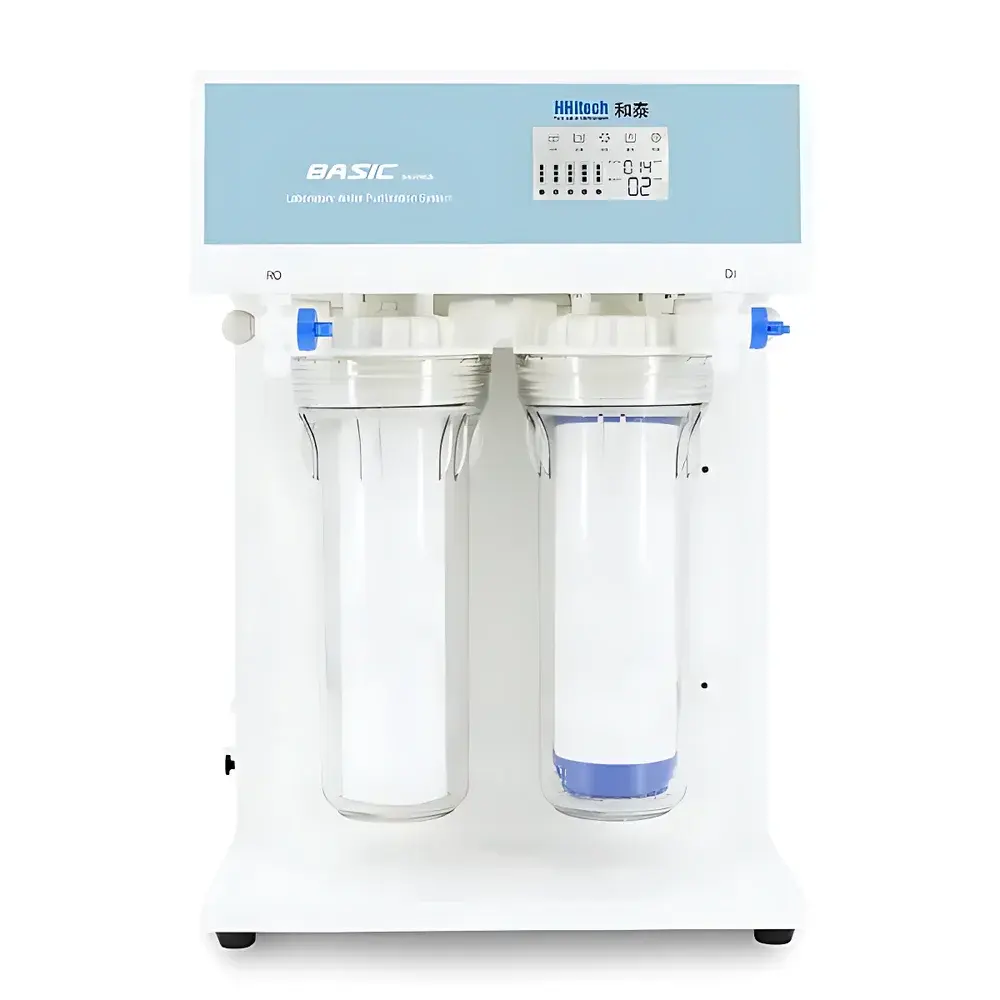
HHitech Basic Series Ultra Pure Water System
| Brand | HHitech |
|---|---|
| Origin | United Kingdom |
| Model | Basic-RO15(IT)/Basic-RO30(IT)/Basic-RO45(IT)/Basic-Q15(IT)/Basic-Q30(IT)/Basic-Q45 |
| Purified Water Output | 15/30/45 L/hour |
| RO Rejection Rate | 97–99% (ions), >99% (organics, MW >200 Da), >99% (particles & bacteria) |
| DI Resistivity | 13–17.5 MΩ·cm @ 25°C |
| Conductivity | 0.077–0.057 µS/cm |
| Bacterial Count | <0.01 CFU/mL (with optional 0.45 + 0.1 µm PES final filter) |
| Particle Count (>0.1 µm) | <1/mL (with optional filter) |
| Feed Water | Municipal tap water, 5–45 °C, 1.0–4.0 kgf/cm² |
| Dimensions (Standard) | 340 × 320 × 470 mm |
| Weight | ~15 kg |
| Dimensions (IT Series) | 535 × 320 × 470 mm |
| Weight | ~20 kg |
| Electrical | 100–240 V, 50/60 Hz |
| Power Consumption | 48 W / 72 W / 120 W |
| Configuration | Main unit (incl. one set of purification cartridges) + integrated 12 L pressurized tank (IT models) + accessory kit |
| Certifications | NSF-certified tubing and fittings |
| RO Membrane | Original Dow Filmtec™ elements |
Overview
The HHitech Basic Series Ultra Pure Water System is a modular, laboratory-grade water purification platform engineered for consistent production of Type I ultrapure water (ASTM D1193-20) and Type II pure water, compliant with ISO 3696:1987 and CLSI EP21-A standards. The system integrates dual-stage purification architecture: a primary reverse osmosis (RO) stage using high-rejection Dow Filmtec™ thin-film composite membranes, followed by electrodeionization (EDI) or mixed-bed deionization (DI) polishing—depending on model configuration (Basic-RO vs. Basic-Q). RO performance is governed by crossflow membrane filtration principles, achieving >99% rejection of organic molecules above 200 Da and >97% ionic removal under nominal feed conditions. The DI stage employs precision-grade ion-exchange resins to elevate resistivity to 13–17.5 MΩ·cm at 25 °C, meeting stringent requirements for HPLC mobile phase preparation, cell culture media formulation, molecular biology applications (e.g., PCR, sequencing), and trace metal analysis.
Key Features
- Modular architecture with physically isolated pre-treatment, RO, and post-purification modules—enabling targeted maintenance without system-wide shutdown.
- NSF/ANSI 61-certified fluid path components—including tubing, quick-connect fittings, and pressure vessels—to eliminate leachable contaminants and ensure long-term integrity of ultrapure water quality.
- Dual installation flexibility: benchtop or wall-mounted (excluding Q45 and IT-series models with integrated tanks), optimizing spatial utilization in regulated lab environments.
- Standard quick-disconnect feed and product water ports support seamless integration with external distribution loops, point-of-use dispensers, or large-volume storage tanks (up to 100 L, via optional pump module).
- Integrated 12 L NSF-certified pressurized storage tank (IT-series models) eliminates need for external air compressors or gravity-fed reservoirs—reducing footprint and microbial risk associated with open-tank systems.
- Energy-efficient design: power consumption ranges from 48 W (Basic-RO15) to 120 W (Basic-RO45), aligning with ISO 50001 energy management benchmarks for laboratory infrastructure.
Sample Compatibility & Compliance
The Basic Series is validated for continuous operation with municipal potable water meeting WHO Guidelines for Drinking-water Quality and EU Directive 98/83/EC. Feed water temperature (5–45 °C) and pressure (100–400 kPa) are monitored via integrated sensors to prevent membrane compaction or thermal degradation. All wetted materials comply with USP for plastic components and FDA 21 CFR 177.1520 for food-contact polymers. Final water quality meets or exceeds requirements for:
- ISO 3696:1987 Grade 1 (Resistivity ≥18.2 MΩ·cm, TOC ≤5 ppb, bacteria ≤0.1 CFU/mL)
- ASTM D1193-20 Type I (for critical analytical applications)
- CLSI EP21-A Annex A specifications for reagent water in clinical laboratories
- USP Purified Water and Water for Injection (WFI) pre-treatment validation pathways
Optional 0.45 + 0.1 µm dual-stage PES final filters (sterile-grade, non-pyrogenic) provide end-point bioburden control compliant with ISO 13408-1 for aseptic processing environments.
Software & Data Management
The Basic Series operates as a standalone, microprocessor-controlled system with no embedded software or cloud connectivity—ensuring data sovereignty and simplifying 21 CFR Part 11 compliance in GxP settings. All operational parameters (feed pressure, RO permeate flow, DI resistivity, tank level, and cartridge service life) are displayed on a backlit LCD interface with real-time logging to internal non-volatile memory (retention ≥10 years). Audit trails include timestamped events for cartridge replacement, system sanitization cycles, and alarm triggers (e.g., low feed pressure, high conductivity breach). Data export is supported via USB port for CSV-formatted reports compatible with LIMS platforms and internal QA documentation workflows.
Applications
- HPLC and UHPLC mobile phase preparation where ionic contamination induces column fouling or baseline drift
- ICP-MS and GF-AAS trace elemental analysis requiring sub-ppt metal ion levels
- Cell culture media and buffer preparation under ISO 13485 or cGMP conditions
- Next-generation sequencing library prep and CRISPR-Cas9 reagent formulation
- Pharmaceutical stability testing per ICH Q5C guidelines
- Calibration of conductivity and TOC analyzers used in water system qualification (IQ/OQ/PQ)
FAQ
What feed water quality is required for optimal RO membrane lifespan?
Municipal tap water with total dissolved solids (TDS) < 500 ppm, free chlorine < 0.1 ppm (achieved via activated carbon prefiltration), and silt density index (SDI) < 3 is recommended. Pretreatment with dual-stage sediment + carbon cartridges is mandatory for non-chloraminated supplies.
Can the Basic-Q series supply water directly to a mass spectrometer?
Yes—when equipped with the optional 0.1 µm PES final filter and operated within validated flow rates (≤2.0 L/min), it delivers water meeting ASTM D1193-20 Type I specifications for LC-MS solvent preparation.
Is the system suitable for GLP-compliant laboratories?
Affirmative. Its deterministic control logic, tamper-evident cartridge housings, and full audit trail capability satisfy OECD GLP Principles Section 5.2.1 for instrument qualification and data integrity.
How often must the RO membrane be replaced?
Under typical UK municipal feed conditions (TDS ≈ 200 ppm), Dow Filmtec™ membranes maintain >95% rejection for 24–36 months—verified by quarterly conductivity monitoring and documented in the system’s maintenance log.
Does the IT-series integrated tank require periodic sanitization?
Yes. The 12 L pressurized tank includes a dedicated UV lamp (254 nm, ≥10 mJ/cm² dose) and supports automated hot-water (80 °C) or ozone-based sanitization cycles per ISO 14644-1 Class 5 cleanroom protocols.



