
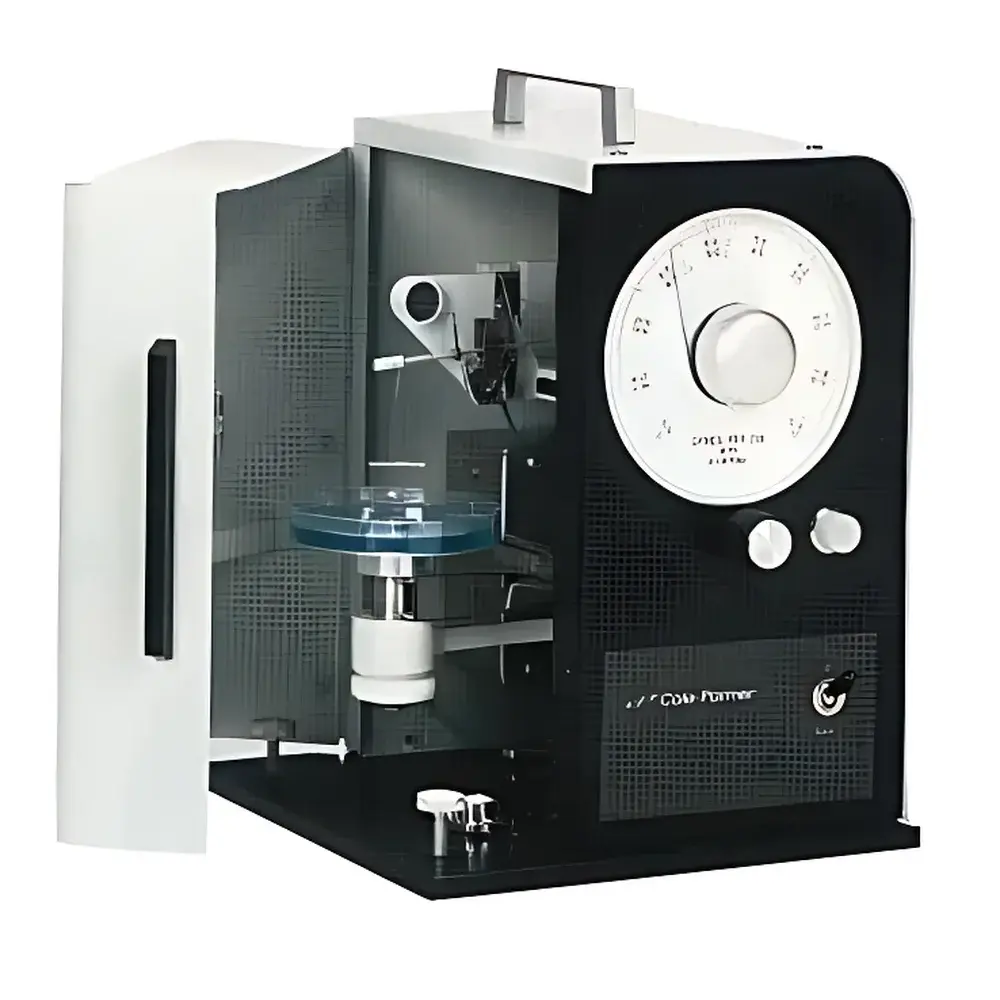
KRUSS K100 Surface Tensiometer
| Origin | USA |
|---|---|
| Manufacturer Type | Authorized Distributor |
| Origin Category | Imported |
| Model | K100 |
| Pricing | Available Upon Request |
| Measurement Principle | Du Noüy Ring Method |
| Compliance | ASTM D971, ASTM D1331 |
| Measurement Range | 0–90 mN/m (dyne/cm) |
| Accuracy | ±0.25 mN/m |
| Standard Accessories | Platinum-Iridium Ring, Dual Stainless-Steel Torsion Wires, Analog Absolute-Value Scale |
| Operation Modes | Manual & Semi-Automatic |
| Drive System (Semi-Auto) | Reversible Synchronous Motor |
| Dual-Scale Dial | Upward/Downward Force Reading |
| Application Scope | Oil-Water Interfacial Tension, Surfactant Solution Characterization, Quality Control in Lubricants & Detergents |
Overview
The KRUSS K100 Surface Tensiometer is a precision-engineered instrument designed for the reliable and repeatable determination of surface tension and interfacial tension using the classical Du Noüy ring method. Based on the fundamental principle of measuring the maximum pull force required to detach a platinum-iridium ring from the liquid–air or liquid–liquid interface, the K100 delivers traceable, SI-unit–compatible results in millinewtons per meter (mN/m). Its mechanical architecture—featuring a calibrated torsion wire system and analog absolute-value scale—is optimized for stability under laboratory and industrial QC environments. The instrument satisfies critical regulatory and standardization requirements, including ASTM D971 (interfacial tension of oil–water systems) and ASTM D1331 (surface tension of aqueous surfactant solutions), making it suitable for method validation in lubricant formulation, detergent development, and petroleum product testing.
Key Features
- Du Noüy ring method implementation with high-reproducibility torsion-wire mechanics and dual stainless-steel suspension wires for minimized hysteresis and drift.
- Platinum-iridium ring (standard configuration) with certified geometry and surface cleanliness protocol for consistent wetting behavior and compliance with ISO 1409 and ASTM standards.
- Manual operation mode enables full operator control over ring immersion and withdrawal rate—ideal for method development, training, and routine process checks.
- Semi-automatic mode employs a reversible synchronous motor to drive both ring and sample stage with synchronized, constant-speed vertical displacement—reducing operator-induced variability and improving measurement repeatability.
- Dual-scale analog dial supports direct reading of upward (ring detachment) and downward (ring re-immersion) forces, facilitating rapid comparative analysis without digital conversion.
- Compliance-ready design includes NIST-traceable calibration documentation, standardized US electrical interface (120 VAC, 60 Hz), and mechanical robustness suitable for GLP-aligned laboratories.
Sample Compatibility & Compliance
The K100 accommodates a wide range of Newtonian and mildly non-Newtonian liquids, including hydrocarbon oils, aqueous surfactant solutions, polymer melts (with appropriate temperature control), and emulsions. It is routinely deployed in applications requiring conformance to ASTM D971 (interfacial tension between insulating oils and water) and ASTM D1331 (surface tension of synthetic detergents). While not inherently compliant with FDA 21 CFR Part 11, its analog readout and mechanical design support audit-ready manual data recording workflows aligned with GLP and GMP documentation practices. All measurements are directly traceable to SI units via certified torsion wire calibration and ring geometry verification.
Software & Data Management
The K100 operates as a standalone analog instrument with no embedded microprocessor or digital interface. Data acquisition relies on manual recording of analog scale readings, supported by optional external digital capture (e.g., USB microscope + image-based measurement software) for archival and trend analysis. Laboratories integrating the K100 into validated quality systems may document measurements using controlled paper-based logbooks or LIMS-integrated electronic notebooks, ensuring full audit trails, reviewer sign-offs, and version-controlled SOPs. Calibration records—including torsion wire certificate, ring certification, and periodic verification logs—are maintained per ISO/IEC 17025 requirements.
Applications
- Interfacial tension measurement of transformer oils vs. moisture-contaminated water (ASTM D971).
- Surface activity screening of anionic, cationic, and nonionic surfactants in cleaning formulations (ASTM D1331).
- Quality assurance of raw materials and finished products in petrochemical, pharmaceutical excipient, and personal care manufacturing.
- Educational use in physical chemistry and colloid science laboratories for demonstrating capillary phenomena and interfacial thermodynamics.
- Stability assessment of emulsions and microemulsions through time-resolved interfacial tension monitoring.
FAQ
What standards does the K100 comply with?
The K100 meets ASTM D971 and ASTM D1331 specifications for interfacial and surface tension measurement, and its mechanical design conforms to ISO 1409 for ring-method tensiometry.
Is the platinum-iridium ring included with the instrument?
Yes—the standard configuration includes one certified platinum-iridium ring, two stainless-steel torsion wires, and an analog absolute-value scale.
Can the K100 measure interfacial tension between two immiscible liquids?
Yes—when configured with appropriate sample cells and density-matched subphases, it measures liquid–liquid interfacial tension per ASTM D971 protocols.
Does the K100 require computer connectivity or proprietary software?
No—it is a fully analog, mechanically operated instrument; no drivers, firmware, or software installation is required.
How often should the torsion wire be recalibrated?
KRUSS recommends annual recalibration by an accredited metrology laboratory, with interim verification performed using standard reference liquids (e.g., pure water at 20 °C: 72.75 mN/m).
Related Products



