
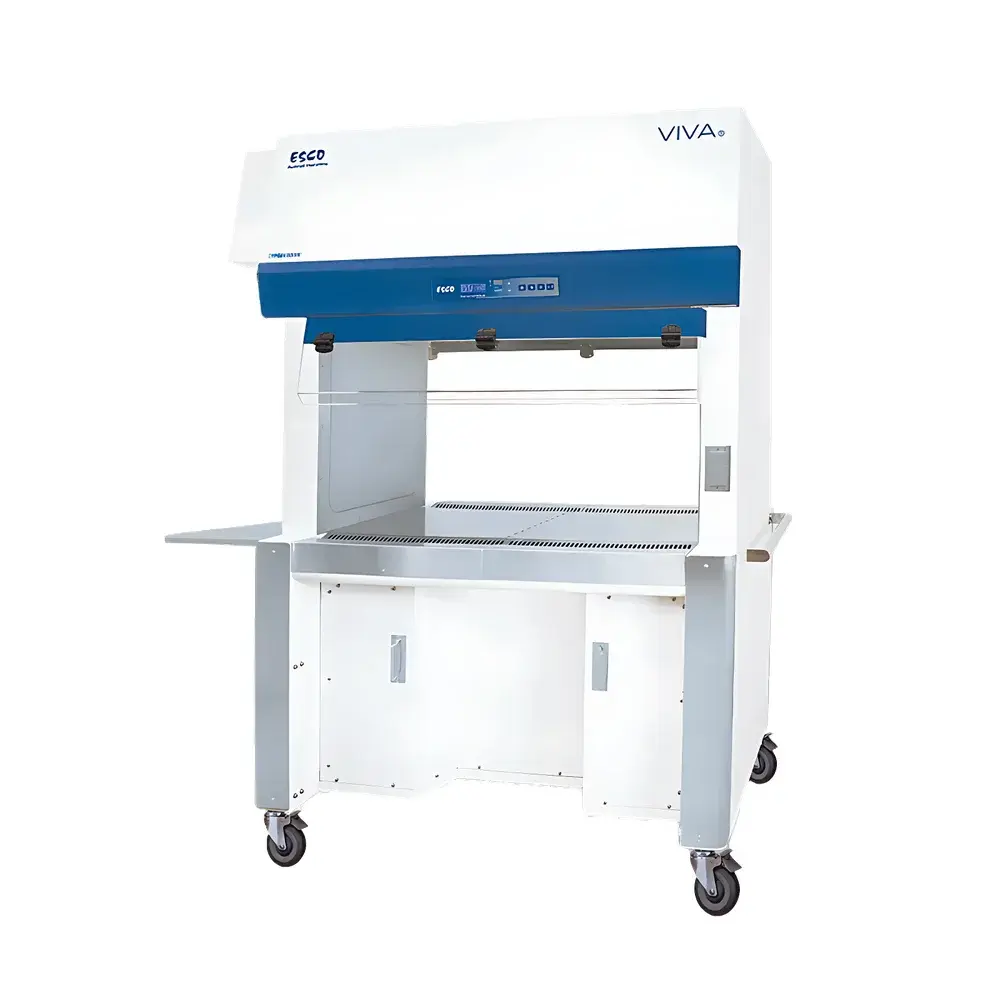
Esco VIVA Dual-Access Open-Design Animal Cage Changing Station
| Brand | Esco |
|---|---|
| Origin | Singapore |
| Manufacturer Type | Authorized Distributor |
| Origin Category | Imported |
| Model | VDA-4A8 / VDA-5A8 |
| Pricing | Available Upon Request |
| External Dimensions (L×W×H) | VDA-4A8 – 1340 × 762 × 1961 mm (low height) / 1340 × 762 × 2245 mm (high height) |
| Work Area Dimensions (L×W×H) | VDA-4A8 – 1100 × 465 × 564 mm |
| Downflow Velocity | 0.24 m/s (47 fpm) |
| Power Supply | 220–240 VAC, 50/60 Hz, 1-phase |
Overview
The Esco VIVA Dual-Access Open-Design Animal Cage Changing Station is an ISO Class 4-certified (ISO 14644-1) laminar airflow workstation engineered specifically for safe, aseptic rodent cage handling in vivariums and preclinical research facilities. Unlike conventional horizontal or vertical laminar flow hoods, the VIVA system employs a dual-sided open architecture with balanced downflow and inward-facing inflow zones—designed to simultaneously protect personnel, animal subjects, and the surrounding environment from cross-contamination. Its core principle relies on unidirectional, ULPA-filtered downward airflow (0.24 m/s) combined with precisely calibrated perimeter inflow velocities that maintain dynamic air curtain integrity at both operator access points. This configuration meets the functional requirements of NIH Guide for the Care and Use of Laboratory Animals and supports institutional compliance with AAALAC International standards for animal facility ventilation hygiene.
Key Features
- Dual-access open-front design enables simultaneous operation by two technicians without compromising airflow containment or ergonomic workflow.
- ULPA filtration system (Minipleat™ unpleated, separatorless filter media) delivers ≥99.999% efficiency at MPPS (Most Penetrating Particle Size) of 0.12 µm and 0.3 µm—exceeding standard HEPA performance and ensuring ISO 4 cleanroom-equivalent air quality within the work area.
- Esco SentinEL™ microprocessor-based control system with LCD interface provides real-time monitoring of downflow velocity, sash position, and filter life; includes audible and visual alarms for low airflow conditions and improper sash height.
- Integrated airflow sensors continuously verify laminar velocity across the entire work surface, triggering alerts if deviations exceed ±10% of nominal setpoint (0.24 m/s), supporting proactive maintenance and GLP-aligned operational verification.
- ISOCIDE™ antimicrobial coating applied to all exposed stainless steel surfaces inhibits bacterial colonization (tested per ASTM E2149) and reduces bioburden accumulation during extended daily use.
- Patented recessed air grille design eliminates turbulence-inducing obstructions, preserving laminar integrity and preventing localized eddy formation that could compromise particle removal efficacy.
Sample Compatibility & Compliance
The VIVA station accommodates standard IVC (Individually Ventilated Cage) systems, static cages up to 1405 mm (VDA-5A8) or 1100 mm (VDA-4A8) in length, and modular rack configurations. It is validated for use with SPF (Specific Pathogen-Free) and immunocompromised rodent models where airborne allergen containment (e.g., dander, bedding particulates) is critical. The unit complies with ISO 14644-1:2015 (Class 4), NSF/ANSI 49 (for non-hazardous biological applications), and EN 12464-1:2021 (Lighting and Air Quality in Indoor Workplaces). Its airflow architecture satisfies institutional biosafety office requirements for non-chemical, non-aerosol-generating animal husbandry procedures and aligns with USP environmental control expectations for low-risk compounding adjacent zones.
Software & Data Management
The SentinEL™ controller logs operational parameters—including cumulative runtime, alarm events, sash position history, and airflow deviation incidents—for audit-ready traceability. Data export via USB interface supports integration into facility-wide CMMS (Computerized Maintenance Management Systems) and enables retrospective analysis of environmental stability trends. While no cloud connectivity is embedded, the system’s event log structure conforms to FDA 21 CFR Part 11 principles for electronic records when paired with institutional validation protocols. Filter replacement timestamps and calibration certificates can be digitally archived alongside user-defined SOP identifiers.
Applications
- Routine cage changing for SPF and germ-free rodent colonies in AAALAC-accredited facilities.
- Handling of allergy-sensitive strains (e.g., BALB/c, NOD mice) where operator exposure to urinary proteins (e.g., Mus m 1) must be minimized.
- Preparation of dosing vehicles or injectables under controlled particulate conditions prior to in vivo administration.
- Quarantine zone operations requiring bidirectional personnel access without recirculation or cross-flow between adjacent workstations.
- Training environments where visual transparency and collaborative technique demonstration are prioritized without sacrificing containment fidelity.
FAQ
What certification standards does the VIVA station meet for air cleanliness?
It achieves ISO Class 4 (≤352 particles/m³ ≥0.1 µm) per ISO 14644-1:2015, verified through certified particle counter testing at multiple locations across the work surface.
Can the VDA-4A8 and VDA-5A8 models be integrated into existing vivarium HVAC systems?
Yes—both models operate as self-contained units requiring only standard 220–240 VAC power; no dedicated exhaust ducting or make-up air balancing is needed, simplifying retrofit installations.
Is routine airflow recalibration required?
Annual verification using a traceable anemometer is recommended per ISO 14644-3; the built-in sensor provides continuous trending but does not replace formal metrological calibration.
Does the ISOCIDE coating require special cleaning agents?
No—standard 70% ethanol or quaternary ammonium disinfectants may be used; abrasive cleaners or chlorine-based solutions are contraindicated to preserve coating integrity.
How is filter service life determined?
SentinEL™ estimates remaining ULPA life based on cumulative runtime and pressure differential tracking; replacement is advised when ΔP exceeds 250 Pa or after 5 years of continuous operation, whichever occurs first.



