
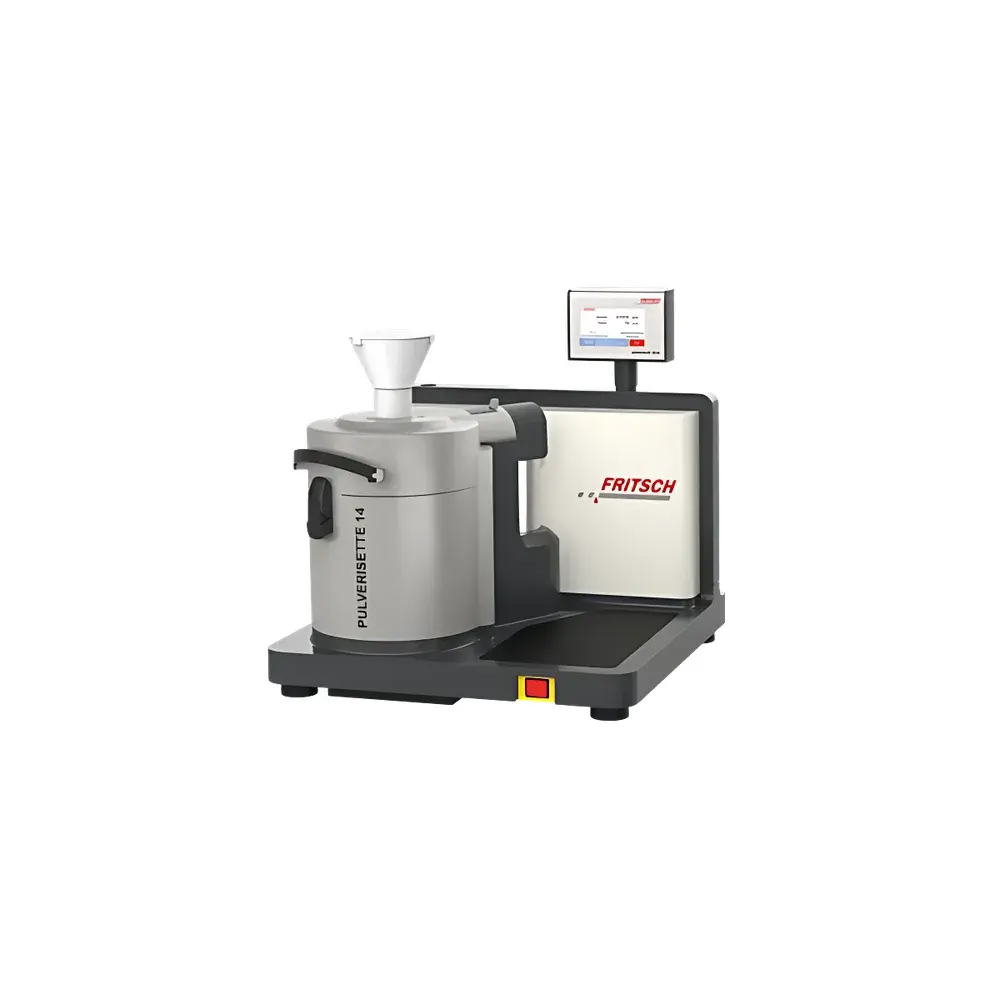
FRITSCH PULVERISETTE 14 Variable-Speed High-Performance Rotor Mill – Reinforced Edition
| Brand | FRITSCH |
|---|---|
| Origin | Germany |
| Model | PULVERISETTE 14 |
| Max. Feed Size | <15 mm |
| Throughput | ≥15 L/h |
| Final Fineness | <40 µm |
| Speed Range | 6,000–24,000 rpm |
| Sieve Aperture Range | 0.08–6 mm |
| Power Supply | 200–240 V, 1-phase, 50–60 Hz |
| Motor Output | 1500 W (VDE 0530 / EN 60034 compliant) |
| Total Power Consumption | 2500 W |
| Net Weight | 44 kg |
| Gross Weight | 70 kg |
| Dimensions (W×H×D) | 55×63×52 cm |
| Rotor Material Options | Pure Titanium, Tungsten Carbide |
| Compliance | RoHS-conformant grinding |
Overview
The FRITSCH PULVERISETTE 14 Variable-Speed High-Performance Rotor Mill – Reinforced Edition is an industrial-grade laboratory rotor mill engineered for high-throughput, reproducible size reduction of dry, brittle, fibrous, and moderately soft materials. Operating on the principle of high-speed impact grinding, the instrument accelerates sample particles against fixed stator elements and between rapidly rotating rotor blades—generating centrifugal forces sufficient to achieve comminution via repeated collision, shear, and attrition. With a maximum rotational speed of 24,000 rpm (corresponding to a tip velocity of up to 437 km/h), the mill delivers exceptional energy input while maintaining thermal stability through an integrated high-volume airflow cooling system. Designed for routine QC laboratories, R&D facilities, and material science departments, the PULVERISETTE 14 meets the mechanical and electrical safety requirements of EN 61000-6-2 (immunity) and EN 61000-6-4 (emission), and complies with VDE 0530 and EN 60034 standards for motor construction.
Key Features
- Reinforced stainless-steel rotor assembly with optional pure titanium or tungsten carbide components—ensuring wear resistance, chemical inertness, and RoHS-compliant operation for trace-sensitive applications.
- Stepless speed control (6,000–24,000 rpm) via intuitive front-panel interface, enabling precise optimization of impact energy for diverse sample matrices—from ceramics and minerals to pharmaceutical excipients and polymer granules.
- Automated locking mechanism for the grinding chamber guarantees secure, vibration-damped closure and eliminates operator exposure during operation.
- High-efficiency forced-air cooling system maintains stable internal temperature (<40 °C rise under continuous load), preventing thermal degradation of heat-labile compounds.
- Modular grinding chamber design accommodates interchangeable sieves (apertures from 0.08 mm to 6 mm) and rotor configurations—supporting both coarse pre-grinding and fine particle generation in a single platform.
- Integrated microprocessor-based safety logic monitors motor load, chamber integrity, and thermal thresholds; automatic shutdown is triggered if operational limits are exceeded.
Sample Compatibility & Compliance
The PULVERISETTE 14 processes a broad spectrum of inorganic and organic solids—including oxides, carbonates, alloys, plant tissues, foodstuffs, and composite powders—provided feed particles are ≤15 mm and moisture content remains below 10 wt%. It is not intended for wet grinding, cryogenic processing, or highly ductile metals without prior embrittlement. All contact surfaces are accessible for cleaning and validated decontamination per GLP/GMP guidelines. The instrument conforms to EU Machinery Directive 2006/42/EC, Low Voltage Directive 2014/35/EU, and Electromagnetic Compatibility Directive 2014/30/EU. Optional documentation packages support audit readiness for ISO/IEC 17025-accredited laboratories.
Software & Data Management
While the base configuration operates via standalone hardware controls, optional digital interfaces (RS-232 or USB) enable integration with laboratory information management systems (LIMS). Parameter settings—including speed, run time, and sieve selection—are logged with timestamp and user ID when connected to compliant data acquisition software. Audit trail functionality satisfies FDA 21 CFR Part 11 requirements for electronic records when paired with validated third-party platforms. No proprietary cloud service or firmware updates are required; all calibration and maintenance logs remain locally stored and exportable as CSV or PDF.
Applications
- Preparation of homogenized reference materials for XRF, XRD, and SEM-EDS analysis.
- Routine particle size distribution (PSD) sampling prior to laser diffraction or sieve analysis (e.g., ASTM E11, ISO 3310-1).
- Homogenization of heterogeneous geological samples for geochemical assay (e.g., ICP-OES, ICP-MS).
- Pharmaceutical batch sampling and blend uniformity testing in accordance with USP <1174> and Ph. Eur. 2.9.12.
- Recycling research: size reduction of electronic waste fractions for metal recovery feasibility studies.
- Food safety labs: grinding of cereal grains, spices, and dried produce for mycotoxin extraction and HPLC quantification.
FAQ
What materials are compatible with the PULVERISETTE 14?
Dry, non-fibrous, and non-sticky solids with Mohs hardness ≤6.5 and moisture content <10 wt%—including soils, ores, pharmaceutical tablets, plastics, and roasted coffee beans.
Can the instrument be used for regulated GMP environments?
Yes—when equipped with optional electronic logging and operated under documented SOPs, it supports 21 CFR Part 11 compliance and routine IQ/OQ validation protocols.
How is particle size controlled?
By selecting interchangeable stainless-steel or hardened steel sieves (0.08–6 mm aperture) and optimizing rotor speed and feed rate to match target PSD specifications.
Is cleaning validated between sample batches?
The open-chamber geometry permits full visual inspection and residue verification; swab testing and rinse recovery studies can be performed using standard lab solvents and analytical methods.
What maintenance intervals are recommended?
Rotor balance verification every 500 operating hours; bearing inspection and lubrication every 2,000 hours; sieve mesh integrity check before each use.



