
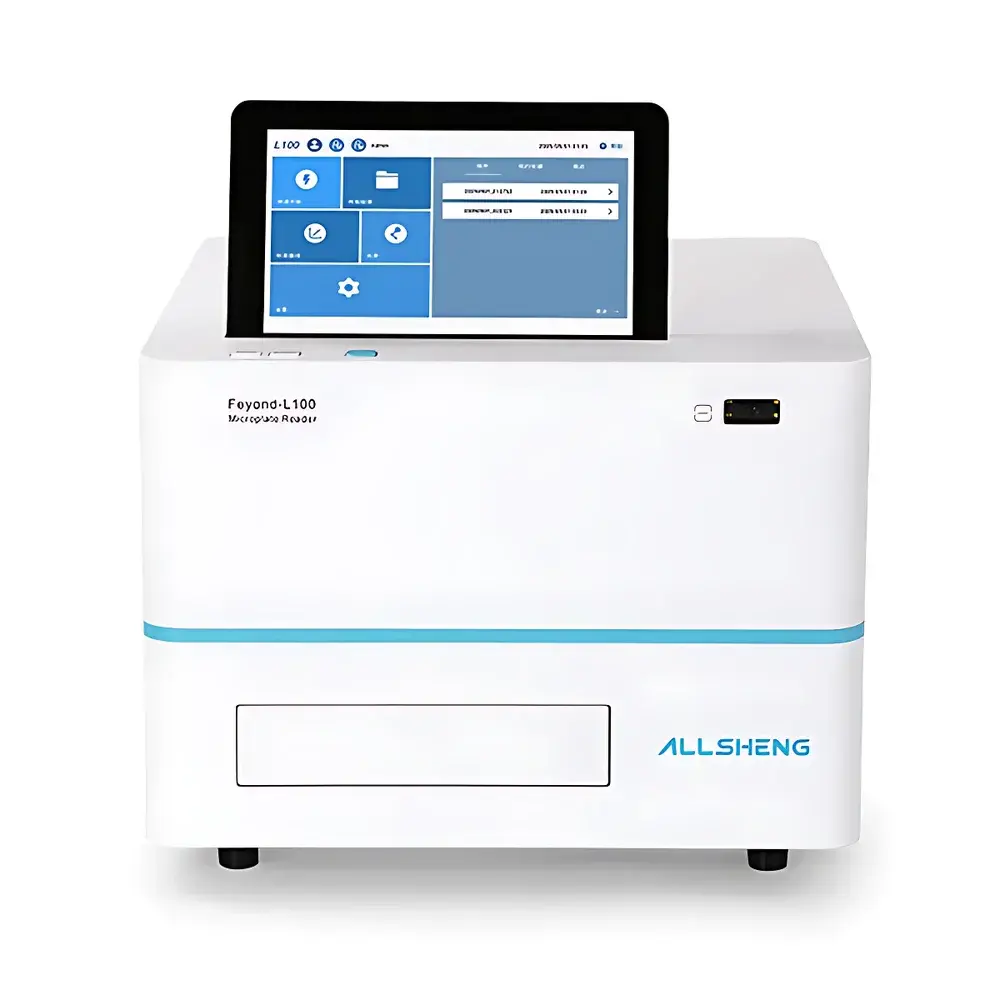
Allsheng Feyond-L100 Chemiluminescence Microplate Reader
| Brand | Allsheng |
|---|---|
| Origin | Zhejiang, China |
| Model | Feyond-L100 |
| Detection Principle | Chemiluminescence (PMT-based) |
| Detection Limit | 5 amol ATP per well |
| Linear Dynamic Range | 6 logs |
| Well-to-Well Crosstalk | ≤0.005% |
| Wavelength Range | 200–850 nm |
| Plate Formats | 6–384-well microplates |
| Automation Level | Fully Automated (integrated dispensers) |
| Compliance | GLP-ready architecture, audit-trail capable software (ReaderLT-I), supports 21 CFR Part 11-compliant configurations |
Overview
The Allsheng Feyond-L100 Chemiluminescence Microplate Reader is a dedicated, high-sensitivity luminometer engineered for quantitative detection of chemiluminescent signals in life science research and quality control applications. Unlike hybrid multimode readers, the Feyond-L100 employs a photon-counting photomultiplier tube (PMT) optimized exclusively for low-light emission—enabling robust performance in luciferase reporter assays, ATP quantification, and chemiluminescent ELISA. Its optical architecture features a temperature-stabilized PMT, neutral-density filtering for signal attenuation without spectral distortion, and proprietary fiber-optic light collection paths calibrated per plate format (6-, 24-, 96-, 384-well). The system operates on a true time-resolved acquisition principle, supporting both flash (e.g., firefly luciferase) and glow (e.g., Renilla, Gaussia) kinetics with sub-second dispenser-to-detection synchronization. Designed for integration into regulated environments, its mechanical and electronic subsystems meet IEC 61010-1 safety standards and support traceable calibration via ABS Optical Performance Validation Plates.
Key Features
- Ultra-low detection limit of 5 amol ATP per well—validated using standardized ATP reference standards traceable to NIST SRM 1970
- Auto-gain optimization algorithm dynamically adjusts PMT voltage per well to maintain signal linearity across 6 orders of magnitude, eliminating manual dilution series and repeat reads
- Dedicated chemiluminescence optics with format-specific fiber bundles minimize inter-well crosstalk to ≤0.005%, verified per ANSI/SLAS 1-2014 guidelines
- Fully integrated dual-channel reagent dispensers with <±1% CV precision at 5–300 µL volumes; programmable pre- and post-dispense delay intervals for kinetic assay control
- Neutral-density filter wheel enables automatic gain compensation for high-intensity signals without saturation, preserving low-end sensitivity
- Compact benchtop footprint (280 × 420 × 320 mm) with fanless thermal management for vibration-sensitive luminescence measurements
Sample Compatibility & Compliance
The Feyond-L100 accommodates standard ANSI/SLAS-compliant microplates including opaque white, black, and clear-bottom formats—critical for distinguishing surface-bound vs. solution-phase luminescence. It supports all major commercial chemiluminescent assay kits, including ATP bioluminescence (e.g., CellTiter-Glo), single- and dual-luciferase reporter systems (Promega, BPS Bioscience), and Gaussia princeps luciferase assays. From a regulatory standpoint, the instrument’s firmware and ReaderLT-I PC software provide configurable user roles, electronic signatures, and full audit trails compliant with FDA 21 CFR Part 11 requirements when deployed with validated IT infrastructure. Calibration and performance verification follow ISO/IEC 17025-aligned procedures using supplied ABS Optical Performance Validation Plates and certified ATP reference materials.
Software & Data Management
Controlled via ReaderLT-I PC software (v3.2+), the Feyond-L100 delivers deterministic protocol execution, real-time kinetic curve visualization, and automated data reduction—including background subtraction, well-mapping, and multi-parameter normalization (e.g., Firefly/Renilla ratio calculation). Raw photon counts are stored in vendor-neutral .csv and .xlsx formats with embedded metadata (timestamp, PMT voltage, gain setting, dispenser parameters). The software includes built-in validation tools for linearity assessment (via serial dilution templates), limit-of-detection calculation (IUPAC CLSI EP17-A2 methodology), and plate uniformity analysis. For laboratory information management system (LIMS) integration, it supports ASTM E1384-compliant data export and HL7 messaging protocols.
Applications
- Quantitative ATP measurement in cell viability, cytotoxicity, and microbial load assays
- Transient and stable transfection efficiency monitoring using firefly and Renilla luciferase dual-reporter constructs
- High-throughput screening of transcriptional regulators, kinase inhibitors, or GPCR modulators via luciferase-based biosensors
- Chemiluminescent immunoassays (CLIA) requiring ultra-low background and high signal-to-noise ratios
- Quality control of bioluminescent reagents and enzyme-conjugated detection antibodies
- Validation of CRISPR/Cas9 editing efficiency using promoter-driven luciferase reporters
FAQ
What is the minimum detectable ATP concentration per well under standard assay conditions?
The validated lower limit of detection is 5 amol ATP per well using CellTiter-Glo reagent and white 96-well plates, measured at 1-second integration time.
Does the Feyond-L100 support glow-type luciferase assays such as NanoLuc or Gaussia?
Yes—the system’s extended integration time (up to 10 seconds per well) and low-noise PMT enable reliable quantification of sustained glow signals without signal decay correction artifacts.
Can the instrument be qualified for GMP environments?
When paired with ReaderLT-I software configured for 21 CFR Part 11 compliance (electronic signatures, audit trail, role-based access), and operated with documented IQ/OQ/PQ protocols, the Feyond-L100 meets baseline requirements for QC release testing in pharmaceutical development labs.
Is custom filter installation supported for non-standard emission wavelengths?
The optical path accepts user-installed bandpass filters (25 mm diameter, 1–10 nm FWHM); however, factory calibration is required after any hardware modification to ensure photometric accuracy and crosstalk specification adherence.
How is plate-to-plate variability addressed during multi-run experiments?
The system includes an internal reference LED for daily optical stability verification, and ReaderLT-I software applies plate-normalized background correction using edge-well averaging algorithms per ANSI/SLAS 4-2013 standards.
Related Products





