
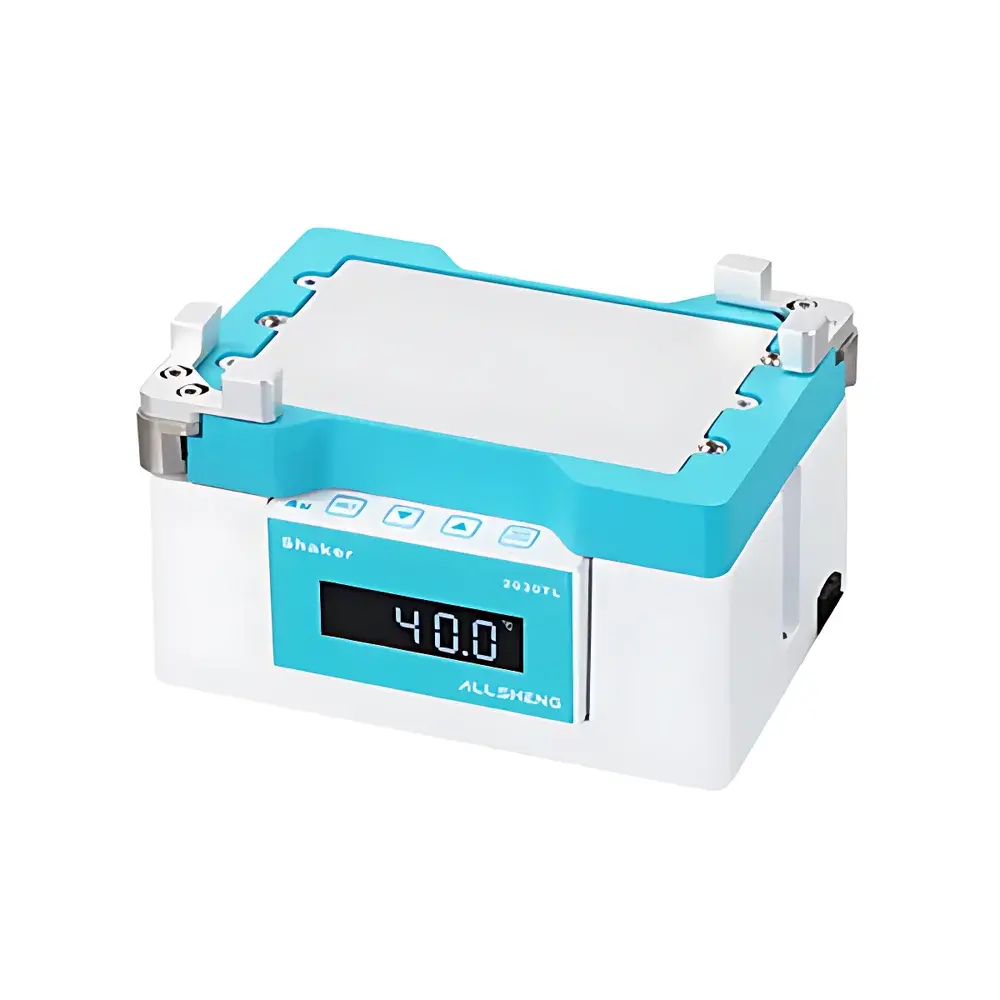
Allsheng Au-Shaker 3020TL/2030TL Automated Temperature-Controlled Orbital Shaker for Integrated Liquid Handling Workstations
| Brand | Allsheng |
|---|---|
| Model | Au-Shaker 3020TL/2030TL |
| Heating Range | RT +5°C to 105°C |
| Temperature Uniformity | ±0.5°C |
| Temperature Accuracy | ±0.5°C |
| Setpoint Resolution | 0.1°C |
| Max Speed | 3000 rpm (3020TL) / 2000 rpm (2030TL) |
| Orbit Diameter | 3 mm (3020TL) / 2 mm (2030TL) |
| Acceleration Time | 1–10 sec |
| Zero-Positioning Accuracy | ±0.1 mm |
| Clamping Precision | ±0.1 mm |
| Power Supply | 24 V DC, 120 W |
| Communication Interface | DB9 connector with CAN protocol |
| Dimensions (W×D×H) | 142 × 105 × 94 mm |
| Compatible Plate Formats | 96-well, 384-well, 1536-well microplates, 0.5–2.5 mL deep-well plates, PCR plates |
Overview
The Allsheng Au-Shaker 3020TL and 2030TL are precision-engineered, temperature-controlled orbital shakers designed specifically for integration into automated liquid handling workstations. Unlike standalone benchtop shakers, these instruments feature a dual-purpose mechanical architecture: an electromechanically actuated edge-locking clamping mechanism and high-fidelity 2D motion control system that ensures repeatable plate positioning and vibration-isolated oscillation. The core operating principle relies on controlled orbital motion—generated via brushless DC motor-driven eccentric cam systems—to induce homogeneous mixing in microvolume samples while maintaining thermal stability across the entire plate surface. Both models operate within a calibrated heating range of RT +5°C to 105°C, utilizing Peltier-based heating elements combined with PID-regulated thermal feedback loops. Their compact footprint (142 × 105 × 94 mm), low-profile design, and dual mounting holes enable rigid fixation onto robotic deck platforms—minimizing resonance transfer during high-speed dispensing or aspiration cycles. The instruments comply with IEC 61000-6-2 (immunity) and IEC 61000-6-3 (emission) standards for laboratory automation environments.
Key Features
- Automated edge-locking clamping mechanism with ±0.1 mm positional repeatability—enables seamless handoff between robotic grippers and shaker platform
- Zero-position auto-alignment function with sub-millimeter accuracy (±0.1 mm), reducing risk of misalignment-induced tip collision during pipetting
- Two configurable orbital amplitudes: 3 mm (Au-Shaker 3020TL, max 3000 rpm) and 2 mm (Au-Shaker 2030TL, max 2000 rpm), optimized for distinct viscosity and volume regimes
- Thermal performance validated per ISO 13485-aligned protocols: ±0.5°C uniformity across 96-well plate surface at 37°C; ≤10 min ramp time from RT+5°C to 95°C using standard 0.5+1.5 mL deep-well module
- Dual-mode operation: fully controllable via CAN bus (DB9 interface, 2 m shielded cable) for synchronized timing with workstation schedulers—or autonomous operation via built-in LCD interface with timer (up to 99 h 59 min)
- Robust 24 V DC power architecture (120 W nominal) with overcurrent and thermal shutdown protection, suitable for continuous duty in GMP-compliant assay development labs
Sample Compatibility & Compliance
The Au-Shaker series supports standardized microplate formats defined in ANSI/SLAS specifications: 96-well (ANSI/SBS 1-2004), 384-well (ANSI/SBS 4-2004), and 1536-well (ANSI/SBS 9-2012) plates, as well as 0.5–2.5 mL deep-well plates and skirted/unskirted PCR plates. Each plate type engages the edge-locking clamp via mechanical registration—not adhesive or vacuum-based fixation—ensuring consistent torque transmission and minimizing lateral drift during high-RPM agitation. Temperature calibration is traceable to NIST-certified reference thermistors, and thermal mapping data are generated per ASTM E2251-17 Annex A1 for heated shaker validation. Instruments meet CE marking requirements under Directive 2014/30/EU (EMC) and 2014/35/EU (LVD), and support audit-ready operation when integrated into FDA 21 CFR Part 11–compliant workflows via external electronic log generation.
Software & Data Management
While the Au-Shaker operates independently via its front-panel interface, full integration into workstation control software (e.g., Hamilton VENUS, Tecan FluentControl, or custom LabVIEW-based sequencers) is achieved through CAN 2.0B protocol over DB9 physical layer. Command structure includes synchronous start/stop triggers, real-time RPM and temperature reporting (1 Hz update rate), and fault-code polling (e.g., overtemperature, clamp failure, communication timeout). No proprietary drivers are required; CANopen object dictionary entries follow DS-301 v4.2 conventions. For GLP/GMP environments, all parameter changes—including setpoint modifications, runtime adjustments, and clamp engagement status—are timestamped and logged externally by the host workstation controller, satisfying ALCOA+ data integrity principles.
Applications
These shakers are routinely deployed in high-throughput applications where thermal homogeneity and mechanical synchronization are critical: enzymatic reaction incubation (e.g., ligase or polymerase steps in NGS library prep), cell-based assay plate conditioning prior to imaging, antibody-antigen binding kinetics in ELISA development, and solvent-based sample dissolution in pharmaceutical solubility screening. The 3020TL’s higher speed and amplitude suit low-viscosity buffers and rapid equilibration needs (e.g., PCR master mix homogenization), whereas the 2030TL’s lower orbit diameter provides gentler agitation ideal for fragile cell suspensions or viscous lysates. Both models eliminate manual plate handling in walk-away protocols—reducing contamination risk and operator variability in regulated QC/QA testing.
FAQ
What plate formats are mechanically supported by the edge-locking clamp?
The clamp accommodates ANSI/SBS-compliant 96-well, 384-well, and 1536-well microplates, plus 0.5–2.5 mL deep-well plates and standard PCR plates—without requiring adapters.
Can the Au-Shaker be used outside of an automated workstation?
Yes. It functions autonomously via its integrated LCD interface with timer, temperature, and speed controls—no external controller required.
Is temperature calibration performed per well or across the entire plate surface?
Calibration and uniformity validation are conducted across the full plate footprint using a 9-point thermal mapping grid per ISO/IEC 17025 methodology.
Does the instrument support remote firmware updates?
Firmware updates are performed via CAN bus using authenticated binary payloads; no USB or network interface is provided.
What safety certifications apply to installation in Class 1000 cleanrooms?
The unit meets ISO 14644-1 particle emission limits for Class 5 environments when operated with filtered intake air; housing materials comply with USP cytotoxicity testing.



