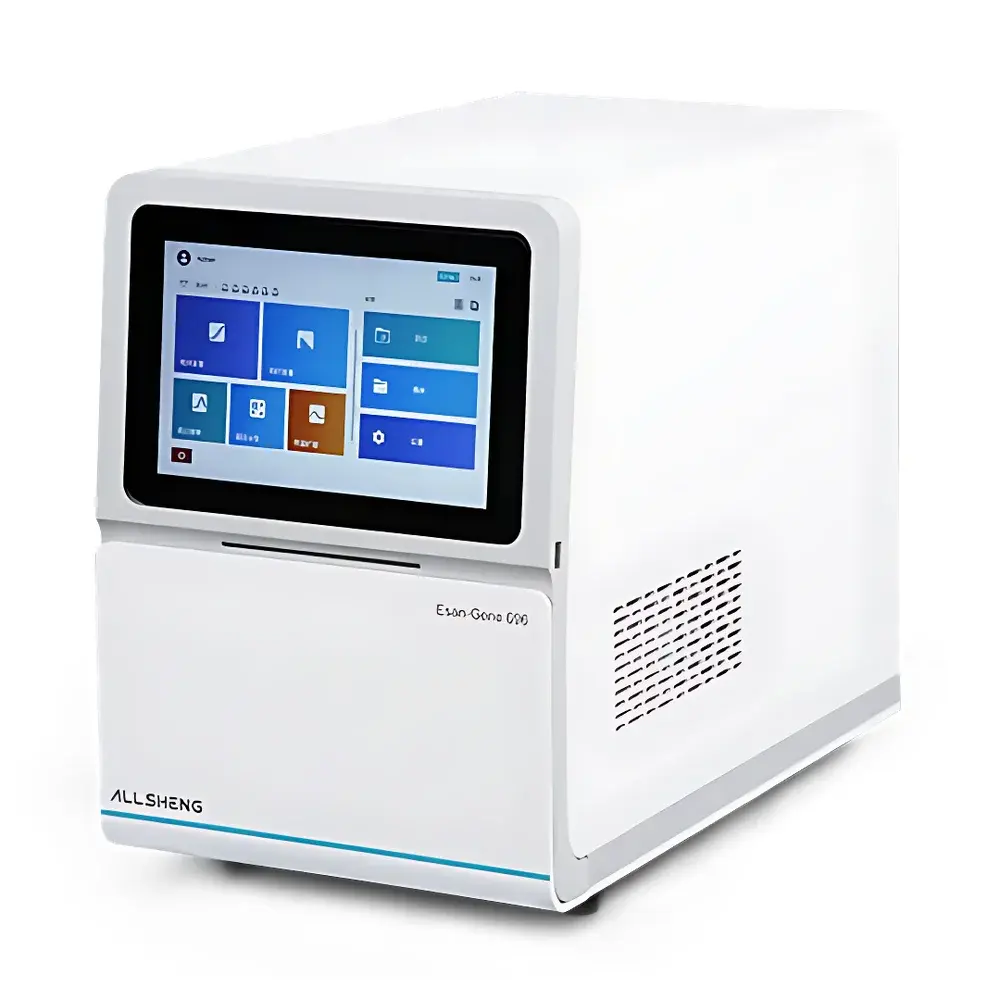
Allsheng Esan-Gene 696/696A Real-Time Fluorescent Quantitative PCR System
| Brand | Allsheng |
|---|---|
| Origin | Zhejiang, China |
| Model | Esan-Gene 696 / Esan-Gene 696A |
| Sample Format | 696 — 0.2 mL tubes & 96-well plates |
| Reaction Volume | 10–100 µL |
| Optical Channels | 6 (F1: FAM/SYBR Green I |
| F2 | HEX/JOE/VIC |
| F3 | ROX/Texas Red |
| F4 | Cy5/Quasar-670 |
| F5 | Cy5.5 |
| F6 | user-definable, default FRET) |
| Dynamic Range | 10⁰–10¹⁰ copies/µL |
| LOD | 1 copy |
| Ct Reproducibility | CV ≤ 1% |
| Temperature Range | 4–99.9 °C |
| Heating Rate | 3.5 °C/s (avg) |
| Cooling Rate | 2.5 °C/s (avg) |
| Block Uniformity | ±0.2 °C @ 95 °C |
| Temperature Accuracy | ±0.15 °C |
| Temperature Precision | 0.1 °C |
| Melting Resolution | 0.1 °C |
| Gradient Range | 1–40 °C across 6 zones |
| Heat Lid Temp | 30–110 °C |
| Display | 10.1″ LVDS capacitive touchscreen |
| Interfaces | USB-A ×3, LAN ×1 |
| Data Export | Excel, PDF |
| Compliance | Designed for GLP-compliant workflows |
Overview
The Allsheng Esan-Gene 696 and 696A are benchtop real-time fluorescent quantitative polymerase chain reaction (qPCR) systems engineered for precision nucleic acid quantification in research, clinical diagnostics, forensic analysis, and applied bioscience laboratories. These instruments employ Peltier-based thermocycling with multi-zone independent block control, enabling high-fidelity thermal ramping and uniformity across the entire 96-position reaction module. Fluorescence detection is performed via top-illuminated CMOS imaging—eliminating sequential scanning delays and capturing synchronous signal acquisition across all wells within 1 second per channel. The optical architecture integrates high-power white LEDs as excitation sources, coupled with independently rotating filter wheels for excitation and emission, fiber-optic light delivery, and region-of-interest (ROI)-adaptive calibration algorithms. This design ensures minimal photobleaching, low cross-talk, and robust signal-to-noise ratios essential for low-abundance target detection and high-multiplex assay execution.
Key Features
- Top-view CMOS imaging system: Simultaneous fluorescence capture across all 96 wells per channel, reducing cycle time and improving inter-run reproducibility.
- Multi-channel optical configuration: Six fully configurable detection channels support standard dyes (FAM, SYBR Green I, HEX, VIC, ROX, Texas Red, Cy5, Quasar-670, Cy5.5) and user-defined FRET pair setups without hardware expansion.
- Modular thermal control: Six-zone Peltier modules with dynamic temperature compensation deliver ±0.2 °C uniformity at 95 °C and ±0.15 °C absolute accuracy—validated per ISO 13485-aligned thermal verification protocols.
- Adaptive heat lid: Programmable lid temperature (30–110 °C) with pressure-sensitive sealing to prevent evaporation during extended amplification or melt-curve protocols.
- Integrated cold storage: On-board 4 °C sample preservation mode maintains reagent integrity pre- and post-run without external refrigeration.
- Intuitive standalone operation: 10.1″ industrial-grade touchscreen running Windows IoT OS enables full assay setup, real-time monitoring, Ct calculation, melt-curve analysis, and report generation—no PC dependency required.
Sample Compatibility & Compliance
The Esan-Gene 696 accepts standard 0.2 mL single tubes, 8-tube strips, and full 96-well clear/white/frosted plates. The 696A variant accommodates 0.1 mL formats—including low-profile plates and micro-volume strips—optimized for reduced reagent consumption and enhanced thermal transfer efficiency. Both models comply with international standards for laboratory instrumentation safety (IEC 61010-1), electromagnetic compatibility (IEC 61326-1), and environmental resilience (IP20). While not CE-IVD or FDA 510(k)-cleared out-of-the-box, the system’s architecture supports integration into ISO 15189-accredited diagnostic workflows and GLP/GMP environments when deployed with validated SOPs, change control documentation, and electronic audit trail extensions aligned with 21 CFR Part 11 requirements.
Software & Data Management
The embedded qPCR software provides native support for absolute and relative quantification, allelic discrimination (SNP genotyping), presence/absence calling, high-resolution melt (HRM) analysis, and isothermal amplification monitoring. Its proprietary Ct algorithm applies multi-order derivative peak fitting to raw fluorescence curves—enabling precise threshold determination without passive reference dyes. ROI auto-calibration compensates for minor optical drift or fiber misalignment over time. Data export options include Excel (.xlsx) and PDF reports with embedded amplification plots, melt curves, and well-level metadata. USB and Ethernet interfaces facilitate secure offline transfer or networked LIS/HIS integration. Optional wireless modules enable encrypted Wi-Fi transmission compliant with WPA2-Enterprise security policies.
Applications
The Esan-Gene 696/696A serves diverse molecular biology applications requiring high sensitivity and analytical rigor: gene expression profiling (e.g., ΔΔCt analysis of cytokine transcripts), pathogen load quantification (viral/bacterial DNA/RNA), methylation-specific PCR (MSP), copy number variation (CNV) assessment, CRISPR editing validation, pharmacogenomic SNP screening, forensic STR profiling, food authenticity testing, and environmental microbiome monitoring. Its broad dynamic range (10⁰–10¹⁰ copies/µL) and sub-copy detection limit make it suitable for early-stage infection diagnostics and rare mutation detection in liquid biopsy workflows.
FAQ
What sample formats does the Esan-Gene 696 support?
The Esan-Gene 696 is compatible with 0.2 mL PCR tubes, 8-tube strips, and standard 96-well plates (clear, white, or frosted).
How does the 696A differ from the 696 model?
The 696A features a redesigned thermal block optimized for 0.1 mL tube formats and low-volume 96-well plates, offering improved thermal kinetics and reduced reagent consumption.
Is the system compatible with third-party master mixes and probes?
Yes—the instrument’s open-channel configuration and broad excitation/emission spectral support ensure compatibility with commercially available hydrolysis probes, intercalating dyes, and hybridization probes from major vendors.
Does the software support automated pass/fail criteria for clinical assays?
Customizable QC thresholds, internal control validation rules, and batch-level reporting templates can be configured to meet CLIA or CAP-defined acceptance criteria.
Can data be exported in machine-readable formats for LIMS integration?
Raw fluorescence values, Ct results, melt curve derivatives, and experimental metadata are exportable in .csv and .xlsx formats; API-level integration is supported via optional SDK licensing.