
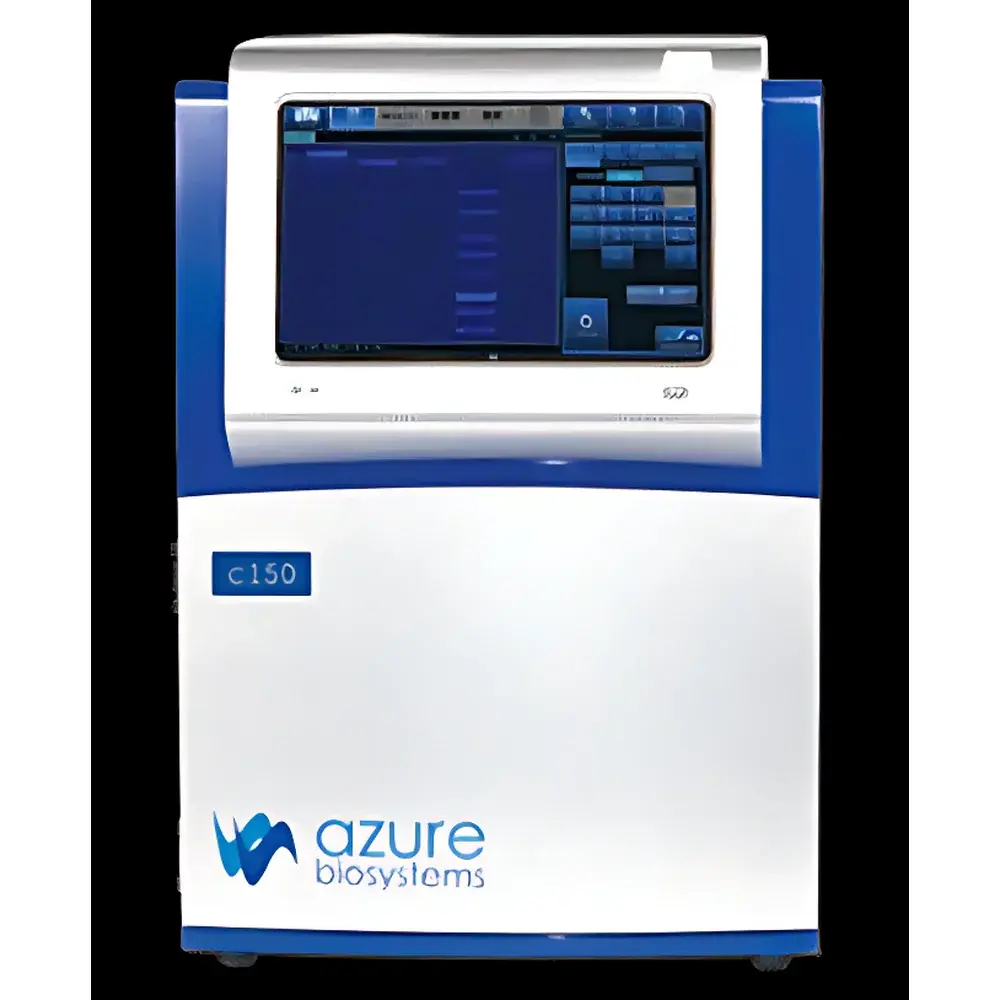
Azure Biosystems C600 Multimodal Molecular Imaging System
| Brand | Azure Biosystems |
|---|---|
| Origin | USA |
| Model | C600 |
| Instrument Type | Multicolor Fluorescent Gel Imager |
| CCD Resolution | 8.3 MP |
| Bit Depth | 16-bit |
| Dynamic Range | 4.8 OD |
| CCD Sensor Size | 3/4" |
| Detection Sensitivity | >0.05 ng (chemiluminescence) |
| Signal-to-Noise Ratio | >56 dB |
| Lens | 6x Zoom Motorized Objective |
Overview
The Azure Biosystems C600 Multimodal Molecular Imaging System is a high-performance, integrated benchtop imaging platform engineered for quantitative and qualitative analysis of biomolecular samples across multiple detection modalities. Based on cooled scientific-grade CCD imaging technology with precise optical path management and motorized 6x zoom lens control, the system enables reproducible capture of signals from ultraviolet (UV), visible white light, chemiluminescence, near-infrared (NIR) fluorescence (700 nm and 800 nm channels), and visible-spectrum fluorescence (e.g., Cy2/Cy3/Cy5). Its architecture adheres to fundamental principles of photon-limited detection—maximizing quantum efficiency, minimizing thermal noise via Peltier cooling, and ensuring linear response over a 4.8 optical density (OD) dynamic range. Designed for core facilities, academic laboratories, and regulated QC environments, the C600 supports end-to-end workflows from gel electrophoresis and western blotting to microplate-based assays and tissue section imaging.
Key Features
- Cooled 8.3-megapixel CCD sensor with 16-bit digitization for high-fidelity signal capture and low-noise performance (SNR >56 dB)
- Motorized 6x zoom lens enabling consistent magnification control and optimal field-of-view adaptation without manual refocusing
- Integrated dual-laser NIR excitation (685 nm and 785 nm) with dichroic filtering for simultaneous two-color protein detection on western blots
- Dedicated UV transilluminator (302 nm) optimized for ethidium bromide–free nucleic acid staining (e.g., SYBR® Safe, SYBR® Green) and safe gel excision
- Blue-light (470 nm) and white-light (LED) illumination modules for sensitive visualization of Coomassie- and silver-stained gels without UV exposure
- Chemiluminescent detection capability with sub-femtogram sensitivity—validated for enhanced chemiluminescence (ECL) substrates including luminol-based reagents
- Touchscreen-enabled embedded interface with preconfigured acquisition protocols and one-click “stain-free” imaging mode for total protein normalization
- Rugged, all-in-one enclosure with integrated dark chamber, eliminating external light leakage and vibration artifacts
Sample Compatibility & Compliance
The C600 accommodates a broad spectrum of sample formats including SDS-PAGE gels, agarose gels, nitrocellulose and PVDF membranes, X-ray film, histological sections, multiwell plates (6–96-well), Petri dishes, and blotting matrices. Its optical design ensures uniform illumination and flat-field correction across all modalities. From a regulatory perspective, the system supports GLP- and GMP-aligned workflows through audit-trail-capable software (see Software & Data Management), and its detection performance aligns with common validation benchmarks cited in ISO/IEC 17025-accredited molecular biology labs. While not FDA-cleared as a diagnostic device, it meets functional requirements referenced in USP , CLSI EP17-A2, and ASTM E2595-18 for analytical instrument qualification in life science applications.
Software & Data Management
Acquisition and analysis are managed via AzureSpot™ software—a Windows-based application compliant with FDA 21 CFR Part 11 requirements when deployed with appropriate IT controls (e.g., user authentication, electronic signatures, and immutable audit trails). The software provides fully programmable acquisition sequences, automatic exposure optimization, background subtraction algorithms, band/spot intensity quantification using integrated density or volume metrics, and multiplexed channel registration for ratiometric analysis. All image metadata—including exposure time, gain, lens position, illumination source, and calibration parameters—is embedded in TIFF and PNG exports. Data export options include CSV, Excel, and PDF report generation with customizable templates suitable for publication or internal SOP documentation.
Applications
- Quantitative western blotting with dual-channel NIR detection for endogenous protein normalization and post-translational modification profiling
- High-sensitivity chemiluminescent detection of low-abundance targets in immunoprecipitation and proximity ligation assays
- Genomic DNA/RNA integrity assessment via agarose gel electrophoresis under UV or blue-light excitation
- Protein expression screening across bacterial, mammalian, and insect cell lysates using Coomassie- or silver-stained 1D/2D gels
- Semi-quantitative analysis of reporter gene expression in cell-based assays using fluorescent dyes in multiwell plates
- Documentation and densitometric analysis of histological stains (e.g., DAB, fluorescent immunohistochemistry) on glass slides
FAQ
Does the C600 support time-lapse or kinetic imaging?
No—the system is optimized for endpoint static imaging; it does not provide real-time video capture or frame-rate acquisition.
Can I use third-party fluorescent dyes beyond Cy2/Cy3/Cy5?
Yes—filter sets are interchangeable; users may install custom bandpass filters compatible with Alexa Fluor®, IRDye®, or DyLight® dyes upon verification of spectral overlap.
Is the UV transilluminator safe for routine gel documentation?
The 302 nm UV module includes interlock safety shutoff and optional UV-blocking acrylic shield; however, standard PPE (e.g., UV-blocking goggles) remains recommended per OSHA guidelines.
What maintenance is required for long-term CCD stability?
The thermoelectrically cooled sensor requires no routine servicing; annual verification of dark current and pixel uniformity is advised per laboratory quality assurance protocols.
How is data integrity ensured during software updates?
AzureSpot™ employs version-controlled database schema migration and retains legacy project files without conversion loss; backup utilities support scheduled encrypted archival to network drives or NAS devices.



